
Orbus is considering moving to a zone-based fare system for public transport in Otago.

Feedback closed 29 July 2026.
ORC will analyse the feedback and make recommendations to Council in September 2026.
Last year we asked people how they felt about zones that would enable us to charge more for longer-distance fares.
At that time, the feedback you gave us was that you needed to know what zones might look like and how much trips would cost. We also heard that regional connectivity was important to people.
By charging higher fares for longer distance travel, we have a system that better reflects the costs of running it, while still being accessible and affordable. We’ve had zones in the past, and we’ve heard a lot of positive feedback on the shift to flat fares.
The previous zone system was complex and costly, and we don’t want to go back to what we had. We’re keen to understand how the proposed system might impact people.
We’re proposing two options for the Dunedin network and two for the Queenstown network. They would be much simpler and with fewer zones than the previous Dunedin zone system, which we know was confusing.
The first Dunedin option is to have four zones – with most of the Dunedin network in a single zone, then outer parts of the network, such as Waikouaiti/Palmerston, Hampden and Ōamaru, being in the second, third and fourth zones.
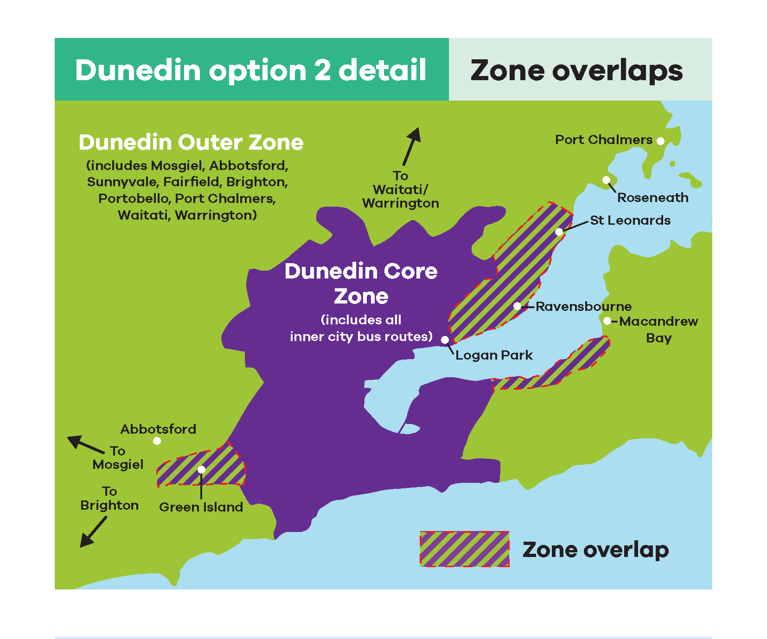
The second Dunedin option is to have five zones – with Dunedin divided into a core and an outer zone. The core is inner city suburbs, with areas such as Mosgiel, Portobello, and Port Chalmers included in an outer Dunedin zone. There would be three additional zones to Waikouaiti/Palmerston, Hampden and Ōamaru.
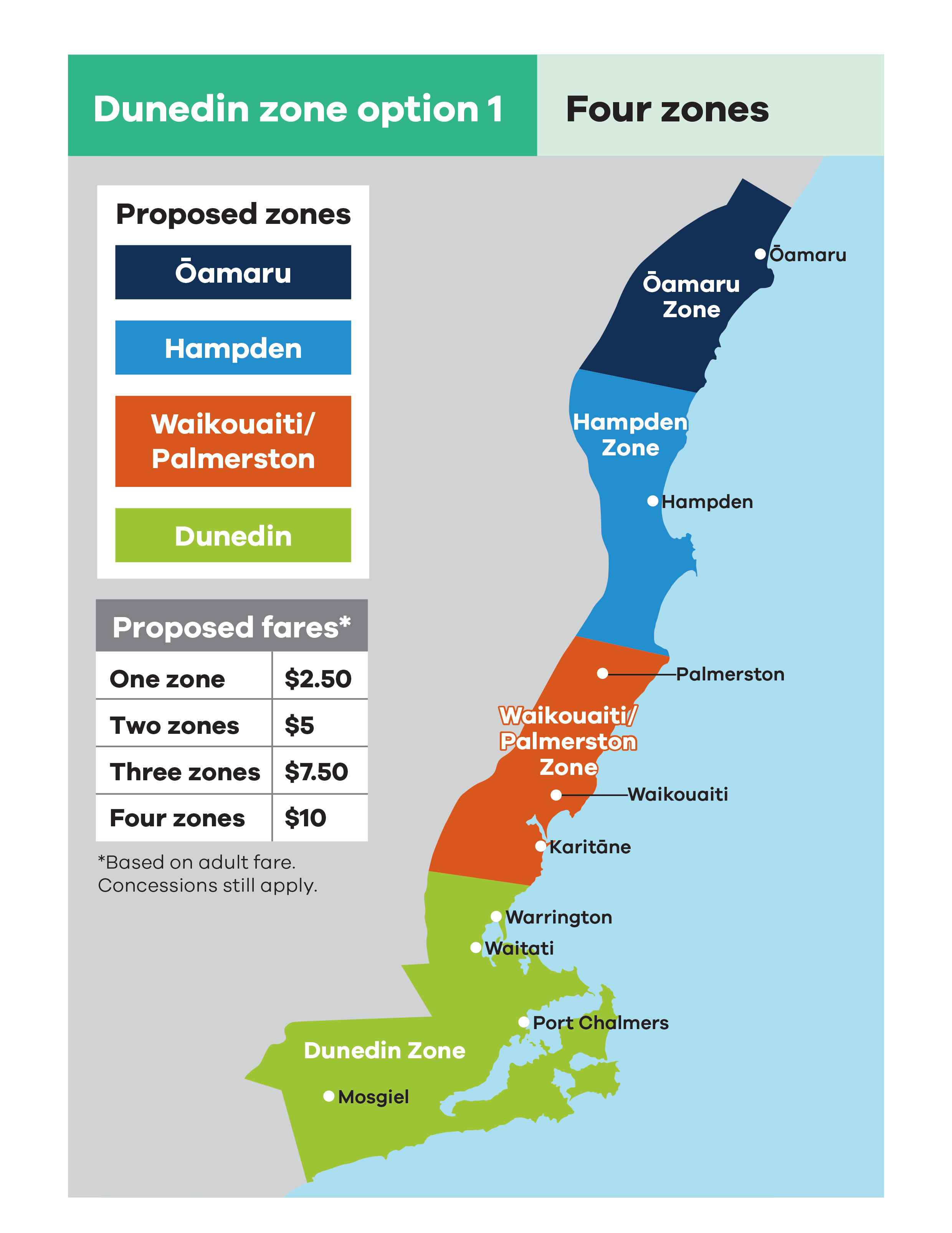
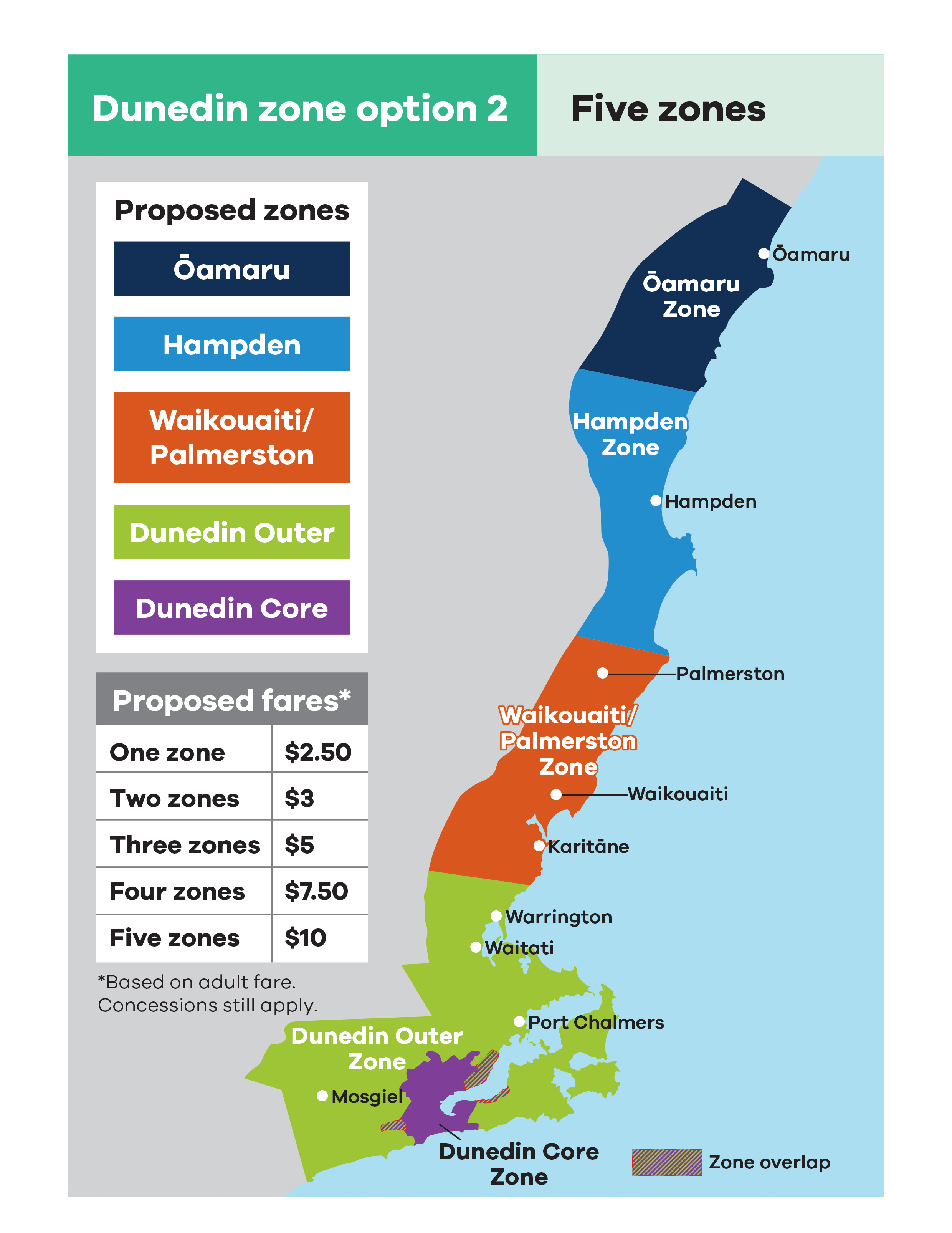
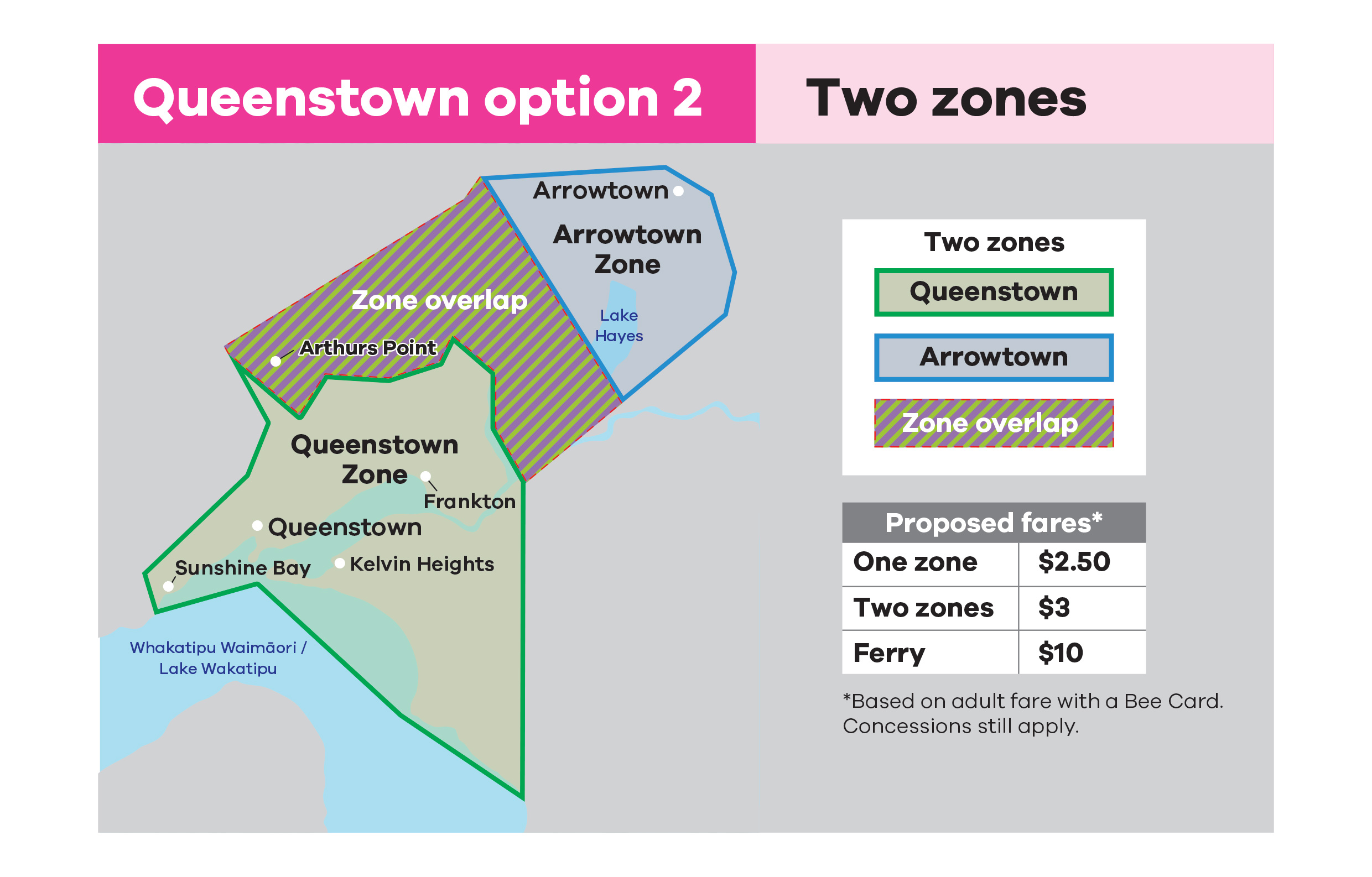
Proposed overlap zones make it fairer for people who travel short distances but cross a zone boundary, only needing to pay the lesser fare.
For example, in the Dunedin five-zone option, if you travel from either North East Valley in the Dunedin core zone or Mosgiel in the Dunedin outer zone to Green Island in the overlap area, you will only pay for one zone.
In the Queenstown two-zone option, if you travel from either Queenstown or Arrowtown to Arthurs Point in the overlap area, you will only pay for one zone.
Fare caps reward frequent bus and ferry use by setting a dollar limit on how much you pay over a given period (a day, week or month). Once a passenger reaches the cap, any further travel in that fare zone is free.
Fare caps are not a pass you choose to buy, but will apply automatically when you use your Bee Card.
However, fare caps come at a cost, which means we may need to increase the base fare by 20 to 30 cents.
You would be charged for the number of zones you travel through during a trip.
Passengers would be automatically charged according to where they tag on and off. Concessions would be used in the same way.
Fares would differ slightly depending on whether we move to a four- or five-zone network for Dunedin, or a one- or two-zone network for Queenstown.
The zones we’ve proposed still have most journeys costing $2.50 using the Bee Card. If you are travelling a longer distance, the fare will increase.
| Trip | Option 1: Four zones | Option 2: Five zones |
|---|---|---|
| Normanby to St Clair | $2.50 (one-zone trip) | $2.50 (one-zone trip) |
| Mosgiel to Dunedin | $2.50 (one-zone trip) | $3 (two-zone trip) |
| Dunedin to Palmerston | $5 (two-zone trip) | $5 (three-zone trip) |
| Dunedin to Hampden | $7.50 (three-zone trip) | $7.50 (four-zone trip) |
| Ōamaru to Dunedin | $10 (four-zone trip) | $10 (five-zone trip) |
| Trip | Option 1: One zone | Option 2: Two zones |
|---|---|---|
| Sunshine Bay to Frankton | $2.50 (one-zone trip) | $2.50 (one-zone trip) |
| Arrowtown to Queenstown | $2.50 (one-zone trip) | $3 (two-zone trip) |
We want to know how people would be affected if we remove the ability to pay bus and ferry fares with cash.
From mid-2027, Motu Move is being introduced, allowing fares to be paid using almost any NZ bank card, contactless debit or credit card, phone or smart watch, or a prepaid card. This is likely to significantly reduce the number of cash payments.
Removing cash fares would mean quicker journeys, as drivers won’t have to deal with cash transactions.
We’re considering moving to a zone-based fare system in Otago and are asking people for feedback on options. We’re keen to understand how the proposed system might impact people.
13 July – 29 July 2026.
Their preferences of fare zone and capping options for the Dunedin and/or Queenstown networks and how the changes might affect people. Also, we want to know how people would be affected if we remove the ability to pay fares with cash.
ORC will analyse your feedback and consider relevant changes. We’ll make recommendations to Council on these changes in September 2026, including when we would be introducing them. We’ll keep people updated on this page.
Paper copies will be available at your local library or council service centre.
Feel free to contact us if you have any questions:
Online: orc.govt.nz/buszones
Email: transport@orc.govt.nz
Phone: 0800 672 8736.
Fare caps reward frequent bus and ferry use by setting a limit on fares over a given period (a day, week or month). Fare caps are not a pass you choose to buy but apply automatically.
For example, the $27 weekly fare cap would mean that bus passengers pay no more than $27 a week no matter how many bus trips they take that week. Once a passenger reaches the cap, every additional trip that week would be free.
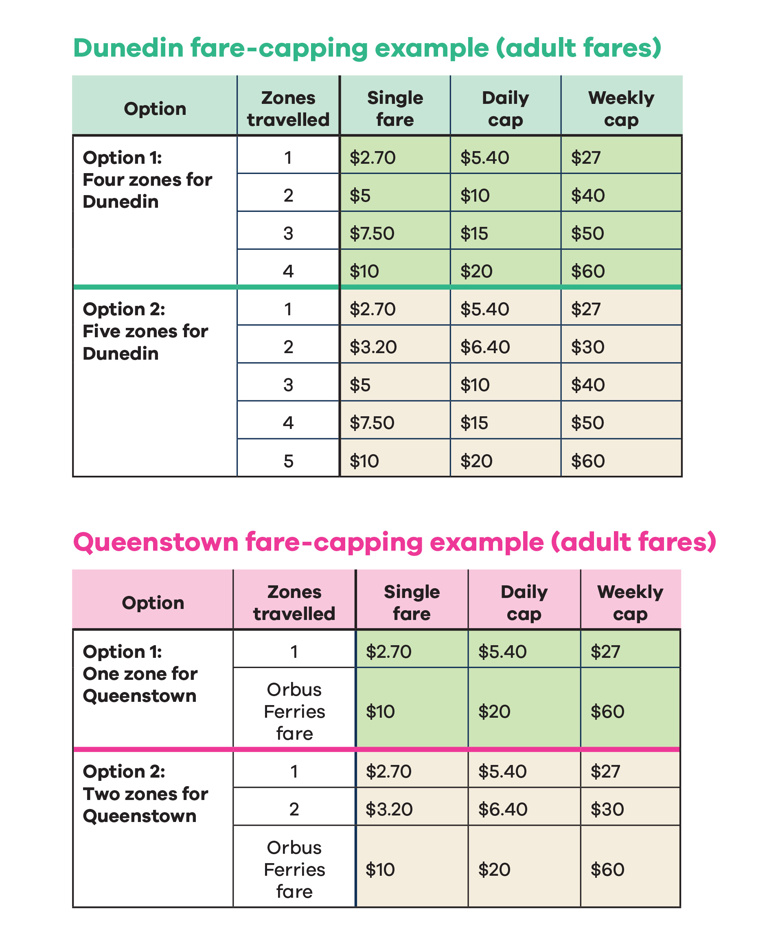
There can be a cost to fare caps. We’re interested to know if people would be willing to pay a higher base fare (i.e. an increase from $2.50, the adult Bee Card fare, to $2.70) to help cover the additional costs of implementing fare capping.
A monthly cap is an alternative to a weekly cap and would be approximately four times higher. A monthly cap would be for a calendar month, so 31 days in January, 30 in April, and so on.
Fares will be based on the number of zones that you travel through. These are proposed fares, based on an adult fare with a Bee Card.
Dunedin option 1
| Proposed fares* | |
| One zone | $2.50 |
| Two zones | $5.00 |
| Three zones | $7.50 |
| Four zones | $10.00 |
Dunedin option 2
| Proposed fares* | |
| One zone | $2.50 |
| Two zones | $3.00 |
| Three zones | $5.00 |
| Four zones | $7.50 |
| Five zones | $10.00 |
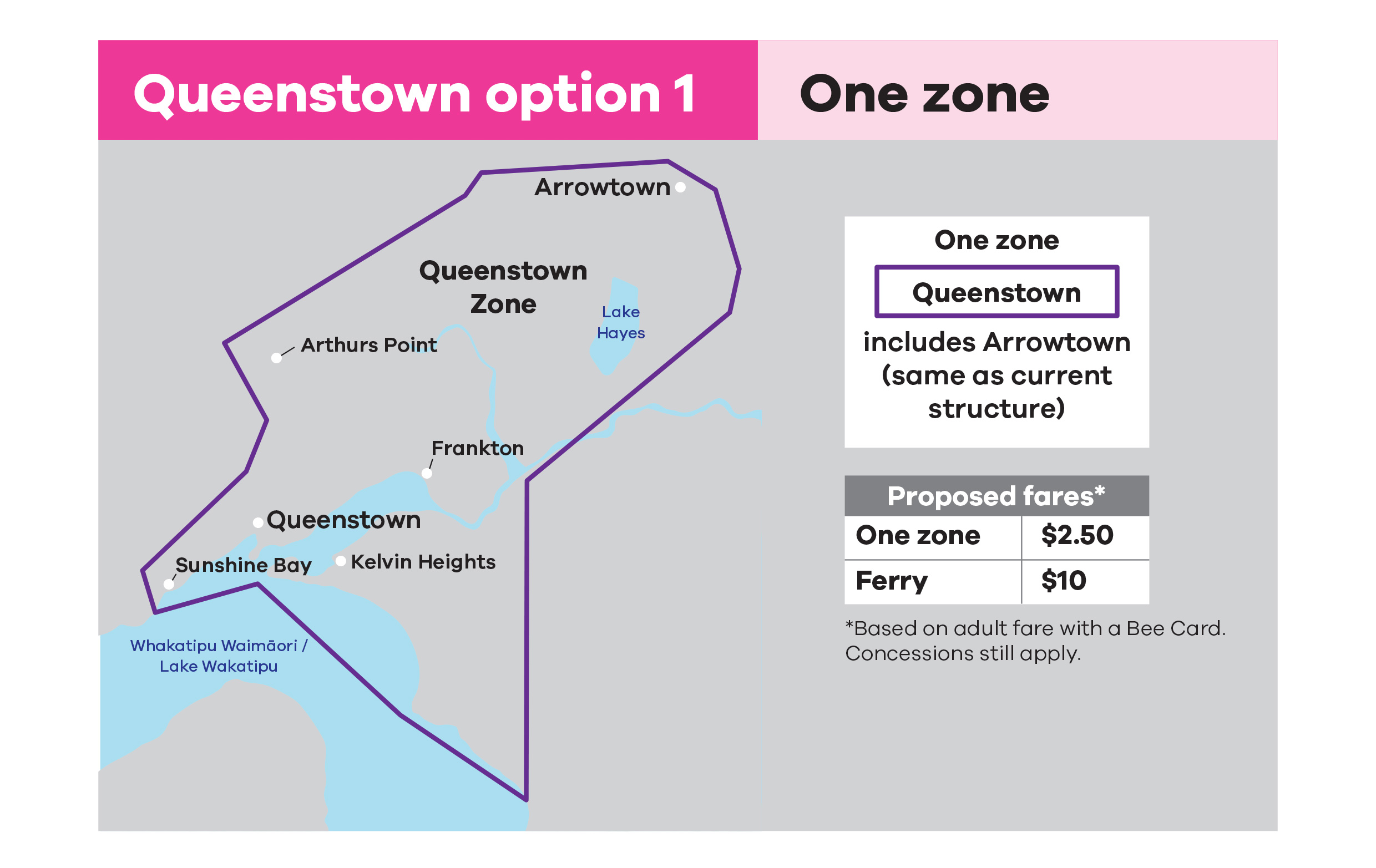
Queenstown option 1
| Proposed fares* | |
| One zone | $2.50 |
| Ferry | $10.00 |
Queenstown option 2
| Proposed fares* | |
| One zone | $2.50 |
| Two zones | $3.00 |
| Ferry | $10.00 |
*Based on adult fare with a Bee Card. Concessions still apply.
The zone fares will apply to all passengers, but concessions will apply in the same manner as they do now.
ORC considers school students in the planning of services and timetables. We are considering options for additional services to cover Ministry of Education withdrawals in Queenstown.
There is no change for people travelling off peak on Super Gold; travel will still be free. All child and community connect discounts will continue to apply.
Fare cap dollar values will be discounted by the same amount as the concession value. For example, children will travel for free once 60% of the adult fare cap has been reached.
The ferry has a higher fare and is used by many visitors. A weekly fare cap of 10 trips on the ferry would not affect very many people, so compared to the bus, the fare cap needs to be a lower number of trips in order to make a difference.
Yes, ferry passengers will be able to transfer to bus services.
If the Council decides to go ahead with fare capping, this would be implemented when the National Ticketing System (Motu Move) is implemented in Otago in 2027. Under Motu Move, people will be able to pay their fare with most bank cards.
We will follow fare policy guidance from NZTA and follow the details of any changes in fare policy once they are released.
Under Motu Move, people will be able to pay their fare with most bank cards. Also, removing cash fares would mean quicker journeys as drivers won’t have to deal with cash transactions.
A decision has not been made about this yet. We’re asking people how they would be affected if the Council decided to remove cash fares.
If the Council decides to go ahead with removing cash fares, this would be implemented when the National Ticketing System (Motu Move) is implemented in 2027. Under Motu Move, people will be able to pay their fare with most bank cards.
We will be working to establish a retail network under Motu Move that will allow people in Dunedin and Queenstown to top up their Motu Move card.
Last year we asked people how they felt about zones that would enable us to charge more for longer-distance fares. At that time, the feedback people gave us was that they needed to know what zones might look like, and how much trips would cost.
A zone-based fare system allows us to charge more for people travelling longer distances. By charging higher fares for longer-distance travel, we have a system that better reflects the costs of running it, while still being accessible and affordable.
At their meeting on 23 September 2026.
The Council is yet to decide when the changes might happen; however it is likely to be a staged approach.
We’ve had zones in the past, and we’ve heard a lot of positive feedback on the shift to flat fares. The previous zone system was complex and costly, and we don’t want to go back to what we had.
We have proposed overlap zones which make it fairer for people who travel short distances but cross a zone boundary. They pay the lesser fare.
Fares will be based on the number of zones that you travel through. These are proposed fares, based on an adult fare with a Bee Card.
Dunedin option 1
| Proposed fares* | |
| One zone | $2.50 |
| Two zones | $5.00 |
| Three zones | $7.50 |
| Four zones | $10.00 |
Dunedin option 2
| Proposed fares* | |
| One zone | $2.50 |
| Two zones | $3.00 |
| Three zones | $5.00 |
| Four zones | $7.50 |
| Five zones | $10.00 |
Queenstown option 1
| Proposed fares* | |
| One zone | $2.50 |
| Ferry | $10.00 |
Queenstown option 2
| Proposed fares* | |
| One zone | $2.50 |
| Two zones | $3.00 |
| Ferry | $10.00 |
*Based on adult fare with a Bee Card. Concessions still apply.
The zone fares will apply to all passengers, but concession will apply in the same manner as they do now.
Feel free to contact us if you have any questions about the survey or the proposed changes.
Email us at transport@orc.govt.nz or call us on 0800 672 8736.

Call us Mon–Fri 8am–5pm
Orbus Dunedin
Orbus Queenstown



