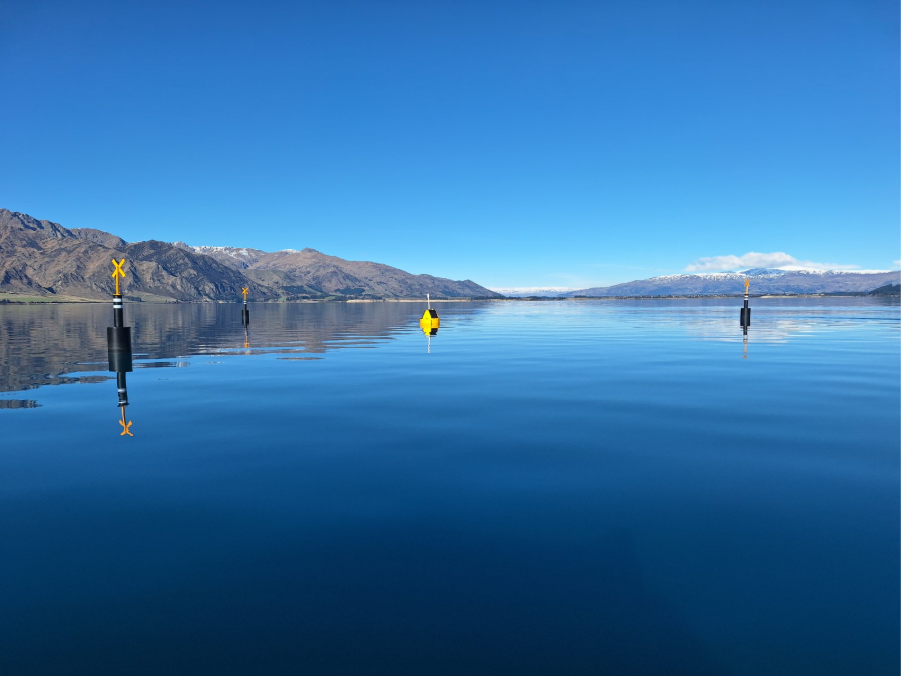
The buoy completes ORC’s network of high-frequency monitoring buoys across Otago’s four deep high-country lakes — Wānaka, Hāwea, Whakatipu / Wakatipu and Waiwhakaata / Lake Hayes.
Science and Resilience portfolio co-lead and ORC councillor Gretchen Robertson says the new buoy will provide valuable information about one of Otago’s most important freshwater systems.
“Our deep lakes are outstanding freshwater environments, valued across New Zealand. Their scale and complexity make monitoring both challenging and important, and this work gives us a clearer picture of what is happening beneath the surface. It builds the long-term knowledge we need to understand these lakes, track their condition over time, and make informed decisions about their future.”
The four lakes form a significant part of the headwaters of the Clutha/Mata-au River, New Zealand’s largest catchment by both area and water volume. They are also globally rare, with their extraordinary depths shaped by ancient glaciers.
“Whakatipu, for example, reaches around 400 metres deep, with its deepest point approximately 80 metres below sea level,” says Cr Robertson.
“These lakes are much more than spectacular landscapes; they are important water reservoirs that support diverse species and ecosystems. By monitoring conditions throughout the water column, we can better understand how these lakes function, identify changes in their health early.”
The buoys collect data at different depths between four and eight times a day, measuring water temperature, dissolved oxygen, chlorophyll, phycocyanin, turbidity, pH, conductivity, and weather conditions.
The network can monitor conditions down to 120 metres, depending on the lake and the type of measurement. At Lake Hāwea, all measurements can currently be collected down to 120 metres.
At Lakes Whakatipu and Wānaka, the full range of water-quality measurements is currently collected to 70 metres, while temperature and dissolved oxygen are measured to 120 metres. ORC is working to extend the remaining measurements to 120 metres.
At Lake Hayes, the buoy can monitor the full depth of the lake, which is approximately 33 metres.
“Monitoring deeper water is particularly important because the thermocline — the layer where water temperature changes rapidly — can occur well below 70 metres in the larger lakes,” says Cr Robertson.
While the new buoy completes the high-frequency monitoring network, ORC’s wider deep lakes monitoring programme extends well beyond the range of the buoys. Additional sensors measure temperature and oxygen near the lakebed, while monthly water-quality profiles provide information from the surface to near the lakebed. ORC also monitors lake snow, animals and plants, and rivers and streams flowing into and out of the lakes.
Cr Robertson says the new Hāwea buoy gives us another important piece of the puzzle.
“The real value comes from bringing all this information together over time. The more we understand how these lakes naturally behave, and how they respond to changing pressures, the better placed we are to protect them for future generations.”
The first high-frequency monitoring buoy was installed in Lake Hayes in 2019, followed by buoys in Lakes Whakatipu and Wānaka in 2022. The Lake Hāwea buoy was installed in 2026.
In 2024, ORC established the Otago Deep Water Lakes Technical Advisory Group to identify knowledge gaps and provide scientific advice on future lake management.
Near-real-time data from the monitoring buoys in Lakes Hāwea, Wānaka, Whakatipu and Waiwhakaata / Hayes is available through ORC’s Environmental Data Portal here: orc.govt.nz/edportal