SJ Allen Holdings Limited (SJ Allen) is a commercial waste disposal firm that services wastewater treatment plants (WWTPs), grease traps, mud tanks/sumps, winery wastewater, portaloos and septic tanks throughout Central Otago area.
On 28 January 2026, the Otago Regional Council (ORC) granted SJ Allen resource consent RM25.407.01 to discharge five waste types to land at a rural property it owns in Lauder, Central Otago. These waste types are described on this page, and include waste activated sludge (WAS) from WWTPs, grease trap waste, mud tank/sump waste, winery wastewater, and similar waste types that meet Soil Eco-Guideline limits. The consent runs until 28 January 2041 and is subject to 29 conditions that ORC monitors for compliance.
WAS from WWTPs is expected to be the main waste discharged at the site. Grease trap waste, mud tank/sump waste and winery wastewater are currently discharged at another SJ Allen property in Alexandra (under ORC consent RM20.287.01.V1), but SJ Allen is seeking to consolidate these activities at the Lauder property.
This page explains what has been consented, the conditions attached to it, and how ORC is monitoring the site.
Purpose: To discharge contaminants to land for the disposal of waste collected from around Central Otago and Queenstown-Lakes
Location: Lauder, approximately 1km northeast of the intersection of Muddy Creek Road and Brown Road
Legal description: Section 25 and Section 47 Block V Lauder Survey District, Section 20 Block V Lauder Survey District
A resource consent is required for this activity under the Regional Plan: Water for Otago. The discharge of WAS, grease trap and mud tank/sump waste and winery wastewater contain contaminants from an industrial or trade premise. Therefore, the activities are considered a discretionary activity under rule 12.B.4.1.
Five types of waste are covered by the consent. Waste activated sludge (WAS) is expected to be the main waste discharged at the site.
1. Waste activated sludge (WAS)
What it is: Organic material left over after micro-organisms break down domestic wastewater at treatment plants (mainly from Alexandra and Project Pure WWTPs). Screening at the treatment plant removes solids and recognisable sewage material beforehand. The waste is mostly domestic in origin, with minimal to no input from industrial trade waste.
How much: Up to 2,000 tonnes per year (at 20% dry solids). In the first 12 months, WAS can only be applied to a maximum of 50 hectares.
How it's applied: Spread onto the land surface using a muck spreader or similar. It is then worked into the soil via discs to at least 50mm depth within 24 hours of being applied.
Land management: A "catch crop" (such as oats, ryecorn or triticale) must be sown after each application. No crops for human consumption may be harvested from treated land for 12 months after WAS is applied.
2. Grease trap waste
What it is: Fats, oils and liquid waste from takeaway and fast-food kitchens.
How much: Up to 1,200 m³ per year (max 20 m³ per day).
How it's applied: Placed into soakage trenches (roughly 1-2 m wide, 1.5-2 m deep, up to 150 m long), then capped with soil.
3. Mud tank/sump waste
What it is: Waste from light industrial sites such as garages and roading contractors – mostly wash-down water and stormwater, with no heavy industrial input.
How much: Up to 1,200 m³ per year (max 20 m³ per day).
How it's applied: Into soakage trenches, layered with grease trap waste.
4. Winery wastewater
What it is: Mostly wash water (90%) plus screened winery waste (10%).
How much: Up to 1,200 m³ per year (max 20 m³ per day).
How it's applied: Discharged directly from a tanker truck onto separate strips of land (2.4 m wide), tracked by GPS to ensure even coverage.
5. Other waste
The consent also allows similar waste types, provided they meet Soil Eco-Guideline limits. Currently, only WAS is being discharged at the site – no other waste types are scheduled for 2026.
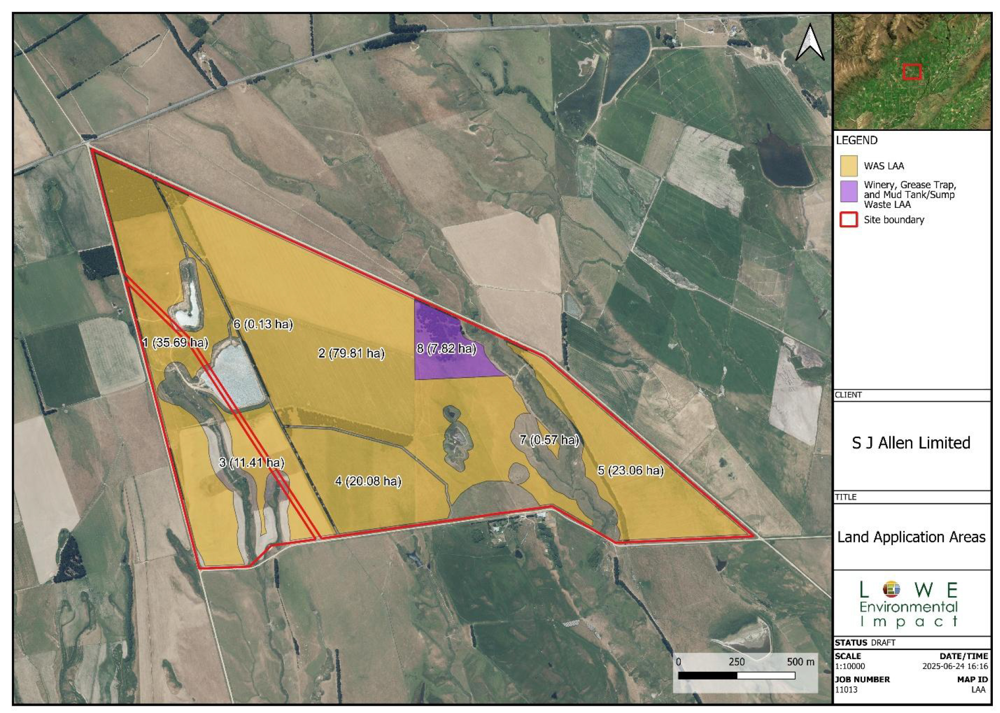
The property has 178.57 hectares of consented land application area:
170.75 ha for WAS
7.82 ha for grease trap waste, mud tank/sump waste and winery wastewater
To protect neighbours and the environment, no discharge is permitted:
Setback | Distance |
From any property boundary | 10 m |
From formed public roads | 20 m |
From ephemeral wetlands | 20 m |
From natural watercourses | 50 m |
From water storage ponds | 20 m |
From irrigation races | 5 m |
From any residential dwelling | 200 m |
There is also a surface water take on neighbouring land to the south. A permanent 50m exclusion zone applies around a surface water take on neighbouring land, plus an additional 200m buffer for the first five years of the consent.
ORC's role is to process the consent and then monitor SJ Allen's compliance with it – responding to any incidents and taking enforcement action where needed.
Here's what that monitoring looks like in practice:
Operations and Maintenance Manual (OMM) SJ Allen must operate strictly in line with its Operations and Maintenance Manual, which sets out day-to-day procedures, monitoring and contingency plans. Before any waste could be discharged, the OMM had to be reviewed and accepted by ORC, including an independent technical audit by ORC's technical review panel.
Testing every load coming onto the site Each of the waste types must be sampled at set intervals for parameters such as heavy metals, hydrocarbons and biological oxygen demand. All testing is carried out by an IANZ-registered (independently accredited) laboratory, and results must go to ORC within two weeks of being received.
Groundwater monitoring Before any discharge began on the 29th June 2026, SJ Allen installed two groundwater monitoring wells and carried out baseline testing in June 2026. These monitoring wells are located on the south side of the property, near a neighbouring residence. Ongoing sampling is required quarterly for the first two years, then annually. If results show a rising trend across three consecutive samples, SJ Allen must investigate further and report to ORC within 30 working days on the cause, any effects, and remedial action.
Odour monitoring There is no separate air discharge permit for this site – odour is managed as a Permitted Activity under the Regional Plan: Air for Otago, meaning it must not be offensive or objectionable beyond the property boundary. ORC responds to odour complaints via the Pollution Hotline and carries out proactive odour surveys at the boundary on days when discharge is occurring.
A full compliance audit within year one As a high priority activity under ORC’s Compliance and Enforcement Policy, the site will be routinely audited by Compliance Staff. An initial audit will be completed before the end of 2026, and again once the consent has been operating for 12 months. This audit looks at all 29 conditions – including a site visit and review of every sample result submitted over the year.
Regular reporting to ORC In addition to sample results, SJ Allen must also keep ORC informed through two formal reports:
Annual Report (due 15 August each year, covering 1 June – 31 May): covers all maintenance records, sampling results, volumes of each waste type, and an overall compliance summary.
Monitoring Summary Report (due at the one-year mark, July 2027): sent to both ORC and Aukaha (mana whenua), analysing monitoring results and effects, tracking nitrogen applied versus exported from the land, and outlining any proposed changes to how the site is managed. ORC and Kā Rūnaka will have the opportunity to comment on any proposed changes.
If you notice offensive odour, dust, or anything else of concern near this site, please contact us:
Pollution Hotline (24/7) 0800 800 033 | General enquiries 0800 474 082 | Report pollution online
For questions about the consent itself: Consents Enquiries consent.enquiries@orc.govt.nz
ORC processes resource consent applications and monitors compliance with any consent granted. We are the regulator, not the operator – SJ Allen is responsible for running the site within its consent conditions.
Yes. Grease trap, mud tank/sump and winery wastewater have previously been discharged at another SJ Allen property under a separate consent (RM20.287.01.V1). SJ Allen is consolidating these activities at the Lauder site.
No, the application was processed on a non-notified basis. ORC's analysis under the steps required by the Resource Management Act 1991 (RMA) found that the potential adverse effects on soils, groundwater and nearby surface water bodies would be less than minor, and that these effects were not expected to extend beyond the property boundary – meaning effects on neighbouring owners or occupiers were also considered less than minor.
Non-compliance can lead to enforcement action under the Resource Management Act 1991, ranging from abatement notices and infringement fines through to prosecution or Environment Court action, depending on severity.
Yes. Condition 29 allows ORC to review the consent conditions each year, within a three-month window either side of the anniversary of the consent being granted (28 January). ORC can also trigger a review within two months of taking any enforcement action, or after receiving monitoring results. A review can be used to strengthen conditions if needed - for example, to address any adverse environmental effects that emerge over time, keep the consent in line with national standards or regional plans, change how often monitoring or reporting is required, update the monitoring programme, or require SJ Allen to adopt better practices to prevent or reduce environmental effects.
Consents can only be cancelled in specific situations, as set out in the RMA.
The situations are very limited and include:
Where the consent has not be exercised before its “lapse” date – usually 5 years.
Where the council reviews the consent (a formal process set out in the RMA) and finds;
the information supplied by the applicant in the consent application contained inaccuracies which materially influenced the decision made on the application; and
there are significant adverse effects on the environment.
The consent holder has been convicted of an offence for contravening the consent; and
the Court has ordered the consent authority to review the resource consent; and
there are significant adverse effects on the environment.
There is no separate air discharge permit for this site – odour is managed as a Permitted Activity under the Regional Plan: Air for Otago.


