Clean air is essential for healthy communities and a healthy environment. ORC monitors air quality across the region to understand how air pollution changes over time, identify areas where air quality may be affected, and assess whether air quality meets New Zealand's national standards and guidelines.
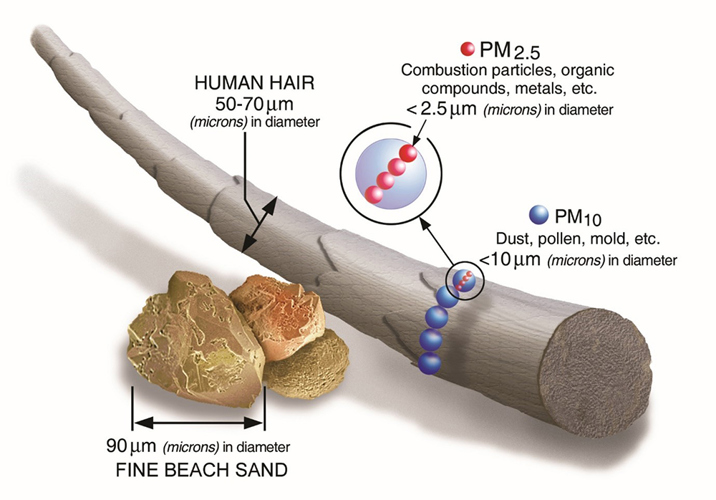
The main air pollutant monitored in Otago is particulate matter (PM10 and PM2.5) – tiny solid or liquid airborne particles that can be inhaled deep into the lungs, where they can affect respiratory and cardiovascular health.
People who may be more vulnerable to the effects of air pollution include young children, older people, pregnant people, and people with existing health conditions.
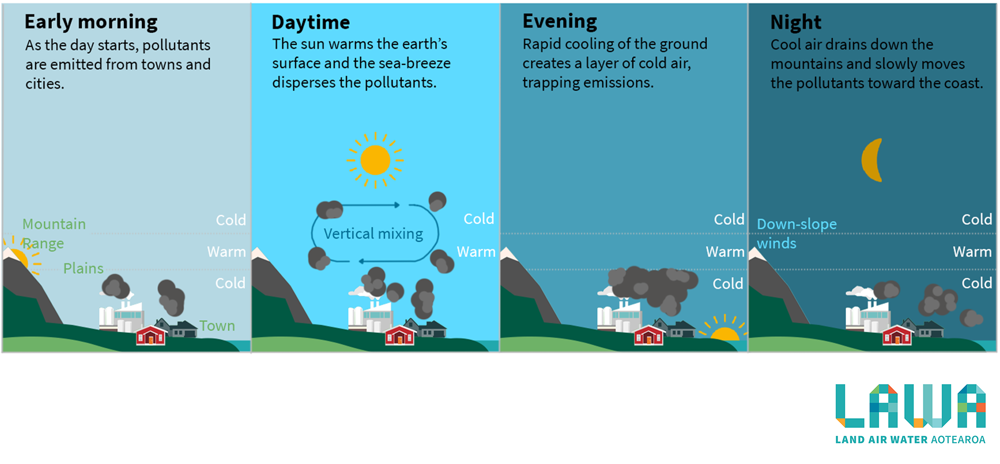
During winter, smoke from domestic home heating is the biggest source of particulate matter in many Otago towns. Weather conditions also have an important influence on air quality. Many of Otago's high pollution events occur during cold, calm winter days and nights.
Temperature inversions can form when a layer of warmer air sits above colder air near the ground. This effectively traps the colder air and pollutants close to the ground. When smoke and other particles are emitted into this ground-level layer, they cannot disperse as easily, resulting in periods of poor air quality.


Air Pollution, Weather, and Landscape
During calm winter nights, pollution can be trapped in a layer of low, cold air due to the combined effects of high emissions and New Zealand’s weather and landscape.
ORC operates a network of continuous air quality monitoring stations across Otago. These stations use highly accurate scientific instruments to measure particulate levels around the clock, providing long-term data that helps us:
- Understand trends in air quality over time
- Measure compliance with national air quality standards
- Inform air quality management and planning
- Support research and community education; and
- Provide publicly available information on local air quality.
Monitoring results are published through Land, Air, Water Aotearoa (LAWA), New Zealand's national environmental data platform. LAWA brings together environmental monitoring information from regional councils across the country, making it easy to explore current conditions, historical trends, and downloadable datasets for Otago's monitoring sites.
Browse the monitoring sites below to view the latest air quality information and long-term trends for each location.

Alexandra
Alexandra is known for experiencing temperature extremes, and has very poor air quality during winter months, due to the cold, calm weather and basin topography. Air quality monitoring has been undertaken in Alexandra since 2005,

Arrowtown
Air quality has been monitored in Arrowtown since 2006. Seasonally, particulate concentrations are very high in winter, when wood burners are in use, and are very low at all other times of the year.

Balclutha
Balclutha residents rely heavily on coal for domestic heating. Consequently, the town’s nightly emissions are some of the highest in the region. Historic air quality monitoring has shown exceedances of the National Environmental Standards several times a year.

Clyde
Air quality monitoring began in Clyde in 2008, with winter-only monitoring for PM10. In 2020 the monitoring instrument was upgraded to a continuous optical instrument monitoring PM2.5.

Cromwell
Cromwell is one of the worst in Otago for air quality, a combined result of a continental climate, inversion layers and home heating. Air quality monitoring began in Cromwell in 2008, with winter-only monitoring for PM10. In 2020 the monitoring instrument was upgraded to a continuous optical instrument monitoring PM2.5.

Dunedin
Dunedin has relatively good air quality year-round, although emissions can accumulate in some of the valley areas during still conditions.

Milton
Milton has some of the worst air quality in Otago. PM10 monitoring from 2008-2020 indicates air quality does not meet the National Environmental Standard.

Mosgiel
Mosgiel can experience poor winter air quality when smoke from domestic and industrial emissions concentrates near the ground surface. Temperature inversions can commonly form in winter to create conditions that discourage dispersion, allowing PM10 to accumulate. Mosgiel exceeds the National Environmental Standards for PM10 a couple times a year. Air quality monitoring began in Mosgiel in 2005.

Queenstown
In Queenstown the areas most at risk of higher pollution are the older established residential areas of the Frankton area and Fernhill/Sunshine Bay. The main source of air pollution is wood burners for home heating, however overall, air pollution is not at risk of extremely high concentrations seen in Central Otago because of the presence of the lake, which generally cause increased wind speeds.

Wānaka
Wānaka can often experience atmospheric inversions which can trap pollutants close to the ground. The main source of air pollution is home heating fires, however overall, air pollution is not at risk of extremely high concentrations seen in Central Otago because of the presence of the lake, which generally causes increased wind speeds. The areas most at risk of higher pollution are the older lakefront suburbs, and the low-lying Albert Town.
ORC also has two air quality monitoring trailers that can be deployed to towns across Otago. This can help build a better picture of air quality when there has not been any historic air quality information.
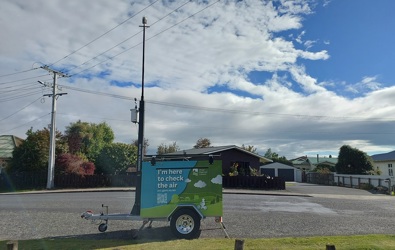
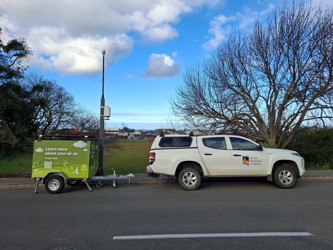
ORC has been monitoring air quality in Otago communities since 2006, providing long-term data that helps us understand air pollution, track trends over time and assess compliance with national environmental standards.
As technology has advanced, ORC has progressively upgraded its monitoring network to ensure it continues to provide accurate, reliable data. Alongside replacing aging equipment, ORC has also expanded its network to monitor additional communities.
2026 – new permanent site installed in Wanaka.
2025–26 – Upgraded meteorological instruments, masts, and data loggers at most monitoring sites across the region, improving the quality and resilience of the monitoring network.
2025 – Alexandra upgraded with new equipment and meteorological instruments.
2025 – Installed a new permanent air quality monitoring station in Frankton, extending monitoring coverage in the Queenstown Lakes area.

2023 – Mosgiel upgraded with new equipment, meteorological instruments and shed.
2023 – Expanded monitoring in Arrowtown to include black carbon, providing greater insight into emissions from combustion sources such as home heating and transport.
2022 – Upgraded the Dunedin monitoring station with new equipment and monitoring shed.
2021 – Upgraded the Arrowtown site with new monitoring equipment, housed in a new monitoring shed.
Monitoring the air we breathe is about more than recording pollution levels. ORC also carries out targeted studies across Otago to better understand where air pollution occurs, what causes it, and how monitoring and management of air quality can be improved. These projects help make informed decisions, ensure monitoring is in the right places, and build a clearer picture of air quality across the region.
Learn more about these monitoring studies on ORC’s Air reports and publications page
Schools Air Watch with The Air Quality Collective (2026)
Otago Regional Council commissioned The Air Quality Collective to deliver a community science project monitoring air quality in schools and homes in Ōamaru, Wānaka and Hāwea. Students and community volunteers used low-cost sensors to help build a better understanding of local air quality patterns, providing valuable information to support the wider monitoring network.
View theairqualitycollective.org project page.
Outdoor burning study – Alexandra and Clyde (2025)
ORC investigated how much outdoor burning contributes to winter air pollution in Alexandra and Clyde. The findings will improve the understanding of local pollution sources and help refine emissions estimates, supporting future air quality management and education initiatives.
Hāwea monitoring (July–August 2025)
ORC carried out temporary monitoring in Hāwea to better understand winter air quality in this growing community. While the study provided valuable information, the monitoring will be repeated during a colder winter to ensure the period when pollution levels are typically at their highest is captured.
Albert Town monitoring (May–June 2025)
ORC compared winter air quality in Albert Town with its monitoring site in Wānaka to identify where the highest pollution levels occur. The results showed Albert Town should be included within the Wānaka airshed to better reflect how air quality is managed in the area.
Alexandra air quality study (2023)
Working with NIWA, ORC investigated how air pollution varies across Alexandra and assessed the impact of relocating the permanent monitoring site in 2018. The study found the current site does not capture the highest pollution levels and recommended relocating the monitor again to meet national monitoring requirements.
Temporary nitrogen dioxide (NO₂) and sulphur dioxide (SO₂) monitoring in Dunedin (2022)
ORC monitored nitrogen dioxide (NO₂) and sulphur dioxide (SO₂) levels in central Dunedin to assess whether either pollutant was approaching national limits. The results showed both remained well within national standards and provided valuable information for future air quality monitoring.
Real-life ultra-low emission burner study (2022)
ORC studied how ultra-low emission wood burners perform in everyday homes rather than under laboratory conditions. The findings contributed to national research and improved estimates of how much pollution wood burners produce, helping to build a more accurate picture of total emissions in a town.
Port Otago sulphur dioxide (SO₂) screening study (2022)
ORC investigated whether emissions from ships, including cruise ships, could cause elevated sulphur dioxide (SO₂) levels around Port Otago during the cruise season. The study found SO₂ levels were low and there was no evidence of a risk to public health.
PM2.5 regional spatial study (2021)
ORC measured fine particle pollution in towns across Otago to identify other airsheds that may be at risk of high winter air pollution. The results improved the understanding of air quality across the region and helped identify where additional monitoring may be needed.

Reports and publications - air
The health of people in Otago depends on clean air. ORC is responsible for managing and reporting on Otago’s ambient (outdoor) air quality and carrying out long-term continuous monitoring. We share several reports that look at the air quality in our region.

Air plans and policies
The Regional Plan: Air for Otago (the Air Plan) assists us in managing Otago's air resource.


