-
-
-
-
-
-
-
-
-
-
-
-
-
-
-
ORC Priority Actions 2026–2028
Otago Regional Council has identified a set of Priority Actions to help focus its work over the remainder of the current council term.
The Priority Actions highlight the areas where councillors want to see the greatest progress and impact for Otago’s communities and environment, while continuing to deliver the Council’s existing responsibilities and services.
The priorities sit alongside the Council’s Long-Term Plan and other existing work programmes, providing additional focus on the issues councillors believe are most important for the region over the next two years. Rather than creating new responsibilities, the Priority Actions help clarify where greater attention, visibility and effort should be directed.
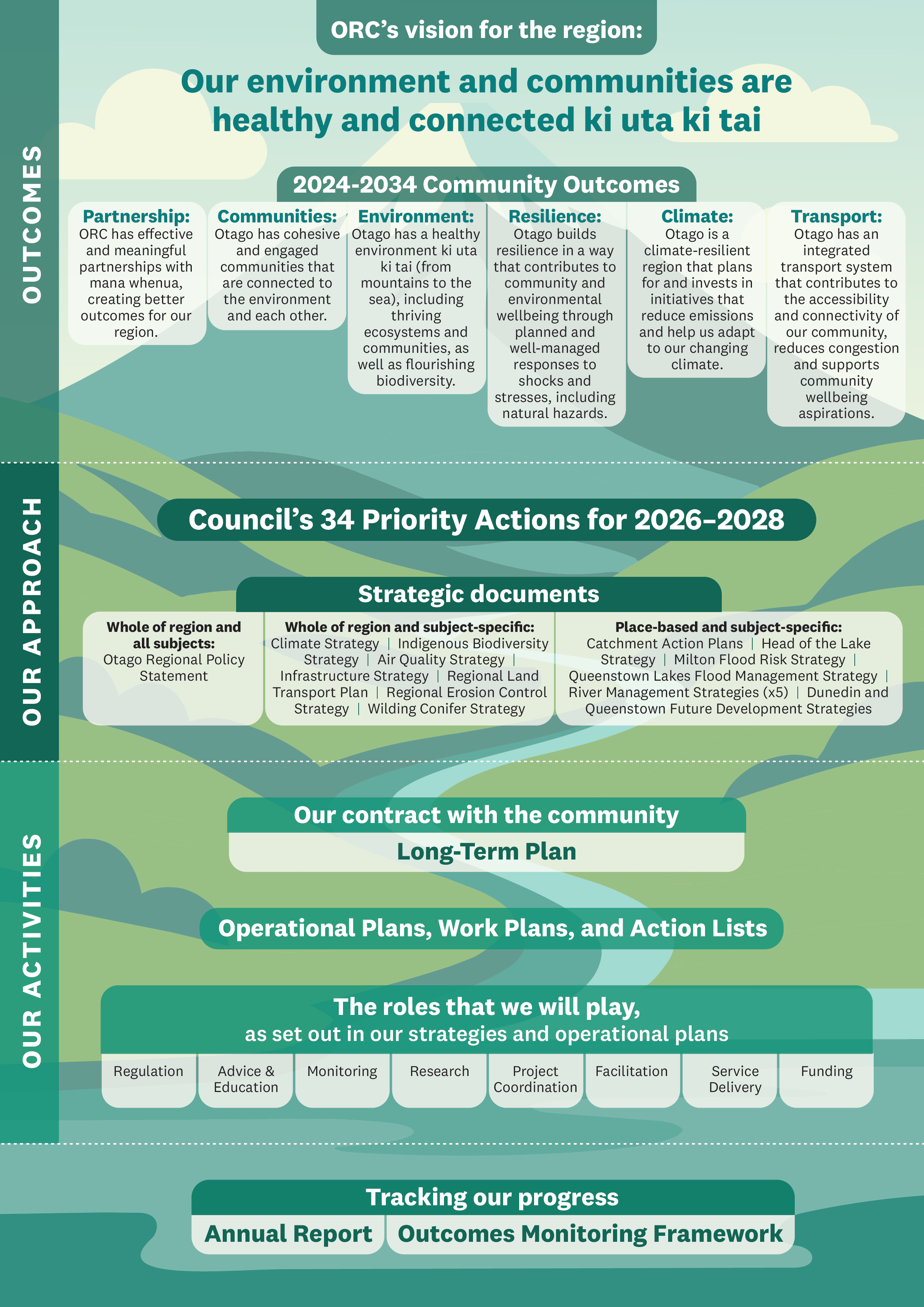
The priorities cover a range of important areas, including science and resilience, environmental delivery and catchment management, public transport, strategy and planning, and governance and community engagement. They also recognise that many of Otago’s opportunities and challenges span multiple areas of Council activity and require a coordinated approach.
Several key themes underpin the Priority Actions. These include making decisions based on sound science, data and evidence, improving transparency and performance reporting, strengthening relationships with mana whenua, communities and stakeholders, and ensuring Council is well positioned to respond to future challenges and opportunities. The priorities also emphasise the importance of integrated decision-making, recognising the close links between environmental management, resilience, infrastructure, transport and community wellbeing.
The Priority Actions are intended to help Council focus its efforts where they can make the greatest difference for Otago. They will guide planning, reporting and decision-making, while helping ensure progress is visible and outcomes are clearly communicated to communities.
Council will report regularly on progress against the Priority Actions, providing communities with a clear view of what is being delivered and how it contributes to a thriving, resilient and sustainable Otago.
Review and align science programmes with community and catchment needs, ensuring outputs are accessible, relevant, and support decision-making. Clearly articulate how statutory and discretionary activities contribute to core environmental outcomes and identify any gaps in capability or coverage and how these will be addressed.
Provide councillors with a clear assessment of flood and drainage infrastructure risk, including any implications of deferred maintenance, and ensure existing community liaison mechanisms are used to test and inform this analysis.
Review flood and drainage rating structures to ensure equity across catchments, including consideration of who contributes to and benefits from schemes, with community input prior to any recommendations to Council.
Improve accessibility of environmental and natural hazard information, including consideration of property-level visibility and integration of relevant external data sources where practicable.
Ensure irrigation, water storage and hydro opportunities are appropriately enabled, including addressing any unintended regulatory or organisational barriers.
Progress work to understand coastal environmental issues, opportunities and risks, in partnership with communities, to ensure a strong evidence base is available regardless of future regulatory settings.
Provide councillors with advice on opportunities to support integrated catchment management and partnership approaches, including consideration of models such as UNESCO Biosphere designation where appropriate.
Identify and address barriers to good practice water use in the non-regulatory space, including working with water users, communities and sector expertise to support improved outcomes.
Strengthen pest management outcomes for control of rabbits, with the establishment of a working group and a focus on practical delivery, partnerships, and community and landowner collaboration.
Assess opportunities for eradication or a step-change intervention for lagarosiphon, including appropriate funding options and delivery models.
Support community and voluntary efforts to control wilding pines. Advocate for fair contributions from government and those responsible for the source of the wildings.
Accelerate delivery of integrated catchment management plans, with a focus on non-regulatory actions, learning from completed plans, and identifying funding pathways.
Audit and Risk to complete a deep dive into consenting, and compliance condition activities to ensure they are operating fairly, transparently, at an appropriate cost, efficiently and in a timely fashion. This would include setting conditions, monitoring and enforcement of above.
Finalise and implement the Environmental Fund framework to ensure funding is directed toward agreed priority actions and outcomes, with appropriate governance oversight.
Support landowner collaboration and environmental and flood resilience initiatives where these contribute to improved catchment outcomes.
Advocate with Central Government for a more integrated and flexible approach to school and public transport provision that better reflects community needs and supports efficient service delivery.
Re-establish transport liaison groups in Dunedin and Queenstown to strengthen feedback from users and operators, with structure and membership to be developed through a subsequent process.
Ensure public transport performance reporting supports effective governance oversight, including reliability, accessibility and service effectiveness. Implement if practicable not before timetabling.
Progress the Ōamaru trial and provide options for future service delivery, including transition arrangements into future planning cycles.
Improve understanding of the wider transport system, including community and private provision, and identify opportunities to support improved access where gaps exist.
Maintain and strengthen relationships with central government, including ministers, officials and relevant stakeholders, to support Council priorities and advocacy.
Continue to consult with Mana Whenua on a mutually agreeable way to provide opportunities for Māori to contribute to decision making processes.
Review communication functions, channels and website functionality to identify gaps and barriers to the provision of these functions.
Strengthen engagement with territorial authorities, particularly in areas of reform, regulatory overlap and unitary service provision.
Ensure community feedback from the 2026 Community Survey is reflected in work programmes and clearly communicated back to stakeholders.
Establish clear internal processes to track and follow up on commitments made by councillors and staff to communities.
Identify where Council effort and resources can achieve the greatest improvement in freshwater outcomes, informed by existing science, catchment planning and community priorities.
Identify priority locations for targeted resource investment across river and lake systems, and report to Council on where effort will achieve the greatest environmental benefit, including consideration of areas such as Waihola, Tomahawk Lagoon, Dunstan, Lake Hayes and the Manuherekia.
Review current approaches to gravel extraction and willow management, ensuring processes are clear, efficient and supported by appropriate community engagement.
Audit and Risk to review contract creation and management practices (including arrangements that are not formal contracts but involve payment for goods and services), as well as KPIs, to ensure these reflect intended outcomes and support effective and accountable performance monitoring.
Identify opportunities to progress elements of the draft Land and Water Plan through non-regulatory approaches and existing mechanisms, where appropriate, to support timely environmental outcomes.
Support structured engagement with Manuherekia water users to identify and address barriers to progressing water infrastructure and catchment outcomes.
When decisions papers come to Council, identify whether the activities or actions proposed are mandatory, discretionary, or mixed.
Identify priority locations for targeted resource investment into air quality improvement initiatives across the Otago region, with a focus on the greatest environmental improvements in the lowest quality air sheds.
Following the election of the new Council in October 2025, elected members signalled a desire to revisit and clarify Council's priorities for the remainder of the triennium.
In early 2026, Councillors identified 34 priority actions across six portfolio areas (Science and Resilience, Strategy and Planning, Environmental Delivery, Public Transport, Governance and Community Engagement, and Cross Portfolio) to focus effort and resources on delivering the greatest impact on the wellbeing and environmental outcomes that matter most to the Otago community.
Staff have been working with Portfolio Leads to determine the most appropriate actions required to achieve the outcomes sought by Council, alongside establishing a monitoring and reporting framework.
Each of the 34 priority actions is supported by detailed sub-actions specifying deliverables, ownership, and completion dates. As of 9 July, 14 actions are in active delivery, 5 are in planning phase, and 15 are not yet started.
Initial assessment shows that across the 100 tracked sub-actions, 33 represent new work requiring new capacity or resource investment, whilst 61 represent acceleration or formalisation of existing work -indicating Council is being strategic about workload realism rather than expanding scope.
Portfolio load varies significantly. Environmental Delivery has the most resource-intensive portfolio (46% new work, 41 sub-actions), with capacity concentration in lagarosiphon intervention assessment, rabbit pest management strategy, and wilding pine community support. Public Transport has the highest proportion of new work (56%) but smaller absolute workload (9 sub-actions), largely centred on governance setup (liaison group reestablishment). Governance and Community Engagement is largely business as usual work (7% new work), as most actions formalise existing governance obligations. Science and Resilience (42% new work) is concentrated in foundational framework development work for the science programme review.
Eleven actions currently have no populated sub-actions and require scoping before realistic delivery timelines can be confirmed: three in Science and Resilience (SRA2, SRA4, SRA5), one in Strategy and Planning (SPA3), one in Environmental Delivery (EDA5), one in Public Transport (PTA5), and five in Cross Portfolio (CPA1–CPA3, CPA5–CPA6). Portfolio leads for several Cross Portfolio actions are still being assigned. Completion of sub-action scoping and resource planning is a priority for the next reporting cycle.
The priority actions framework ensures Council is transparent about what it has committed to achieve and provides a clear line of sight between governance direction and operational delivery. Progress will be reported quarterly to track pace of delivery, identify emerging risks, highlight areas requiring Council attention or decision-making. For new, complex actions or those requiring new funding, Council may receive stand-alone reports seeking direction or providing status updates.
The next update will be provided in October 2026.

New ‘Priority actions’ set focus for ORC works
ORC has adopted a new set of 34 “priority actions” for ORC staff, to clarify and focus on Council’s priorities for the remainder of the current Council’s triennium.

Council Meeting - 29 April 2026
Council meeting where matters for consideration included discussion and clarification of Council’s priorities for the remainder of the triennium.


