
Fish of Otago
Did you know Aotearoa New Zealand has extraordinary diversity of native freshwater fishes?
We share this country with lamprey, eels, smelt, bullies, flounder, mullets, triplefin, torrentfish, and a whopping 34 galaxiid species.
Otago’s rivers, streams, and wetlands are home to a fascinating mix of native and introduced freshwater fish. From the elusive Eldon’s galaxias to longfin eels, whitebait species, and brown trout, our region supports rich biodiversity across alpine and lowland habitats.
Aotearoa New Zealand’s rivers, lakes, and wetlands are home to extraordinary communities of freshwater fishes. While other countries boast hundreds of different freshwater fish species, we have a much smaller selection of just under 60 native species.
While we lack in numbers, what we do have is incredibly unique. Out of our 57 native species, 49 are found nowhere else on Earth (meaning they're endemic to Aotearoa New Zealand). This distinctive lineup includes eels, bullies, torrentfish and galaxiids (a family that is internationally renowned for whitebait and their rare relatives).
Otago is famous for its diverse and unique freshwater fishes. The region boasts 33 native freshwater fish species – more than any region in the country. The freshwater fish community of Otago includes two species of eels, a torrentfish, a lamprey, five bullies, a mullet, two smelt, a flounder, a triplefin, and 19 galaxiids. There are four whitebait galaxiids in Otago which typically migrate to the sea to complete their life cycle. The other 15 species spend their lives strictly in freshwater. This includes one mudfish, three slender “pencil” galaxias, and 11 species of flathead or roundhead galaxias.
The Otago Region is a stronghold for two species, with over 20% of the nationwide population living here:
Koaro (Galaxias brevipinnis)
Pomahaka galaxias (Galaxias “Pomahaka”)
The Otago Region also has a remarkable nine freshwater fish species that are endemic to the region – found nowhere else on Earth:
Nevis galaxias (Galaxias “Nevis”)
Clutha flathead galaxias (Galaxias “species D”)
Teviot flathead galaxias (Galaxias “Teviot”)
Alpine galaxias (Manuherikia) (Galaxias aff. paucispondylus “Manuherikia”)
Central Otago roundhead galaxias (Galaxias anomalus)
Taieri flathead galaxias (Galaxias depressiceps)
Eldon’s galaxias (Galaxias eldoni)
Dusky galaxias (Galaxias pullus)


Did you know ...
In Otago, we have 33 species of native freshwater fishes, more than any other region. Nine species are found only in Otago, showcasing the region’s unique freshwater fish community.
The Otago Regional Council periodically assesses the conservation status of freshwater fishes in the Region. The latest assessment was completed in 2026.
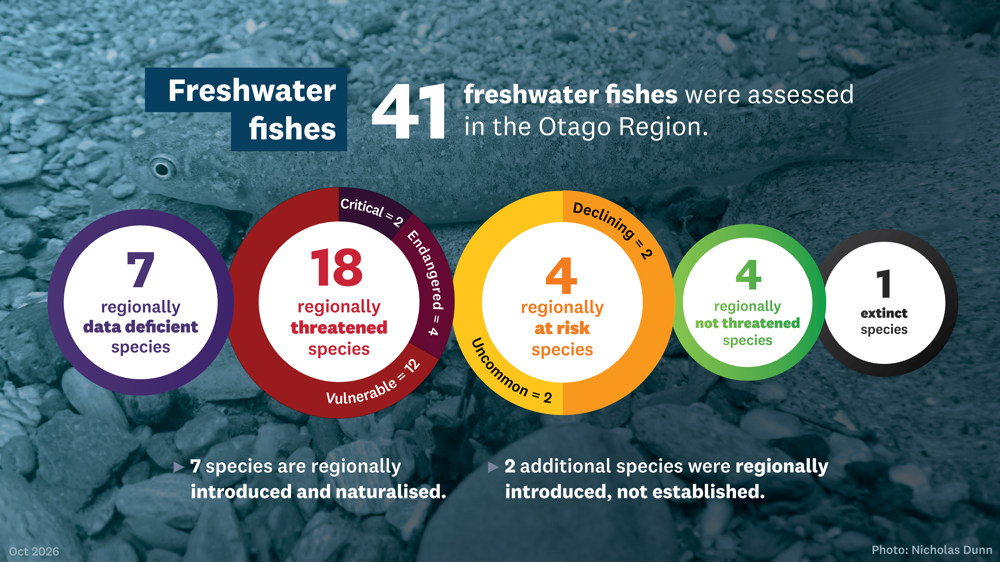
The 2026 assessment was completed in conjunction with a panel of experts including Dr Nicholas Dunn and Daniel Jack (Department of Conservation | Te Papa Atawhai), and independent consultant Dr Richard Allibone.
You can find out more about the conservation status of selected species group in Otago on our regional threat assessments webpage, including assessments of freshwater fishes.
Two species of freshwater eel live in Otago, the endemic longfin eel (Anguilla dieffenbachii), which is only found in Aotearoa New Zealand, and the native shortfin eel (Anguilla australis) which is also found in also found in Australia and New Caledonia. Like many freshwater fish, female eels grow larger than males, taking their time to reach larger sizes to hold more eggs. The males head off to spawn earlier, as they do not need the body mass to support egg production.
The longfin eel is Aotearoa New Zealand’s biggest freshwater fish, growing slowly over decades or even a hundred years to reach up to two metres long and weighing about 40 kilograms.
Shortfin eels grow quicker and reach their breeding size at younger ages than longfin eels.
While they spend most of their lives in local rivers, streams, and wetlands, the life cycle of both species starts and ends in the Pacific Ocean, near Vanuatu. Eel life stages have specific terms:
Eels begin life as leptocephali, leaf-shaped l larvae that drift on ocean currents.
As ocean currents carry them towards a coast, they transform into glass eels, tiny, transparent eels that move into coastal waters
When they enter freshwater, they become elvers and develop darker colouring. Elvers are excellent climbers, using mucus on their skin to climb waterfalls, damp rocks and even dam walls up to 40 metres high. This allows them to reach the headwaters of rivers.
Eels spend decades growing in freshwater, where they eat insects, fish and even birds. Large eels have been known to swallow waterfowl whole.
When they are ready to reproduce, eels change again and begin their final journey from freshwater to the deep Pacific Ocean, where they spawn and die.
From the side:
On longfin eels, the top fin (dorsal fin) extends much further forward than the bottom fin (anal fin).
The top and bottom fins on shortfin eels are much more even, although the top fin still extends slightly further forward.
Eels don’t always lie calmly on their sides to let us identify them.
From the top. The top fin on longfin eels extends from the tip of their tail about two-thirds or three-quarters of the length of their body towards their head. The top fin on shortfin eels extends from the tip of their tail just past halfway along their body towards their head.
One other way (but with a bit less certainty) is to watch for wrinkles. Longfin eels have distinct, prominent wrinkles when they curve their body. Shortfin eels are relatively smooth and sleek, even when tightly coiled.
Bullies are typically bottom-dwelling (benthic) fish that are known for stocky bodies, blunt heads, and darting swimming patterns.
Five native bully species live in the rivers, lakes, and wetlands of Otago, these are:
Common bully (Gobiomorphus cotidianus)
Giant bully (Gobiomorphus gobioides)
Redfin bully (Gobiomorphus huttoni)
Bluegill bully (Gobiomorphus hubbsi)
Upland bully (Gobiomorphus breviceps)
While most bullies in Otago are travellers that must migrate between rivers and the ocean to complete their life cycles, the upland bully spends its entire life in rivers, lakes, and streams (i.e., freshwater-resident).
During breeding season, male bullies claim a nest site and become fierce fathers. After the female lays her eggs, the male aggressively guards the nest from hungry bugs and other fish until they hatch.
Though you can find bullies living near each other in Otago, they prefer different habitats. For example, the rare bluegill bully is built specifically to live in fast-flowing rivers and often shares these turbulent waters with another native speed-demon, the torrentfish.
Common name | Type | Typical adult habitat | Typical breeding habitat |
Common bully | Freshwater-resident or migratory | Slow-flowing rivers and streams, and lakes | Under or among cobbles, gravels, logs or other cover in slow-flowing rivers and streams |
Giant bully | Migratory | Slow-flowing coastal waterways, particularly estuaries | Under or among cobbles, gravels, logs or other cover in slow-flowing coastal waterways and estuaries |
Redfin bully | Migratory | Small, bouldery streams, especially runs and pools | Under or among cobbles, gravels and boulders in small streams |
Bluegill bully | Migratory | Swift-flowing rivers and streams, particularly rocky rapids | Among cobbles, gravels and boulders in swift-flowing rivers and streams |
Upland bully | Freshwater-resident | A range of freshwater habitats, including shallow, slow-flowing areas | Under or among cobbles, gravels, logs or other cover in slow-flowing rivers, streams and lakes |
Lamprey (Geotria australis) are one of the most extraordinary and ancient creatures navigating Otago’s rivers. This 360-million-year-old “living fossil” looks like an eel but is actually a unique, jawless fish with a skeleton made entirely out of cartilage and has been around since before the dinosaurs.
Like eels, lamprey migrate and transform during different life stages; however, the journey of the lamprey starts and ends in freshwater.
Lampreys begin life as worm-like larvae called ammocoetes, quickly burrowing into soft sand where they blindly filter-feed.
As they transform into juveniles called macropthalmia, they develop eyes, a sucker mouth and a brilliant bright-blue colour. Once fully transformed, they migrate out to sea.
Out at sea, lampreys become parasitic, attaching themselves to fish or whales with their sucker mouths and feeding from their hosts.
After a few years, they are ready to return to freshwater. At this stage, called velasia, their colour changes from bright blue with a silver belly to a dull brown as they begin their journey upstream.
Lampreys can travel up to 200 km upstream to reach their spawning grounds. Once they begin this final journey, adult lampreys stop eating completely and put all their energy into spawning.
The male develops a large pouch that helps prepare a nest and attract a female.
After spawning, both parents die, leaving the next generation to begin the cycle again. No return trip is needed for a life cycle that has endured for hundreds of millions of years.
Galaxiids are freshwater fish belonging to the Galaxiidae family and are found throughout the southern hemisphere.
Galaxiids are named after the star-like speckling on their upper bodies and are famous for having no scales and a dorsal fin that sits further back towards the tail. Some species are very small, reaching a maximum of 100 mm and living only for a few years.
Otago has 19 species of galaxiid, which includes four whitebait species, a mudfish, three slender “pencil” galaxias, and 11 species of flathead or roundhead galaxias.
Whitebait refers to the juveniles of five migratory galaxiids, four of which live in Otago. These are
Inanga (Galaxias maculatus)
Koaro (Galaxias brevipinnis)
Giant kokopu (Galaxias argenteus)
Banded kokopu (Galaxias fasciatus)
To complete their lifecycle, these migratory galaxiids need to move between habitats that can feed their tiny larvae. The microscopic food is found in river mouths and in the coastal marine environment for coastal rivers. Lakes can also contain the microscopic food, allowing some of these species to complete their lifecycle by migrating to and from a lake instead of the sea.
Despite its name, the Canterbury mudfish (Neochanna burrowsius) also lives in Otago, in small wetlands near the Waitaki River. This is the only mudfish in Otago.
When creeks and wetlands dry out, mudfish can burrow into damp mud and enter a dormant state for months until the water returns.
These are an ancient group of small, slender fish that live only in freshwater habitats. Otago has three species, the lowland longjaw galaxias (Galaxias cobitinis), and two alpine galaxias (Galaxias aff. paucispondylus “Southland”, and Galaxias aff. paucispondylus “Manuherikia”).
The lowland longjaw galaxias and the alpine galaxias (Manuherikia) are only found in Otago and are both restricted to a single location.
Their slimline body shape helps them to burrow within gravels and move between surface water and shallow braidplain aquifers.
As their name suggests, longjaw fish have a distinct underbite, which is a highly specialised evolutionary design for feeding on mayflies and stoneflies under cobbles and boulders.
Flathead and roundhead galaxias are members of the Galaxias vulgaris species complex, a group of 12 freshwater fish species native to southern Aotearoa New Zealand that is named after the single common river galaxias they were once grouped as. Eleven of the twelve species live in Otago, and seven are found exclusively in the Otago Region. Research shows the 12 species have split as their distributions expanded from their Otago origins. The 11 found in Otago are:
Eldon's galaxias (Galaxias eldoni)
Dusky galaxias (Galaxias pullus)
Taieri flathead galaxias (Galaxias depressiceps)
Nevis galaxias (Galaxias "Nevis")
Gollum galaxias (Galaxias gollumoides)
Southern flathead galaxias (Galaxias "Southern")
Central Otago roundhead galaxias (Galaxias anomalus)
Clutha flathead galaxias (Galaxias "species D")
Pomahaka galaxias (Galaxias "Pomahaka")
Canterbury galaxias (Galaxias vulgaris)
Teviot flathead galaxias (Galaxias "Teviot")
The torrentfish (Cheimarrichthys fosteri) is a remarkable native freshwater fish built entirely for life in the fast lane.
The closest relative to torrentfish is the marine fish, blue cod (Parapercis colias); torrentfish has no freshwater relatives. True to its name, the torrentfish thrives exclusively in swift torrents and rapids of stony and braided rivers throughout Aotearoa New Zealand.
Unlike other fish that actively avoid or swim against fierce currents, torrentfish use their uniquely evolved flat head, heavy belly, and oversized, triangular pectoral fins to anchor itself against the riverbed.
The yellow-eye mullet (Aldrichetta forsteri) is a highly abundant, schooling fish frequently found throughout the coastal waters and tidal estuaries of Otago.
Instantly recognizable by their striking, bright yellow irises and streamlined grey-green and silver bodies, these nimble omnivores thrive in clear, shallow coastal waters.
Yellow-eyed mullet separate by age, with juveniles occupying freshwater rivers and streams, before moving down to estuaries and the marine environment as they mature into adults.
There are two species of smelt in Aotearoa New Zealand, both are found Otago, and are often named “cucumber fish” for their distinct aroma of freshly sliced cucumber.
Common smelt (Retropinna retropinna) are small, shimmering silver fish that thrive in coastal and lowland rivers in Otago. Measuring up to 13 cm in length, these delicate fish school in rivers as they migrate from the sea into estuaries and sandy river mouths during spring and summer to spawn.
Stokell’s smelt (Stokellia anisodon) are restricted in Otago to the very north and over the regional border. Unlike the widespread common smelt, this range-restricted endemic species is found strictly on the east coast of the South Island, with its absolute southern limit terminating at the Waitaki River. Measuring around 7 to 9 cm in length, Stokell's smelt spends most of their lives at sea. Between October and March, tightly packed shoals make a vital migration into the lower tidal reaches and lagoons of the Waitaki to spawn on slow-flowing, silty riverbeds.
Black founder (Rhombosolea retiaria) is the only freshwater flounder in Aotearoa New Zealand and Otago. All other flatfish live mainly in saltwater environments, only coming into freshwater occasionally for feeding. Black flounder can transition from marine waters, through intermittently closed estuaries, and up to 100 km inland up low-gradient rivers systems like the Clutha River/Mata-Au and Taiari/Taieri River.
Black flounder are instantly recognizable by their dark, slate-black upper body adorned with striking, brick-red spots. They rely on specialised skin cells called chromatophores to adapt their camouflage and become invisible in muddy or gravelly riverbeds.
Operating as a stealthy nocturnal ambush predator, black flounder lie in wait across local estuarine flats to trap bottom-dwelling invertebrates and target migrating whitebait shoals during the spring run.
Estuarine triplefin (Forsterygion nigripenne) are unique as the only species within its large and diverse family of species that has successfully adapted to inhabiting brackish environments (worldwide).
There are around 25 marine species of triplefin in Aotearoa New Zealand, but the estuarine triplefin is the only one that can tolerate fresh and brackish waters.
Lacking a swim bladder, the triplefin sits directly on the seafloor, utilising thickened, finger-like lower pectoral rays to anchor itself against tidal surges. Its life history is deeply tied to these estuarine boundaries; during the winter and summer breeding seasons, highly territorial males guard adhesive egg nests tucked beneath the shelter of intertidal rocks until they hatch.
Ikawai or freshwater fishes are ray-finned fish and jawless fish that rely on freshwater to complete their life cycle. A species list for species can be downloaded below

October 2026
PDF | 1 MB
Otago Threat Classification Series 17: Freshwater Fishes
October 2026
XLSX | 75 KB
Otago Threat Classification Series 17: freshwater fishes. Supplementary Information.

Regional threat assessments
We have published threat assessments on various species' groups in our region, including fish.

Reports and publications - biodiversity
We have developed a range of resources on indigenous biodiversity in Otago, including regional threat assessment reports, educational factsheets and posters about species, and an online native planting guide to inform ecological restoration efforts.

Otago’s oldest galaxiid?
ORC’s Pete Ravenscroft thinks he might have discovered the oldest galaxiid in Otago — a dusky galaxias who resides in Burnt Creek, in the Waipori catchment.

A fighting chance for galaxiids
Removing brook trout from Pisgah Creek is giving threatened native galaxiids a fighting chance to boost their numbers.
DRAFT Fish Passage in Otago
To find out more about freshwater fishes in Aotearoa New Zealand, visit the Department of Conservation website.
Have you spotted a freshwater fish? Take a photo and upload your observation to iNaturalist, including the location and date, to help improve our knowledge of Aotearoa New Zealand’s freshwater fishes. Alternatively, sign up to the NZ Freshwater fish database to log your observations.

iNaturalist – Mātaki Taiao
iNaturalist is an online-access participatory science project where you can record and share observations on plants, fungi, and animals, including freshwater fishes, contributing to scientific research and conservation efforts.

Department of Conservation
Department of Conservation - Te Papa Atawhai promotes the conservation of freshwater fisheries.

The New Zealand Freshwater Fish Database
The New Zealand Freshwater Fish Database contains over 50,000 freshwater fish observations from across New Zealand, dating back to 1901.


