
Butterflies and moths of Otago
Did you know Otago has over 1100 species of butterflies and moths?
Butterflies and moths belong to a group of winged insects known as Lepidoptera or lepidopterans (meaning ‘scaly winged’). Each wing of butterflies and moths is covered by thousands of tiny scales.
Lepidoptera are one of the most widespread and widely recognisable insect orders in the world.
An order or family are a taxonomic rank used in the biological classification of living and extinct organisms.
Taxonomy, in a broad sense the science of classification, but more strictly the classification of living and extinct organisms—i.e., biological classification. This is by arranging organisms into natural, related groups based on some common factor related to each.
About 180,000 species of Lepidoptera have been described globally, representing 10% of the total described species of living organisms.
Lepidoptera are found on all continents, except Antarctica, and inhabit all terrestrial habitats ranging from desert to rainforest, from lowland grasslands to mountain plateaus, but almost always associated with higher plants, especially angiosperms (flowering plants).
Lepidoptera are morphologically distinguished from other insect orders principally by the presence of scales on the external parts of the body and appendages, especially the wings.
Butterflies and moths vary in size from microlepidoptera only a few millimetres long, to conspicuous animals with a wingspan greater than 25 centimetres.


Over 2000 species of Lepidoptera are recognised, making them the third largest order of insects in Aotearoa New Zealand after beetles (Coleoptera) and flies (Diptera).
Although the number of lepidopteran in Aotearoa New Zealand is not diverse by world standards, and is especially poor in butterflies (only about 20 species currently recognised), it is extremely important globally for its high proportion of endemic species (about 90% of all species are only found in Aotearoa New Zealand), and the presence of ancient groups, some rather richly represented (e.g. Micropterigidae with at least 16 species, and the endemic family Mnesarchaeidae with 14).
Because moths are mostly nocturnal (active at night) by nature, they are often overlooked and in the shadow of the brighter, day-flying butterflies. Aotearoa New Zealand has about 20 butterfly species but more than 2000 moth species!
Lepidoptera hold an important position in our ecological system as food for reptiles, birds, and other animals and as pollinators of plants.


Otago is a hotspot for Lepidoptera species within Aotearoa New Zealand.
Over half of all Aotearoa New Zealand’s butterflies and moths are found in Otago, being over 1100 species.
Of those species found in Otago, almost 250 were first described in the region from a specimen collected at a specific location – also known as the Type Locality. A type locality is extremely important for taxonomic studies.
The type locality can provide additional material to assist in determining the identity of a species. It may also serve as a source of comparative material for the description of new species to science (including threatened ones). In addition, the type locality may provide specimens to be used in studies with more modern approaches, such as molecular identification of species.


To celebrate the insect orders and many of our lepidopteran found in Otago, we worked with biologist Samuel Purdie to produce posters. Lepidopterist Carey Knox also produced a poster on brightly coloured moths of Aotearoa New Zealand; all of them are found in Otago.
Please feel free to share these posters around, and you can download and print them out to raise awareness about Otago’s insects, including butterflies and moths.
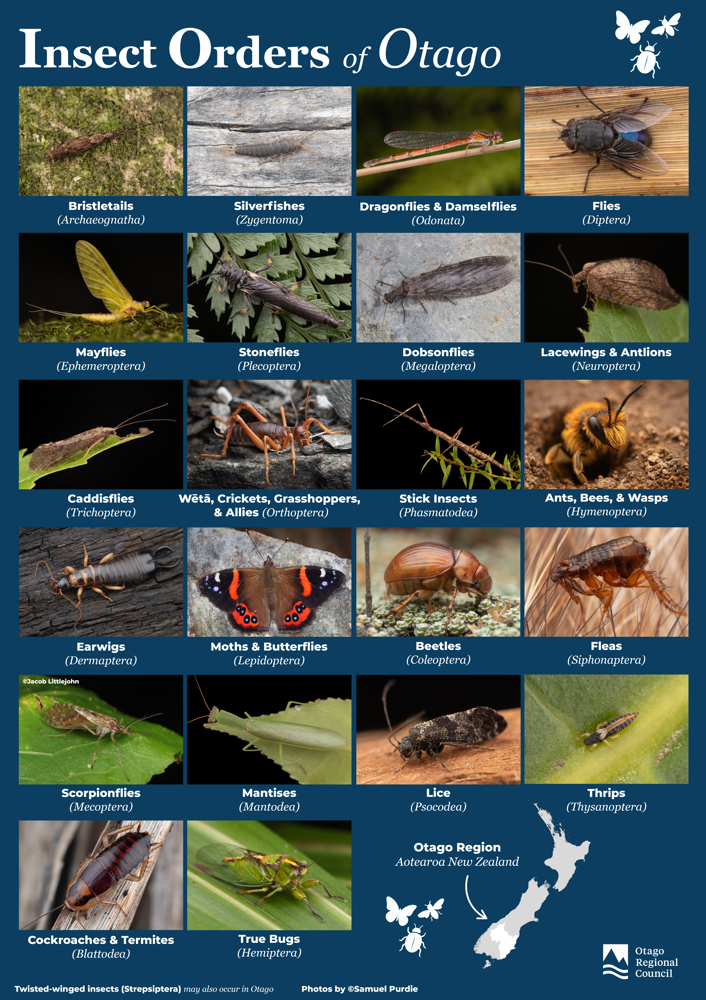
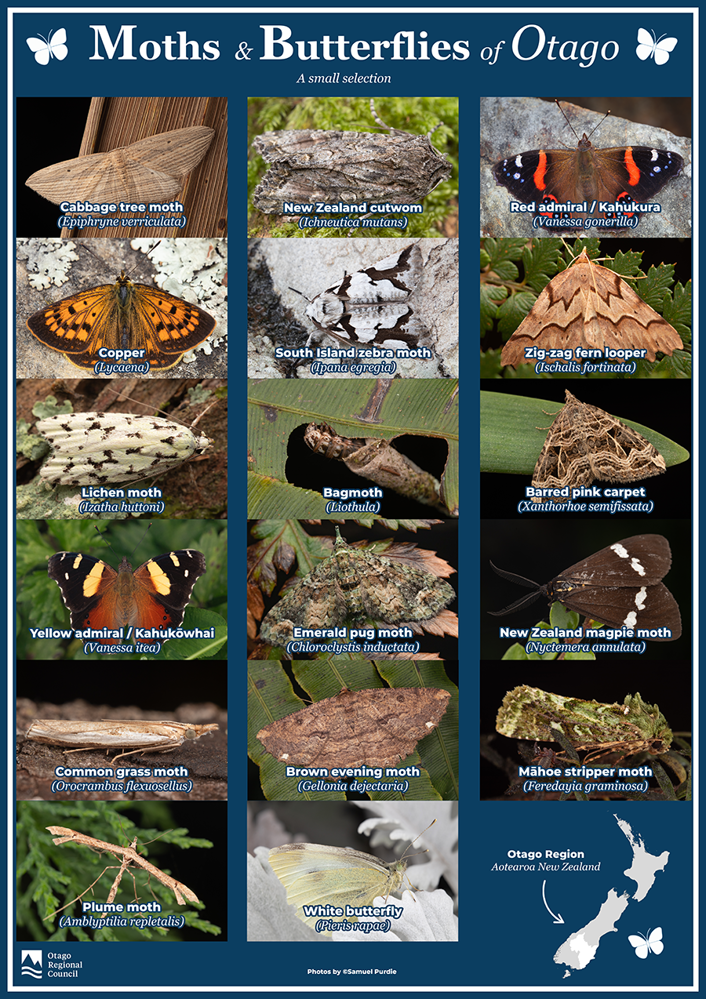


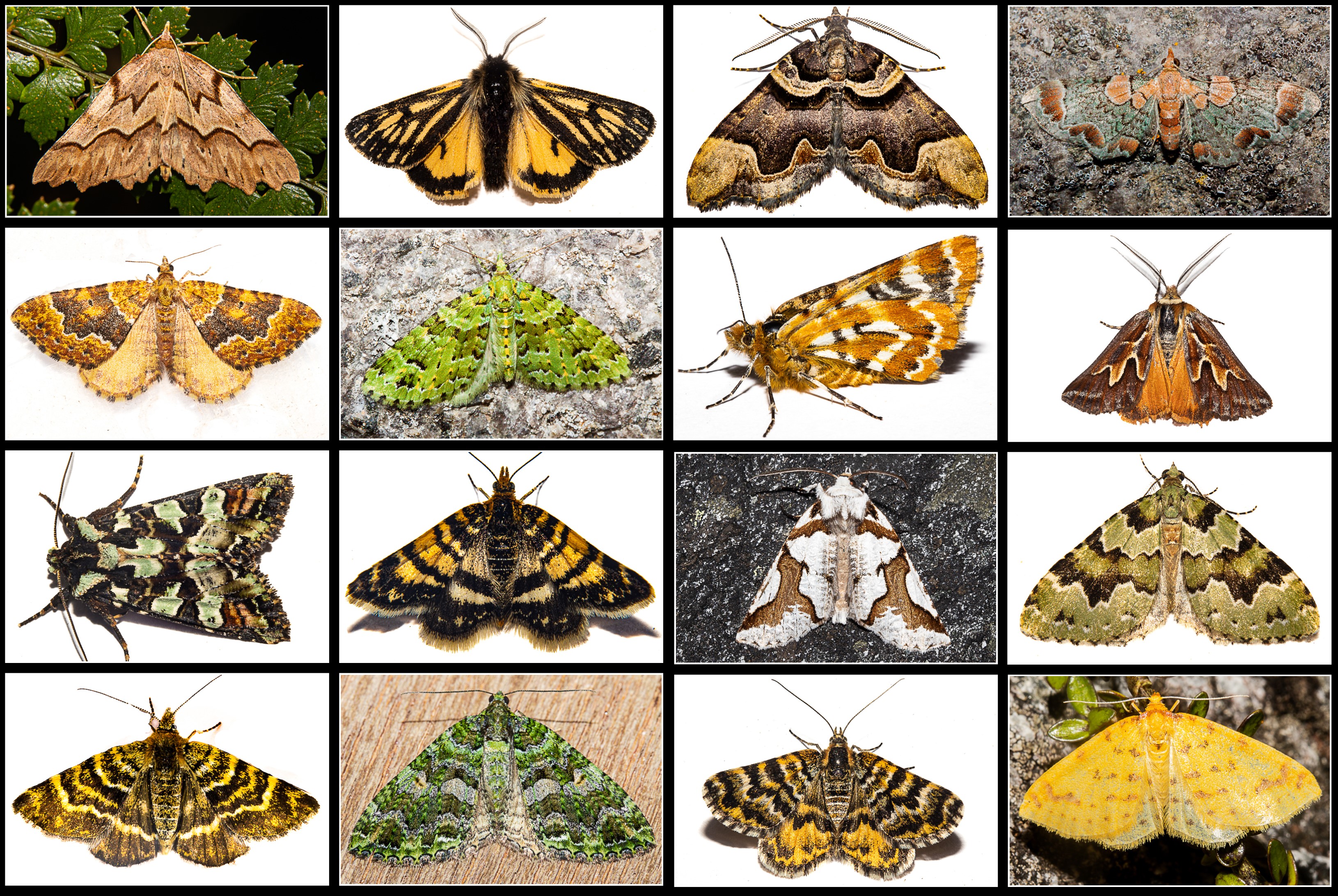
In Otago we have over 1100 species of butterflies and moths. A species list that was compiled by lepidopterist (a person who specialises in the study of butterflies and moths) Carey Knox can be downloaded below.
To find out about our regional endemic species in Otago, including those that are lepidopterans, see the link below. Our compiled list of regionally endemic Lepidoptera has over 40 species in Otago and others that are likely not found outside the Region

To find out more about butterflies and moths in Aotearoa New Zealand, visit the websites for Moths and Butterflies of New Zealand Trust | Pūrerehua Trust, Bioeconomy Science Institute – Butterflies and Moths, and Ahi Pepe | MothNet.
Have you spotted a butterfly or moth? Take a photo and upload your observation to iNaturalist, including the location and date, to help improve our knowledge of butterflies and moths in Aotearoa New Zealand.

Bioeconomy Science Institute – butterflies and moths
The Bioeconomy Science Institute has a website to allow anyone in Aotearoa New Zealand to identify the larger moths they may encounter anywhere in the country. With experience, it can be used to build up local lists of moths for reserves, restoration plots, gardens or any other area of interest.

Ahi Pepe | MothNet
Ahi Pepe MothNet is a participatory science project that aims to engage teachers, students and whānau with moths, and through moths with nature and science.

Moths and butterflies of New Zealand Trust | Pūrerehua Trust
The Moths and butterflies of New Zealand Trust | Pūrerehua Trust vision is to ensure that Aotearoa New Zealand's ecosystems support thriving moth and butterfly populations.

iNaturalist NZ – Mātaki Taiao
To contribute observation records on butterflies and moth to a participatory science platform, visit the iNaturalist platform. iNaturalist is an online-access participatory science project where you can record and share observations on plants, fungi, and animals, including Lepidoptera, contributing to scientific research and conservation efforts.
The Ahi Pepe MothNet project has developed Puka Whakamārama o Te Pepe Nui - Beginners’ Guides to the Macro-Moths that are freely available for download for personal and education purposes. Most of these guides are long-format booklets in either Te reo Māori or English that fold up and are designed for use by small children as well as adults in the outdoors.

PDF | 3 MB
The Puka Whakamārama o Te Pepe Nui - Beginners’ Guides to the Macro-Moths are freely available for download for personal and education purposes. More are available from Ahi Pepe | MothNet ahipepe.org This one is focused on the maco-moths of Otago.

December 2017
PDF | 3 MB
This guide covers the dry inland basins of the Central South Island (Whakatipu-Manuherekia); the Crosby areas of Central Otago (CO); Otago Lakes (OL) and the MacKenzie Basin (MK) [Te reo Māori]

December 2017
PDF | 4 MB
This guide covers the dry inland basins of the Central South Island (Whakatipu-Manuherekia); the Crosby areas of Central Otago (CO); Otago Lakes (OL) and the MacKenzie Basin (MK). [English]

December 2017
PDF | 3 MB
This guide covers the Southern South Island (Ōtākou-Murihiku) and Stewart Island; the Crosby areas of Southland (SL), Fiordland (FD) and Dunedin (DN) [Te reo Māori]

March 2016
PDF | 3 MB

December 2017
PDF | 3 MB
This guide covers the Southern South Island (Ōtākou-Murihiku) and Stewart Island; the Crosby areas of Southland (SL), Fiordland (FD) and Dunedin (DN) [English]


