
Stick insects
Did you know Otago has five species of stick insect?
Aotearoa New Zealand’s stick insects belong to the order Phasmatodea, comprising almost 3000 species worldwide, with most diversity around the tropics.
In Aotearoa New Zealand’s temperate climate, we have more than 20 described species of stick insect.
The name phasmatid (or, sometimes, phasmid) means phantom, a reference to the way stick insects tend to disappear into their surroundings.
An order is a taxonomic rank used in biological classification to group living and extinct organisms that share similar characteristics.
Taxonomy is the science of classifying living and extinct organisms by arranging them into natural, related groups based on shared characteristics. These groups are organised into different taxonomic ranks.
A genus (plural: genera) is a taxonomic rank below order. It groups living and extinct organisms that share similar characteristics. For example, Aotearoa New Zealand stick insects are all in the order Phasmatodea, and there are five genera: Acanthoxlya, Argosarchus, Clitarchus, Niveaphasma, and Tectarchus.
Parthenogenetically describes reproduction by parthenogenesis, a form of asexual reproduction where an unfertilised egg develops into a new individual without fertilisation by sperm.
Asexual reproduction is a mode of reproduction where a single parent produces offspring. The new individuals are genetically identical to each other (clones), which means the organism can reproduce without a mate.
Stick insects are surprisingly common in Aotearoa New Zealand and can be found from coastal vegetation to the high-alpine zone, although many species are poorly known because of their cryptic appearance and nocturnal habits.
All Aotearoa New Zealand species are flightless and completely lack wings. Elsewhere, some species have wings, though few can actually fly. In some species, just the males fly.
Aotearoa New Zealand’s longest insect species is Argosarchus horridus. It can reach an impressive 15 cm in body length but is dwarfed by stick insects found in some other countries. For example, Australia's longest species can reach 30 cm in body length, and there are some species in Asia that can exceed 35 cm in body length (with total lengths, including limbs, exceeding 55 cm).

Despite their size and sometimes fearsome appearance, none of our stick insects can inflict a painful bite or sting.
Stick insects have no ears and can’t make any sound, but they have reasonable eyesight, for they quite often leap away when you reach out to catch them.
The wings of some species mimic leaves, down to the pattern of veins. Other species have the bright colours and appearance of wasps.
Aotearoa New Zealand stick insects, like all phasmatids, are foliage feeders. Many of our stick insects have restricted food requirements, feeding on just a few plant species.
For instance, species in the genus Clitarchus rarely feed on anything other than mānuka and kānuka. In contrast, species in the genus Acanthoxyla consume the widest range of food plants of any local stick insects, not just native trees and shrubs either; they have been observed on introduced species like roses, cypress trees, and pines, as well as a host of native trees and shrubs.
Stick insects often wander away from food foliage to rest during the day, sometimes turning up on the walls of houses or outbuildings, where they are much more visible than on vegetation.


Reproduction varies between species. Acanthoxyla generally has no males so mostly reproduces parthenogenically, except for two males that have turned up in the United Kingdom (invasive populations from Aotearoa New Zealand) and an undescribed species with males in the Far North of Aotearoa New Zealand). Other genera, such as Clitarchus and Argosarchus, can reproduce with or without males. In some populations males have never been found, while in others, males are as common as females.
Generally only females hatch from eggs that haven’t been fertilised by a male. Yet other species can reproduce sexually only.
In most species the male is much smaller than the female. She needs a larger body in which to manufacture eggs and a larger mouth for feeding it.
Spotting stick insects is often a matter of training your brain and eyes to distinguish their shape.
Legs jutting out at unusual angles compared to twigs is often what gives them away.


Stick insects are not as common in Aotearoa New Zealand as previously.
They are subject to a multitude of predators. Introduced birds prey on them, including chaffinches and yellowhammers feeding stick insects to nestlings, and blackbirds, thrushes, silvereyes and house sparrows, all of which feed abundantly on insects, both on the ground and among the foliage of trees and bushes. Native birds like moreporks prey on them, too.
Then there are the numerous introduced mammalian predators—possums, rats, mice and mustelids (stoats, weasels, ferrets)—all of which devour insects.
Stick insects need all the camouflage they can muster!
In Otago, the total number of stick insects is five species. All these species are listed nationally in the New Zealand Threat Classification System, which was last updated for stick insects in 2014. The five species have the threat status nationally of Not Threatened.
None of these five stick insects are regional endemics to Otago. Being a regionally endemic species means they only naturally occur and breed in a Region.
To celebrate the insect orders and many of our stick insects found in Otago, we worked with biologist Samuel Purdie to produce posters.
Please feel free to share these posters around, and you can download and print them out to raise awareness about Otago’s insects, including stick insects.
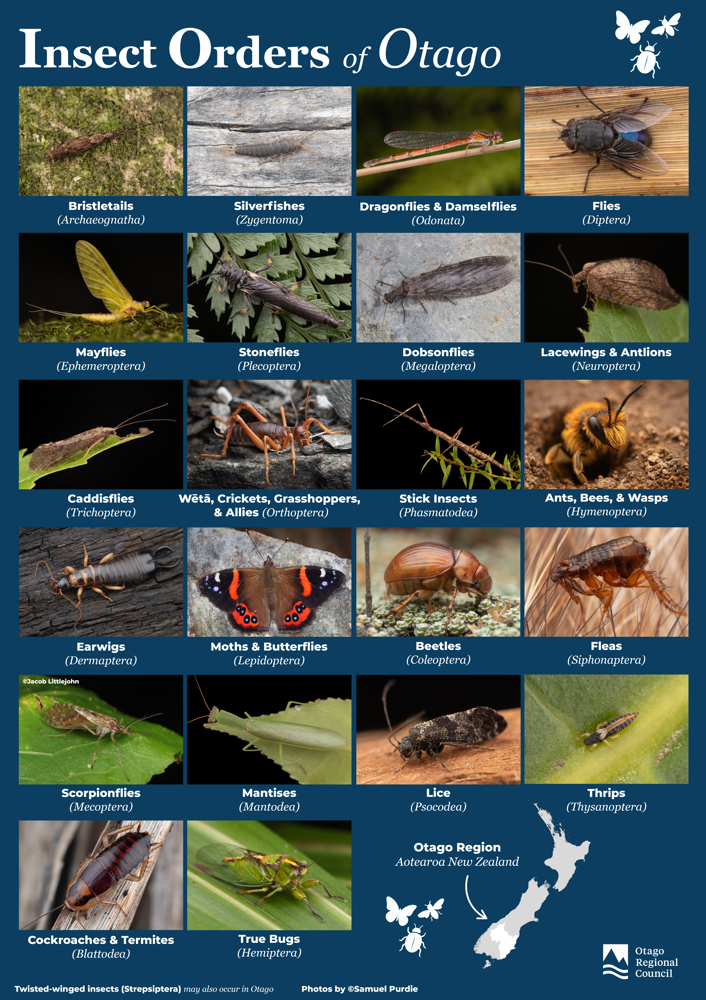


In Otago we have five species of stick insects. A species list can be downloaded below.
To find out more about other species in Otago, visit our Explore Otago’s species and Otago’s unique species websites.


To find out more about stick insects in Aotearoa New Zealand, visit the Manaaki Whenua Landcare Research, a subgroup of the Bioeconomy Science Institute, website or the Te Ara Encyclopaedia of New Zealand website.
Have you spotted a stick insect? Take a photo and upload your observation to iNaturalist, including the location and date, to help improve our knowledge of Aotearoa New Zealand’s stick insects.

Te Ara – The Encyclopedia of New Zealand: stick insects
Te Ara is an online encyclopaedia to the country’s peoples, natural environment, history, culture, economy, institutions and society. The webpage provides an overview on stick insects in Aotearoa New Zealand.

Manaaki Whenua Landcare Research: stick insects
This Manaaki Whenua Landcare Research webpage provides information an overview on stick insects in Aotearoa New Zealand.

iNaturalist – Mātaki Taiao
iNaturalist is an online-access participatory science project where you can record and share observations on plants, fungi, and animals, including stick insects, contributing to scientific research and conservation efforts.


