Media release

Otago communities cautioned to be aware of predicted ‘Significant El Niño’ event

Thursday 2 July 2026

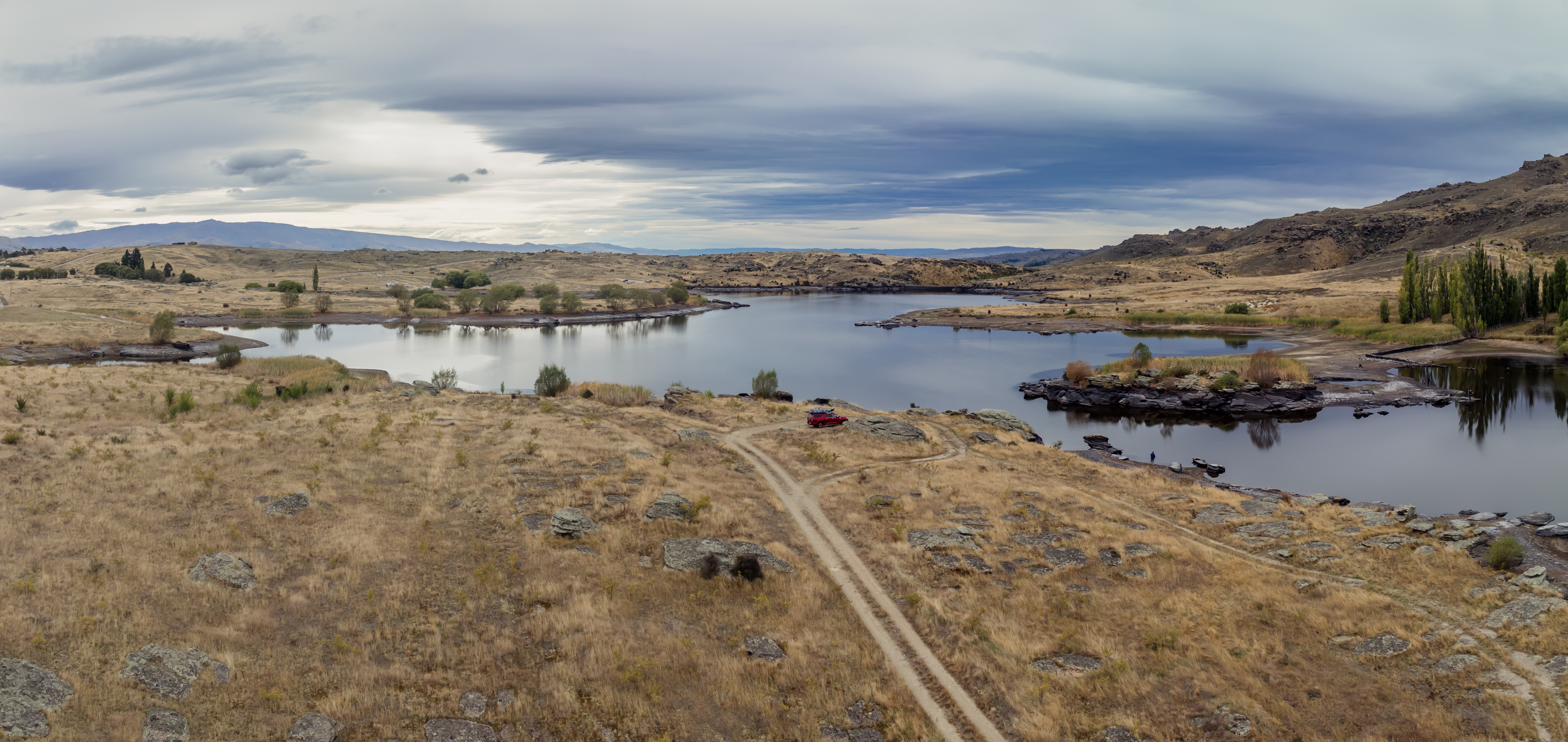
Dry Farmland And Butchers Creek Reservoir, Alexandra, Otago Adobestock 834453809

Otago communities – both rural and urban – are being encouraged to consider the effects of a predicted ‘Significant El Niño’ weather event in late-spring early-summer, which could exceed some of the strongest El Niño events on record for Otago.

ORC’s Principal Scientist, Jason Augspurger, says while every El Niño event is different, in Otago strong El Niño years tend to result in western areas near the Alps experiencing windier and wetter than average weather, whereas central and eastern Otago tend to experience hot, windy, and dry conditions, to the point of drought events.

There is the possibility of drought but also scattered heavy rainfall events for Otago, he says.

“These conditions are projected to persist through spring and intensify into summer,” Dr Augspurger says.

Earth Sciences New Zealand is predicting a ‘Significant El Niño’ weather system to develop later this year, which could be comparable to, or exceed, some of the strongest El Niño events on record.

Earlier strong El Niño events have occurred in 1972–73, 1982–83, 1997–98 and 2015–2016.

“While managing the conditions presented by El Niño isn’t a new challenge for Otago’s rural communities, every El Niño event is different; this year’s event could be the strongest in some time,” he says.

Updating preparations now, while the pressure is off, can mean easier decision making for communities later should any extreme conditions eventuate, he says.

Dr Augspurger says communities should consider being a bit more conservative with water use in the months ahead in case there are water supply shortages and keep an eye on long-range weather forecasts as we track toward the summer season.

“People should start refreshing their thinking about how they’d handle different water restriction scenarios if those were to eventuate at some point this summer, which could affect town and irrigation water supplies,” he says.

Both the heavy rainfall and drought events associated with El Niño years in Otago can have significant impacts on agriculture and households, he says.

For the rural sector, considerations should include grazing options, feed availability, back-up fuel, fixing leaky irrigation systems, stock plans for dry conditions on farms, and how potential water restrictions may impact farms and households.

For households and businesses, they can consider preparedness plans in case of adverse weather or drought conditions. Household preparedness for extreme weather events includes refreshing emergency supply kits containing food, water, torches, and a battery-powered radio.

People can monitor the developing conditions through Earth Sciences seasonal climate outlooks and drought forecasting dashboard (https://niwa.co.nz/climate-and-weather/seasonal-climate-outlookhttps://niwa.co.nz/climate-and-weather/seasonal-climate-outlook).

For farmers, there is guidance on preparing for previous El Niño events available from MPI (https://www.mpi.govt.nz/dmsdocument/9974-preparing-for-el-nino; see MPI fact sheet below).

Earlier this month Environment Southland said Earth Sciences New Zealand forecasting indicated dry to very dry conditions for Southland and Otago through mid to late June, then wetter than average conditions from July, especially in western areas.

“Wetter conditions can have significant impacts on agriculture and cause increased erosion and sediment runoff into waterways. Farmers are well aware of the challenges winter presents, but we’re asking them to be especially vigilant, given how quickly our weather can turn nowadays,” Environment Southland’s General Manager Strategy & Regulation, Hayley Fitchett, said.

As El Niño generally brings colder, wetter, and windier summers to Southland, there could also be increases in flood frequency and magnitude.
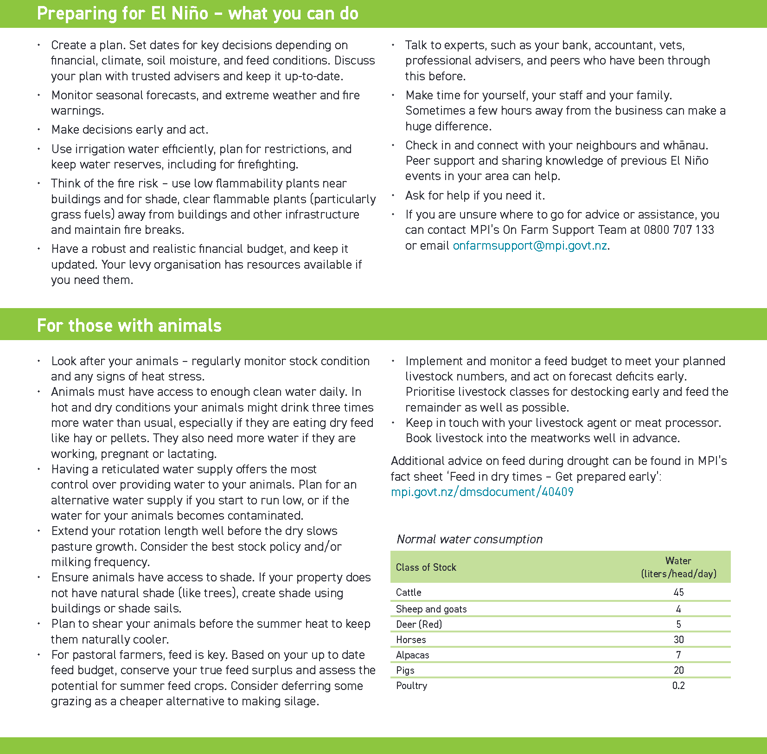
Preparing for El Niño – what you can do

  • Create a plan. Set dates for key decisions depending on financial, climate, soil moisture, and feed conditions. Discuss your plan with trusted advisers and keep it up-to-date.
  • Monitor seasonal forecasts, and extreme weather and fire warnings.
  • Make decisions early and act.
  • Use irrigation water efficiently, plan for restrictions, and keep water reserves, including for firefighting.
  • Think of the fire risk – use low flammability plants near buildings and for shade, clear flammable plants (particularly grass fuels) away from buildings and other infrastructure, and maintain fire breaks.
  • Have a robust and realistic financial budget, and keep it updated. Your levy organisation has resources available if you need them.
  • Talk to experts, such as your bank, accountant, vets, professional advisers, and peers who have been through this before.
  • Make time for yourself, your staff and your family. Sometimes a few hours away from the business can make a huge difference.
  • Check in and connect with your neighbours and whānau. Peer support and sharing knowledge of previous El Niño events in your area can help.
  • Ask for help if you need it.
  • If you are unsure where to go for advice or assistance, you can contact MPI’s On Farm Support Team at 0800 707 133 or email onfarmsupport@mpi.govt.nz.

For those with animals

  • Look after your animals – regularly monitor stock condition and any signs of heat stress.
  • Animals must have access to enough clean water daily. In hot and dry conditions your animals might drink three times more water than usual, especially if they are eating dry feed like hay or pellets. They also need more water if they are working, pregnant or lactating.
  • Having a reticulated water supply offers the most control over providing water to your animals. Plan for an alternative water supply if you start to run low, or if the water for your animals becomes contaminated.
  • Extend your rotation length well before the dry slows pasture growth. Consider the best stock policy and/or milking frequency.
  • Ensure animals have access to shade. If your property does not have natural shade (like trees), create shade using buildings or shade sails.
  • Plan to shear your animals before the summer heat to keep them naturally cooler.
  • For pastoral farmers, feed is key. Based on your up-to-date feed budget, conserve your true feed surplus and assess the potential for summer feed crops. Consider deferring some grazing as a cheaper alternative to making silage.
  • Implement and monitor a feed budget to meet your planned livestock numbers, and act on forecast deficits early. Prioritise livestock classes for destocking early and feed the remainder as well as possible.
  • Keep in touch with your livestock agent or meat processor. Book livestock into the meatworks well in advance.

Additional advice on feed during drought can be found in MPI’s fact sheet ‘Feed in dry times – Get prepared early’: https://www.mpi.govt.nz/dmsdocument/40409/direct

Class of Stock Water (litres/head/day)
Cattle 45
Sheep and goats 4
Deer (Red) 5
Horses 30
Alpacas 7
Pigs 20
Poultry 0.2
