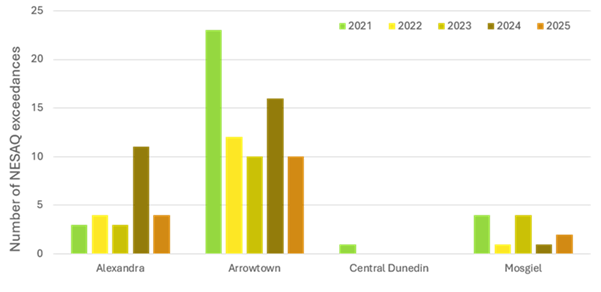
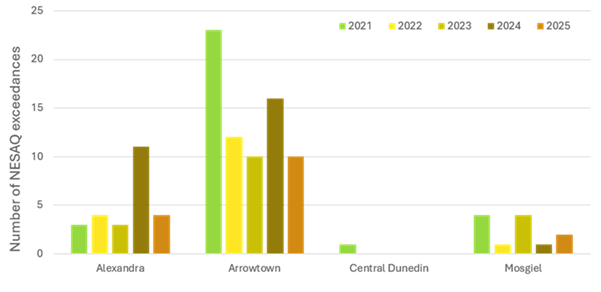
“The number of exceedances can vary considerably between years, with 2025 experiencing fewer days with inversion layers, which would have allowed air pollutants to disperse more easily,” Mr Dyer said.
ORC Air Quality Scientist, Sarah Harrison says previous trend reports indicate that over the long-term, air quality is slowly improving in most airsheds, but we have a way to go before the exceedances numbers get below healthy limits
Compared with previous years, the number of exceedances in 2025 is most similar to 2022 and 2023, showing there is no clear trend in these annual exceedance numbers.
“While some Otago towns still experience periods of poor winter air quality, reducing home heating emissions remains important because they are the main source of winter particulate pollution in many inland Otago communities.”
“The choices people make at home can have a real impact on the air their neighbours and families breathe.”
The report notes that particulate matter from home heating remains the primary air quality issue in Otago, particularly during colder winter conditions when smoke can become trapped close to the ground. Long-term exposure to particulate pollution has been linked to respiratory and cardiovascular disease.
ORC’s Burn Dry Breathe Easy campaign continues to promote responsible wood burning practices, including burning only dry, untreated wood, ensuring fires have enough airflow, and regularly maintaining burners and chimneys.
“Small changes at home can make a meaningful difference to local air quality,” Ms Harrison said.
“Burning dry wood produces less smoke, creates more heat and helps reduce harmful pollution during winter.”
The report also highlighted ongoing investment in expanding and upgrading ORC’s air quality monitoring network to build a more complete picture of air quality across the region.
During 2025, monitoring of particulate matter (PM10) was undertaken at four sites across Otago, while PM2.5 monitoring operated at eight locations (Arrowtown, Wānaka, Queenstown, Cromwell, Clyde, Milton, Central Dunedin and Mosgiel).
ORC also deployed a new mobile air quality monitoring trailer to Albert Town and Hāwea during winter 2025, helping scientists better understand pollution patterns in fast-growing communities and areas without permanent monitoring sites.
“This additional monitoring helps us better understand where air quality pressures exist now and where they may emerge in the future,” Ms Harrison said.
“It means we can make better informed decisions and continue working with communities to improve air quality outcomes across Otago.”
The monitoring site in Milton is being upgraded soon to monitor PM10 which means the community will be able to check their local air quality results compared to national limits on LAWA.
Further to this, one of ORC’s mobile air quality monitoring trailers has recently been deployed to Balclutha with the other scheduled to be set up in Ōamaru next week to collect more information on the patterns and movement of air pollution across these two towns.
This expanded monitoring work complements ORC’s wider community air quality education initiatives including a partnership with The Air Quality Collective.
This year, ORC enlisted the help of Dr Ian Longley at The Air Quality Collective to help build a clearer picture of air quality in parts of Otago where less monitoring information currently exists.
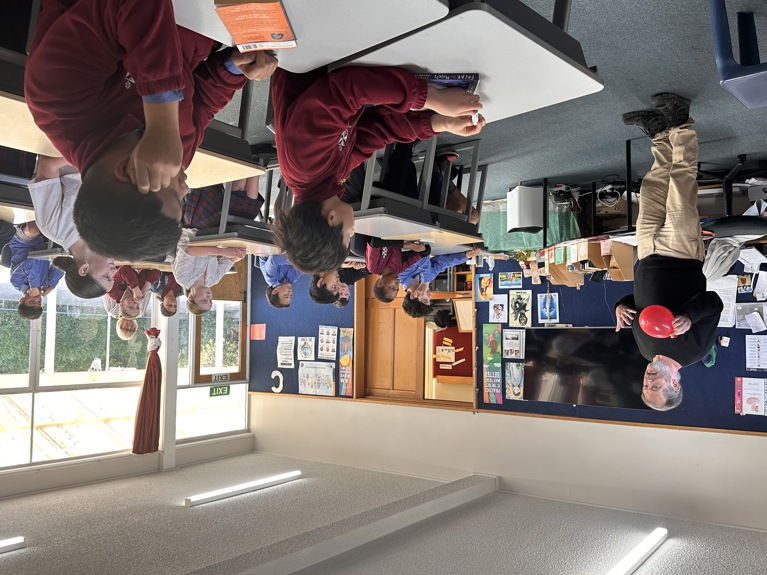
Three Otago schools have been invited to take part in a community science project running in Ōamaru, Wānaka and Hāwea this winter with The Air Quality Collective.
The project will work alongside local schools to investigate how air pollution moves through neighbourhoods and into homes, while helping students and communities better understand their local environment.