-
-
-
-
-
-
-
-
-
-
-
-
-
-
-
Annual plan 2026
-
-
-
-
-
-
-
-
-
-
-
-
-
-
-
-
-
The Annual Plan outlines our budget, funding impacts, and any changes to the projects and funding from the Long-Term Plan.
Something all Otago residents probably agree on is that we want a thriving, prosperous and well-managed region, with strong environmental safeguards.
This is a priority for Otago Regional Council, and councillors are focused on doing this in the most cost-effective ways possible.
Councillors know people are concerned about the cost of their rates. We’ve worked hard to find efficiencies to deliver an overall zero percent rates increase for the year ahead while still delivering important work for Otago.
Exactly what rates look like for individual properties varies depending on location and the services provided, but the overall zero increase is well down on the 8.7% increase that was forecast during the Long-Term Plan.
While reducing costs, there is still plenty of important work to protect the environment and provide public transport services for Otago. We are confident we can deliver for our people and our environment within
the zero budget increase proposed.
You may be aware that the government is proposing significant reform that could see disestablishment of regional councils. If these changes go ahead, the earliest they will take effect from will be around three years from now.
We’ll continue to work hard for Otago, including providing public transport, river management, flood and drainage schemes; monitoring Otago’s air, land, waterways and natural hazards; compliance monitoring and enforcement; harbourmaster functions; and emergency management response.
We aim to show that whatever governance the future brings to Otago, we will hand over our role in the best of heart, supported by a great staff willing to give their all for any new arrangements that come our way.
Hilary Calvert,
ORC Chairperson
As no significant changes have been made to what was consulted on in the Long-Term Plan for the 2026/27 year, Councillors chose not to go to the expense of formally consulting with the community on this annual plan. The Annual Plan was adopted by Council on 29 April 2026. Council will now turn our focus to the next 10-year plan and how we can hear from the community on this.
Providing the same services for less cost was the goal in planning for the year ahead — part of the Annual Plan 2026 process at Otago Regional Council.
During the Annual Plan process, councillors reviewed planned work and costs, balancing this with the need to reduce the rating impact, while still delivering for communities and the environment.
An overall zero percent rates increase has been achieved, and the total amount collected from rates doesn’t change from 2025. However, the rates for each property vary and may have changed from last year.
Overall, general rates (a set amount for each property) are reducing by 3.5%, but some properties will see increases for targeted rates for specific locations or services.
Factors helping to reduce rates include cost savings and efficiencies in work programmes, extended time frames for some work and finding alternative revenue sources.
The directive from government to pause planning work meant ORC spent less than budgeted in 2025, and this money will instead be used for work in 2026–27.
Properties in Queenstown will see an increase in the targeted public transport rate — reflecting the cost of improved services.
In Queenstown, where there were significant improvements to public transport services, this means an overall 23.1% increase for the targeted transport rate.
In Dunedin, where public transport improvements were minor, the transport rate will drop 3.9% overall.
Overall, targeted rates for catchment management will increase by 6.5% due to reduced government funding.
The Harbourmaster rate will also increase due to inflation and increased costs for fuel and insurance.
The rates you pay help this council’s work to protect Otago’s natural resources — water, land and air — on behalf of the community. That includes flood protection, natural hazard adaptation, public transport, compliance and a regional response to natural disasters.
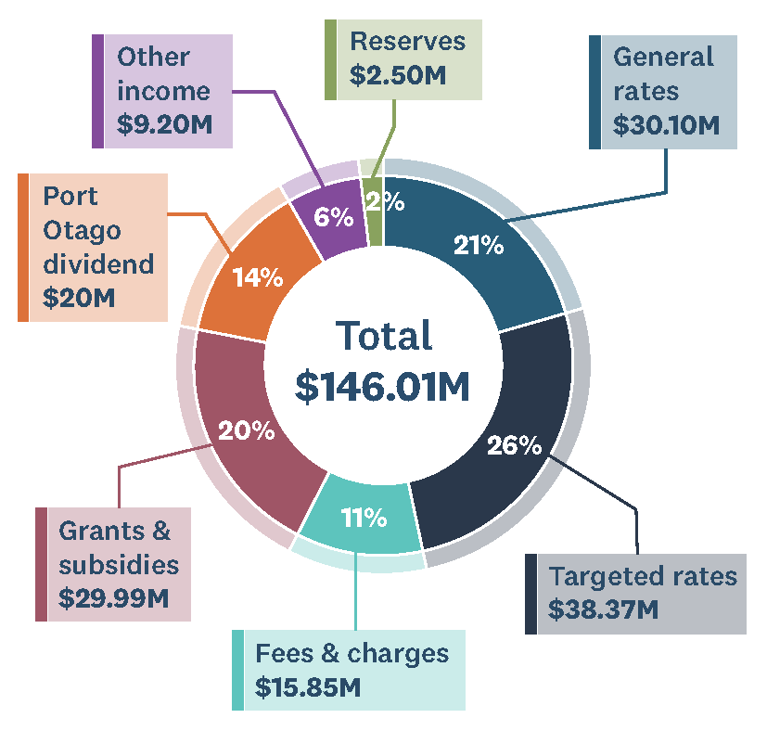
Less than half of ORC’s funding comes from rates — the rest is from fees and charges, grants, reserves, dividends from Port Otago and investment income.
What affects your rates
- General rates — 3.5% overall decrease
- Unspent funds from 2025 to fund some work in 2026
- Efficiencies to reduce costs
- Reduced scale of public transport upgrade in Dunedin
- Changes in timing for work programmes
- Queenstown public transport improvements (targeted rate for Queenstown)
- Inflation, increased cost of insurance and property
- Catchment management rate (targeted district rate)
- Navigational safety costs (targeted district rate)
Otago’s buses are busier than ever — passenger numbers have increased 52% in the last five years.
Public transport services help people to get around Queenstown and Dunedin — with nearly 5.5 million trips taken on our buses last year, over 70,000 trips on the Queenstown ferry service, and more than 140,000 Total Mobility journeys.
Significant public transport improvements in Queenstown are ongoing, including a number of changes last year that saw the number of bus trips in Queenstown increase by close to 100,000 a year.
Improvements include a new Arrowtown to Jack’s Point route, increased frequency of services on other routes and expanded ferry services.
Bus use in Queenstown continues to reach record numbers — around 2 million trips in 2025. The recently updated routes added capacity where it’s needed and have improved travel for passengers.
By the end of 2026, 80% of Dunedin trips will be on zero-emission electric buses, with route and timetable changes already improving service reliability and connections to South Dunedin.
Public transport services provide an important way for people to get around and help the environment by reducing congestion and carbon emissions.
Improved services in Queenstown have been partly funded by central government, but there is also a need to increase the targeted public transport rate for Queenstown properties due to the increased costs. This will see the targeted public transport rate increase for Queenstown properties.
Many communities in Otago are exposed to natural hazards, such as earthquakes, floods and landslides.
Assessing, mitigating and responding to natural hazards is a big piece of work in Otago. We work with communities to make people more aware of natural hazards, so they can reduce the level of risk they face.
This year ORC will assess the flood hazard for Alexandra, Lindsay Creek and Middlemarch (Dunedin); investigate resilience work for the Kaikorai Stream at Green Island; and install river mouth monitoring technology in key areas.
A significant Otago 3D-mapping programme is underway to provide important information for natural hazard assessments and possible mitigations and response. This involves ground-level mapping using LiDAR technology to provide detailed information that can be used in hazard analysis.
Work with communities on natural hazard adaptation programmes will continue for the Clutha Delta, Head of Lake Whakatipu and South Dunedin, and investigation of natural hazard management in Roxburgh is underway.
As well as building awareness of natural hazard risk, ORC manages flood infrastructure to protect people and property. ORC flood protection and drainage schemes are in place to protect around 43,000 hectares of Otago.
Alongside this, river and lake levels are monitored, this includes a flood warning system to alert people to potential flooding.
Warning systems are also in place for civil defence emergencies, and ORC staff are trained to respond to emergency events, such as earthquakes or flooding, when needed.
Find out more about natural hazards in Otago: orc.govt.nz/OtagoNaturalHazards


ORC fees and charges
Council schedule of fees and charges from 1 July 2026 has been set through the annual plan.

Long-Term Plan (LTP)
The Otago Regional Council "Long-Term Plan" (LTP) is prepared in consultation with our community. The LTP sets out what we plan to deliver across a three-year planning cycle. The LTP also looks out, in less detail, 10 years.

No annual plan for 2024-2025 period, please see Long-Term Plan for 2024-34.

June 2023
ISBN 978-0-908324-86-6
PDF | 1 MB
This Annual Plan 2023-2024 (AP) reflects the results of a process that has decided required adjustments to the adopted Otago Regional Council Long-term Plan 2021-31 (LTP).
July 2022
ISBN: 978-0-908324-81-1
PDF | 21 MB
This Annual Plan 2022-2023 (AP) reflects the results of a process that decides what adjustments, if any, are required to the adopted Otago Regional Council Long-term Plan 2021-31 (LTP).
No annual plan for 2021-2022 period, please see Long-Term Plan for 2021-31.
June 2020
PDF | 2 MB
July 2019
PDF | 2 MB
July 2017
PDF | 9 MB
This Annual Plan concentrates on the 2017/18 year. Details of what we want to do and estimates of cost have been provided. Where specific changes have been made from the Long Term Plan, explanations are provided at the start of each of the activity groups of this plan.
June 2016
PDF | 5 MB
This Annual Plan concentrates on the 2016/17 year. Details of what we want to do and estimates of cost have been provided. Where specific changes have been made from the Long Term Plan, explanations are provided at the start of each of the activity groups of this plan.


