Developing the Plan
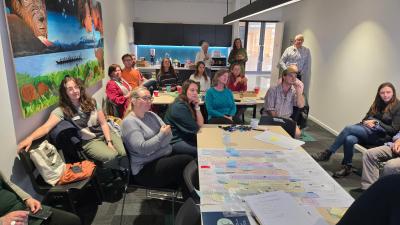
We came together in workshops to shape a shared mission and craft a vision story that reflects our hopes for the Upper Lakes.
Along the way, we identified the environmental values that matter most to us — and everything held within them, from native species and mahika kai to treasured water bodies and resources.
Our vision captures what we care about and what we are working towards together.


Our group established sets of cultural, community, and environmental values to guide planning, goal setting, and long-term outcomes. Reciprocity between people and nature underpins this work: environmental health sustains wellbeing and livelihoods, while cultural values guide how ecosystems are protected, restored, and strengthened for a thriving future.
The environmental, cultural, and community values identified by the Upper Lakes ICG alongside pre-existing community plans. These shared values form the foundation of the CAP goals and actions, ensuring they are grounded in what matters most to the community represented by the ICG.
| Value | Category | Detail |
|---|---|---|
 Mahika kai |
Cultural and community value | Waterbodies, wetlands, and forests sustain traditional food gathering and the cultural practices of mana whenua, maintaining strong connections between people and land. |
 Recreation |
Cultural and community value | Diverse ecosystems provide opportunities for fishing, hunting, hiking, swimming, skiing, and relaxation - enhancing quality of life. |
 Braided rivers |
Natural environment value | Defining rivers with shifting gravel beds, important for mahika kai and taoka birds like dotterels, terns, and wrybill, as well as native fish. |
 Aquifers & groundwater |
Natural environment value | Underground water systems essential for drinking water, farming, biodiversity, and reflecting overall landscape health. |
 Rivers and riparian |
Natural environment value | Rivers and streams vital for travel, mahika kai, and mauri. Healthy riparian zones stabilise banks, filter runoff, and provide habitat for whio, galaxiids, and aquatic insects. |
 Sustainable agriculture |
Cultural and community value | Clean water, healthy soils, and native vegetation underpin farming systems that can balance food production whilst supporting biodiversity. |
 Smaller lakes |
Natural environment value | Through to and alpine tarns support diverse ecosystems, mahika kai, and birdlife. Their health is closely tied to land use and catchment mauri. |
 Wetlands |
Natural environment value | Diminished but vital swamps, bogs, and marshes that regulate water, cycle nutrients, and support native vegetation, fish, birds, invertebrates, and cultural connections. |
 Deepwater lakes |
Natural environment value | Iconic deep lakes with clear water, cultural importance, and habitats for native birds. Historically rich in mahika kai, now valued for recreation but facing water quality trend declines and knowledge gaps. |
 Visitors and tourism |
Cultural and community value | Pristine lakes, forests, and scenery attract visitors who boost the economy and can participate in conservation. |
 Scenic landscapes |
Cultural and community value | Mountains, lakes, rivers, and native vegetation hold deep cultural and spiritual meaning while offering iconic beauty. |
 Taoka Species |
Cultural and community value | All native species are taoka (treasures) for Kāi Tahu. Protecting them maintains cultural identity, biodiversity, and environmental health. |
 Alpine and subalpine |
Natural environment value | Mauka (mountain peaks) with specialised plants and wildlife. Snow and ice feed rivers and lakes, sustaining ecosystems, farms, and people. These are ancestral mountains of Kāi Tahu. |
 Tussock grassland |
Natural environment value | Extensive tussock grasslands capture and slowly release water, supporting downstream systems and diverse wildlife like skinks, moths, pipit, and kārearea. |
 Shrubland and woodland |
Natural environment value | Hardy native shrubs and trees stabilise slopes, restore vegetation, and provide mahika kai and habitat for birds, insects, and skinks. |
 Productive land |
Developed environment value | Farming, vineyards, and orchards central to community identity, intersecting with remnants of native ecosystems and novel habitats for birds and skinks. |
 Urban spaces |
Developed environment value | Fast-growing towns that strongly influence freshwater quality and biodiversity. When well-designed, they connect people with nature and support regeneration. |
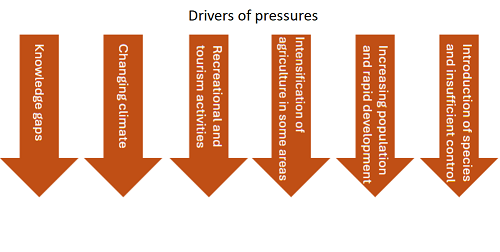
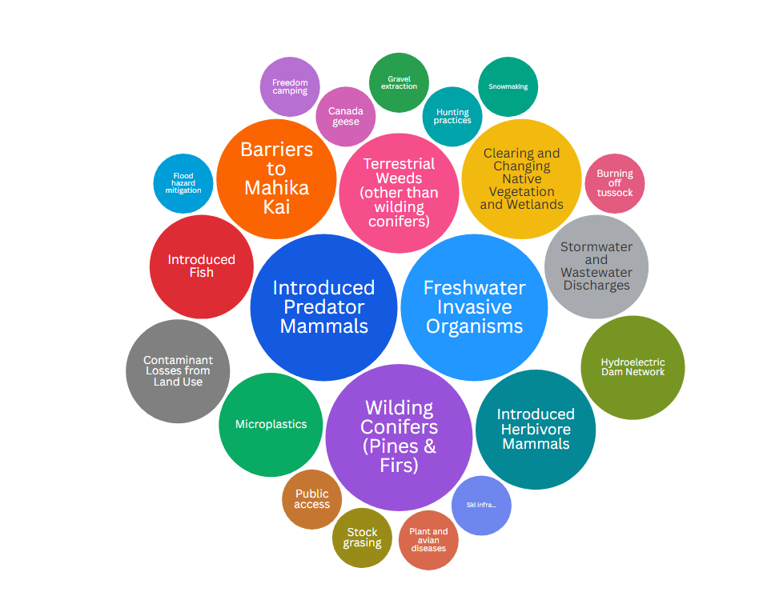
Our group identified the main "pressures" and "drivers" that affect the health of environmental values in the Upper Lakes CAP area. A pressure is a human activity currently happening in the catchment negativley impacts the environment. Drivers are the broader factors that influence why a pressure happens.
We looked at each pressure using three measures:
- Scope: How much of the environmental value is affected?
- Severity: How much damage does it cause?
- Irreversibility: Can we reduce or stop the pressure? How difficult would that be?
The bubble diagram below shows the analysis - the bigger the bubble, the bigger the pressure. The arrows show which drivers contribute to each pressure.
| Pressure rating | Pressure reduction objective | |
| Freshwater Invasive Organisms | Very high | Reduce the risk of new freshwater invasive organisms establishing Contain and remove lagarosiphon |
| Introduced Predator Mammals | Very high | Reduce introduced predator mammal populations (stoats, ferrets, weasels, rats, possums, hedgehogs and feral cats) |
| Wilding Conifers (Pines & Firs) | Very high | Reduce wilding conifer seed sources, infestations and re-infestations |
| Barriers to Mahika Kai | High | Reduce barriers to mahika kai |
| Clearing and Changing Native Vegetation and Wetlands | High | Avoid clearing and change to native vegetation Avoid clearing, draining or filling of wetlands |
| Introduced Herbivore Mammals | High | Reduce introduced herbivore populations (goats, pigs, rabbits, hares, possums) |
| Terrestrial Weeds (other than wilding conifers) | High | Reduce terrestrial weeds (gorse, broom, willows, sycamores, lupins, yellow flag iris, buddleia, cotoneaster) |
| Contaminant Losses from Land Use | Medium | Reduce contaminants - sediments, nutrients, pathogens – from land use entering freshwater |
| Hydroelectric Dam Network | Medium | Assist tuna kuwharuwharu (longfin eel) migration and kanakana (lamprey) migration |
| Introduced Fish | Medium | Reduce introduced fish interactions with non-migratory galaxiids |
| Microplastics | Medium | Reduce contaminants - sediments, nutrients, pathogens, microplastics - in stormwater |
| Stormwater and Wastewater Discharges | Medium | Reduce contaminants - sediments, nutrients, pathogens, microplastics - in stormwater Avoid wastewater discharge to freshwater |
| Burning off tussock | Low | |
| Canada geese | Low | |
| Flood hazard mitigation | Low | |
| Freedom camping | Low | |
| Gravel extraction | Low | |
| Hunting practices | Low | |
| Plant and avian diseases | Low | |
| Public access | Low | |
| Ski infrastructure | Low | |
| Snowmaking | Low | |
| Stock grazing | Low |
We explored the pressures facing our catchments. By linking broad drivers to the impacts we see on the ground, we created a shared picture of the challenges.
Together, we built a situation model that brought all of these pressures into focus, helping us see how they connect and where they matter most.
We then prioritised the pressures by their scope, severity, and irreversibility, setting the stage for action.

Upper Lakes Catchment Action Plan
The Upper Lakes Integrated Catchment Group has been supported by the Otago Regional Council to create a Catchment Action Plan for the Upper Lakes area. The Group will shortly be putting their plan into action.

Story map of the plan
How we made our plan, and how you can get involved.

Plan development
We came together in workshops to shape a shared mission and craft a vision story that reflects our hopes for the Upper Lakes.

Goals & Objectives
Environmental health goals show us what we are aiming for and highlight what we need to achieve to get there.

Strategies
Delivery of actions will not rest with our group alone; a shared responsibility and resourcing model reflects the collective impact approach at the heart of the CAP, where success depends on many hands working together.


