
Birds of Otago
Did you know over 280 different species of bird have been identified in Otago? Most are native to Aotearoa New Zealand, but only one breeds exclusively in Otago and nowhere else.
Aotearoa New Zealand is world famous for its unique birdlife.
The terrestrial vertebrate fauna of Aotearoa New Zealand was, and remains, dominated by birds.
Although birds are a species-rich lineage, with over 11,000 species globally, in most places overseas birds are not the terrestrial dominant vertebrate group.
In the national Checklist of Birds in Aotearoa New Zealand that was updated in 2024, a total of 490 living or recently extinct species or subspecies are listed (432 if including species only).
In Aotearoa New Zealand, birds have become an important part our nationhood.
We are the only nation where the people are colloquially known by a bird name – 'kiwi'.
Our country has many highly distinct lineages, including a giant nocturnal parrot (kākāpō), the flightless moa, and the kiwi.
A characteristic feature of our bird species are their taxonomic – the science of classifying living organisms – and ecological uniqueness, attributed to our prolonged geographical isolation and/or ancient Gondwanaland heritage.
Our birds are often associated with striking biological innovation in traits, including flight, song, colouration, and beak morphology (i.e., form and structure).
Compared to other similar-sized landmasses, there are relatively few species of land (non-aquatic) birds in Aotearoa New Zealand, most of which are found nowhere else.
On the other hand, Aotearoa New Zealand is considered the seabird capital of the world, with remarkable and unique seabirds. More than a third of the 80 or so species of seabirds that breed in Aotearoa New Zealand do not breed elsewhere.
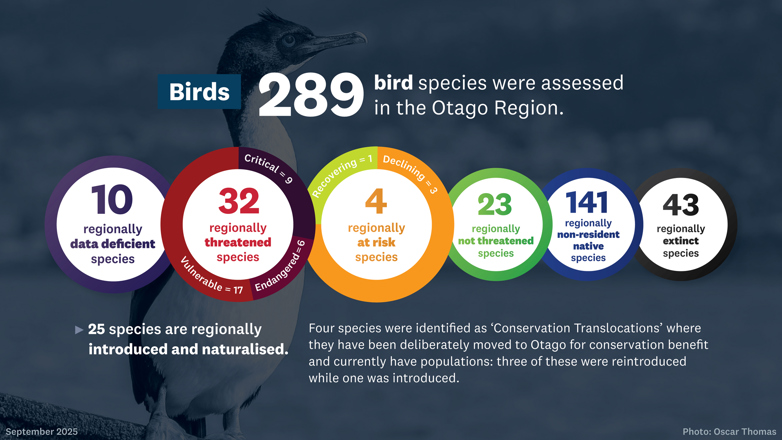
A total of 289 (as of June 2026) bird species have been identified in the Otago Region. This is one of the highest numbers of bird species for any region across the motu (country).
Otago has one species endemic to the Region, the Otago shag/matapo. This species only currently breeds in our Region but can be seen outside of Otago.


We are a national stronghold for eight bird species (including the Otago shag), meaning more than 20% of the national population is here in the Region. They include migratory shorebirds and domestic migrants, emphasising the region's critical role in preserving these species. These eight bird species are:
- Eudyptula novaehollandiae — Australian little penguin / kororā
- Falco novaeseelandiae novaeseelandiae — eastern falcon / kārearea
- Haematopus finschi — South Island pied oystercatcher / tōrea
- Larus novaehollandiae scopulinus — red-billed gull / tarāpunga
- Leucocarbo chalconotus — Otago shag / matapo
- Mohoua ochrocephala — mohua / yellowhead
- Podiceps cristatus australis — Australasian crested grebe / pūteketeke
- Xenicus gilviventris rineyi — southern rock wren / pīwauwau


Interactive map
Our interactive map will help you find factsheets on the birds in the Otago Region that are Regionally Threatened, Regionally At Risk, Regional Migrants or Regional Conservation Translocations. Click on each area in the map to see the PDF documents of species that might found in that area.
All completed factsheets can be downloaded further down this page.
Please be patient, this map will only take a moment more to load.
Like in other regions in Aotearoa New Zealand, there are relatively few species of land (non-aquatic) birds in Otago. Among the living examples include kea, kākā, kākāriki, southern rock wren/pīwauwau, South Island robin/kakaruai, mohua/yellowhead, brown creeper/pipipi, shining cuckoo/pīpīwharauroa, and South Island riflemen/tītitipounamu.


Many our bird species live around our wetlands and rivers. For example, an unusually high proportion of Aotearoa New Zealand’s native birds are wetland species – 30%, compared with less than 7% worldwide. In Otago wetland birds include the Australasian crested grebe/pūteketeke, Australasian bittern/matuku-hūrepo, royal spoonbill/kōtuku ngutupapa, paradise shelduck/pūtakitaki, marsh crake/kotoreke, as well as New Zealand kingfisher/kōtare and fernbird/mātātā at wetland margins.
Our riverine birds include those found on braided rivers, such as black-billed gull/tarāpuka, black-fronted tern/tarapirohe, and wrybill/ngutu pare. One of the few waterfowl worldwide that live year-round on fast-flowing rivers is the blue duck/ko whio who, an iconic back-country species now found in the forested upper catchments of rivers.


Seabirds are birds that obtain all or nearly all of their food at sea.
With a greater diversity of seabirds than anywhere else, Aotearoa New Zealand can rightfully claim to be the world's seabird capital.
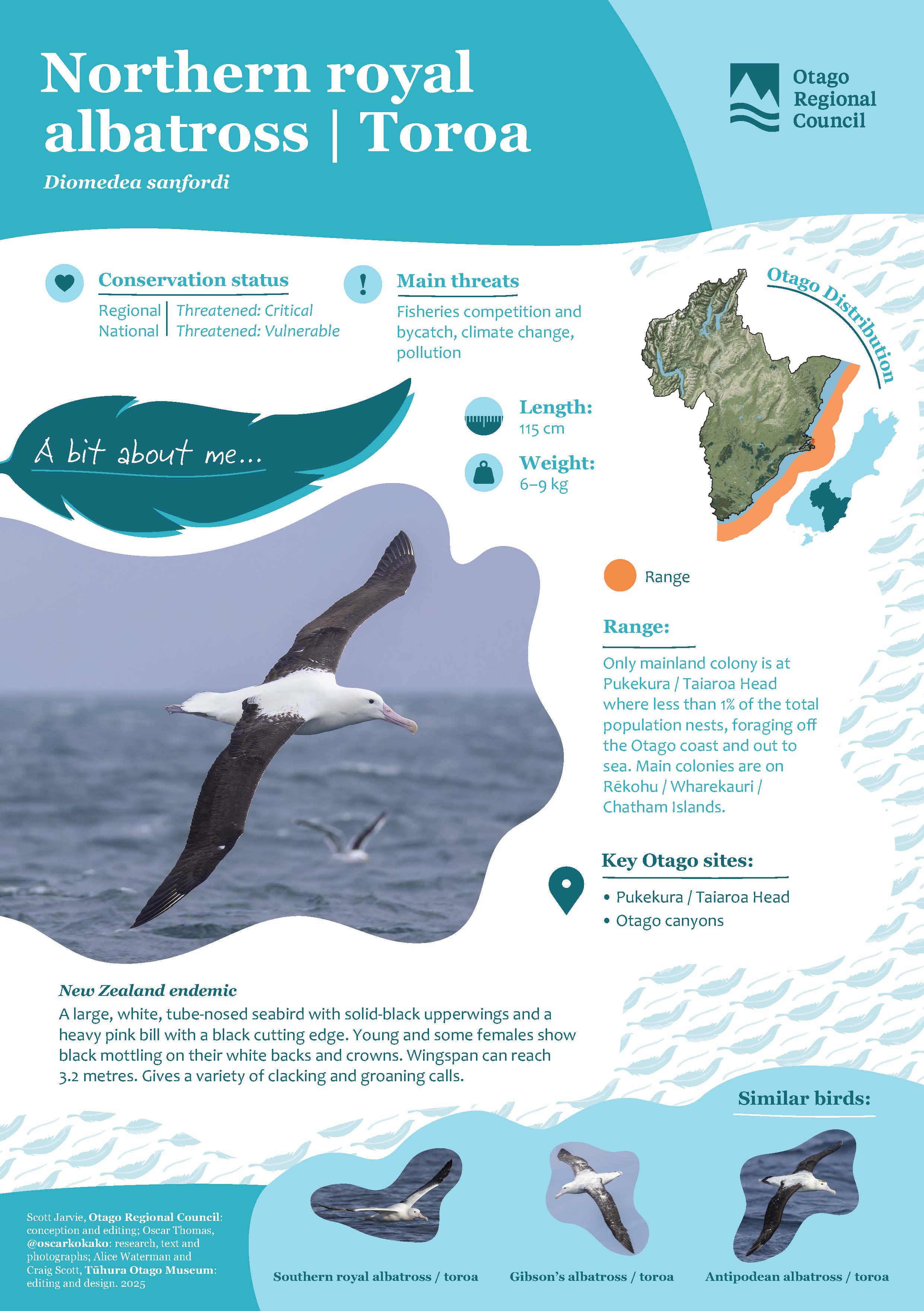
Our seabirds that breed in the Otago include yellow-eyed penguin/hoiho, Australian little penguin/kororā, northern royal albatross/toroa, Otago shag/matapo, sooty shearwater/tītī and fairy prion/tītī wainui. Most seabird species by number, however, do not breed in the Region and are seen in out at sea.


Shorebirds are those birds primarily using our coastal beaches.
These include variable oystercatcher/tōrea pango, South Island pied oystercatcher/tōrea, gulls, eastern bar-tailed godwit kūaka, whitefronted tern/tara, Caspian tern/taranui, and pied shag/kāruhiruhi. Birds in this group can be more likely seen than seabirds.
Migrant waders in particular – especially the rarer species and the vagrants that visit Aotearoa New Zealand including Otago – attract a great deal of interest from bird enthusiasts.
‘Wader spotting’ has become an increasingly popular pastime, despite the difficulties of identification and the often-remote regions these migrant’s favour.


Conservation translocations – the intentional movement and release of organisms to restore populations – have been used to try to establish populations in Otago. These translocations have included reintroduction, the re-establishment of focal taxon within their indigenous range, including for taxa species have gone locally extinct in parts of the Region, such as the South Island kākā and South Island robin/kakaruai released at Orokonui Ecosanctuary – Te Korowai o Mihiwaka in 2008 and 2010, respectively.
South Island saddleback/tieke were reintroduced to Orokonui Ecosanctuary in 2009 and reinforced in 2013 with early signs of establishment appearing promising; however, they disappeared once stoats in 2015. In early 2025, ~100 tieke were translocated to Orokonui Ecosanctuary.
For reintroductions where taxon went extinct in the region, this has also occurred: for example, buff weka/weka translocations started in the 2000s to islands in Lakes Wānaka and Wakatipu / Whakatipu Waimāori, plus some mainland sites, and South Island takahē to the Greenstone Valley and Rees Valley as a promising wild site more recently, plus advocacy birds at Orokonui Ecosanctuary.
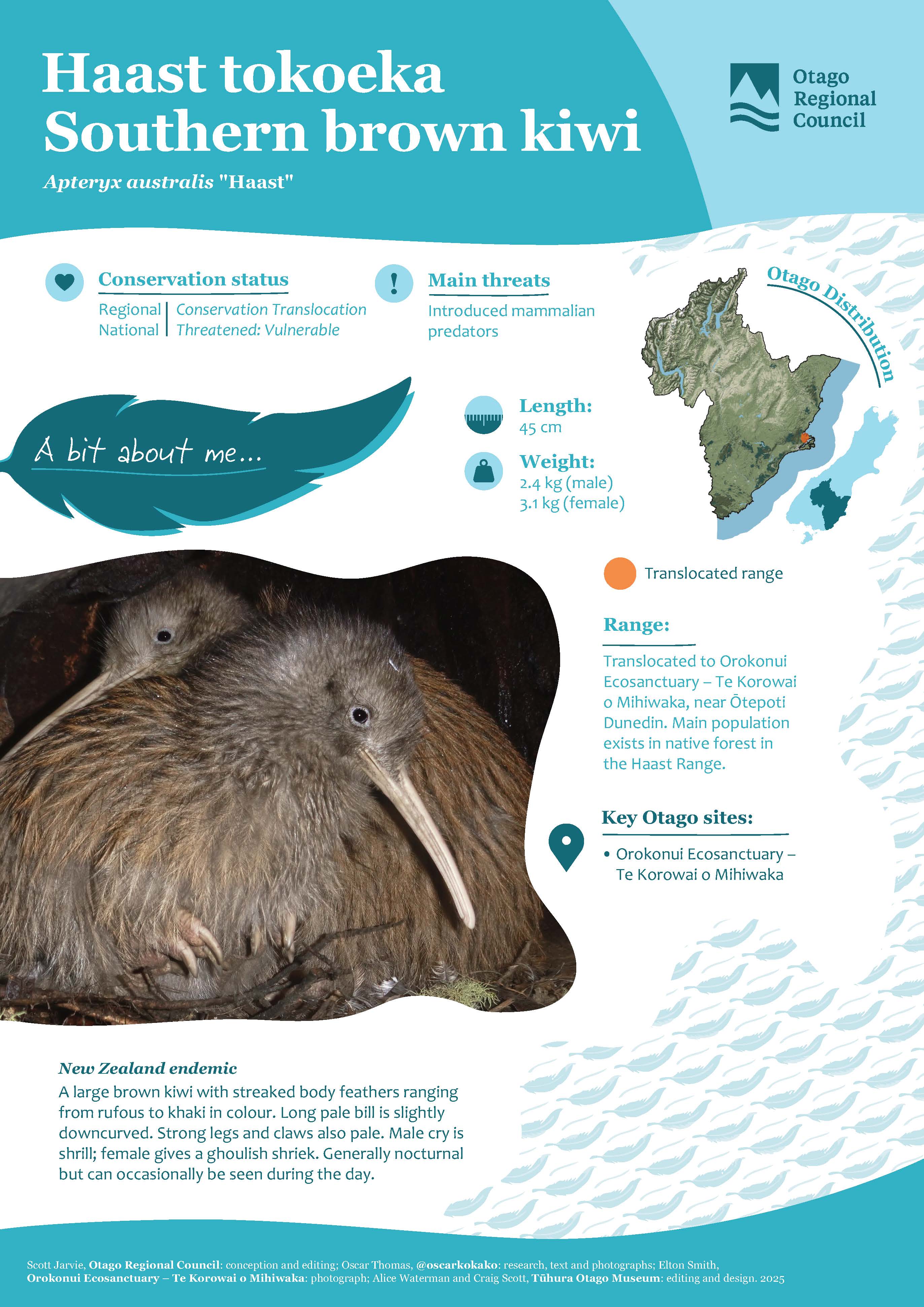
Another type of conservation translocation is assisted migration – or managed relocation – the movement of the focal species outside its indigenous range to avoid extinctions. In Otago, Haast tokoeka/tokoeka were released at Orokonui Ecosanctuary in 2010.
Well-known bird species that have been introduced and naturalised, among them the common starling/tāringi, house sparrow/tiu and yellowhammer/hurukōwhai, comprise about a third of the total number of bird species that breed in Otago.
Species that have become naturalised refers to those deliberately or accidentally introduced by humans and must have established a self-sustaining population in the wild over at least three generations and spread beyond the site of initial establishment.
We also have had bird species introduced to Otago but have not naturalised. These bird species are those where a release is documented, but with no self-sustaining population in the wild; or published records indicate the species bred (or probably bred), but it is no longer extant.
A total of 289 bird species were listed in the Otago Region.
In the regional conservation status for birds the following assessments were made:
- 32 were Regionally Threatened (Regionally Critical = 9; Regionally Endangered = 6; Regionally Vulnerable = 17)
- 4 were Regionally At Risk (Regionally Declining = 3; Regionally Recovering = 1)
- 141 were Regionally Non-resident Native (Regional Migrant = 38; Regional Vagrant = 101; Regional Coloniser = 2)
- 23 were Regionally Not Threatened
- 25 were Regionally Introduced and Naturalised
- 10 were Regionally Data Deficient
- 43 were Regionally Extirpated, i.e., 30 were globally extinct and 13 were regionally extinct
- 4 were Conservation Translocations, where they have been deliberately moved for conservation benefit: three of these were reintroductions while one was a conservation introduction
In addition, 11 species were identified as ‘Introduced, Not Established’. This is where a release has been documented, but there is no self-sustaining population in the wild or a deliberate introduction has been documented, and published records indicate the species bred (or probably bred), but it is no longer around. Two species were 'Not Assessed' but have been assessed in earlier national assessments.
Otago serves as a national stronghold for eight bird species, meaning more than 20% of the national population is found here in the Region. They include migratory shorebirds and domestic migrants, emphasising the region's critical role in preserving these highly mobile bird species. One species was endemic to the Region, the Otago shag/matapo. This species only currently breeds in our Region but can be seen outside of Otago.
ORC completed this update of the conservation status of birds in Otago in 2026, with a panel of experts from the Department of Conservation | Te Papa Atawhai (Bruce McKinlay), University of Otago | Ōtākou Whakaihu Waka (Dr Nicolas Rawlence and Oscar Thomas), and Otago’s Regional Representative for Birds New Zealand (Dawn Palmer).
To celebrate our bird species in Otago, we worked with Tūhura Otago Museum and ornithologist (a person who studies birds) Oscar Thomas from the University of Otago – Ōtākou Whakaihu Waka to produce a series of infographic factsheets.
Our resources have been developed for birds assessed in a regional threat classification based on a rules-based approach. We developed resources for the four threat status categories of Regionally Threatened, Regionally At Risk, Regional Migrants, and Regional Conservation Translocations. The factsheets provide summarised information for each bird species on how to identify them, where to find them, and their main threats and conservation status.
Please feel free to share these resources around, and you can download and print them out to raise awareness about Otago’s birds.


July 2025
PDF | 4 MB
Regional conservation status — Threatened: Critical

July 2025
PDF | 3 MB
Regional conservation status — Threatened: Vulnerable

July 2025
PDF | 3 MB
Regional conservation status — Threatened: Vulnerable

July 2025
PDF | 4 MB
Regional conservation status — Threatened: Endangered

July 2025
PDF | 3 MB
Regional conservation status — Threatened: Vulnerable

July 2025
PDF | 3 MB
Regional conservation status — Threatened: Endangered

July 2025
PDF | 3 MB
Regional conservation status — Threatened: Critical

July 2025
PDF | 4 MB
Regional conservation status — Threatened: Endangered, Conservation Translocation

July 2025
PDF | 3 MB
Regional conservation status — Threatened: Vulnerable

July 2025
PDF | 3 MB
Regional conservation status — Threatened: Vulnerable

July 2025
PDF | 3 MB
Regional conservation status — Threatened: Vulnerable

September 2025
PDF | 4 MB
Regional conservation status — Threatened: Critical

September 2025
PDF | 3 MB
Regional conservation status — Threatened: Critical

September 2025
PDF | 3 MB
Regional conservation status — Threatened: Vulnerable

September 2025
PDF | 3 MB
Regional conservation status — Threatened: Vulnerable

September 2025
PDF | 4 MB
Regional conservation status — Threatened: Endangered

September 2025
PDF | 4 MB
Regional conservation status — Threatened: Vulnerable
September 2025
JPG | 502 KB
Regional conservation status — Threatened: Critical

September 2025
PDF | 5 MB
Regional conservation status — Threatened: Vulnerable

September 2025
PDF | 8 MB
Regional conservation status — Threatened: Critical

September 2025
PDF | 33 MB
Regional conservation status — Threatened: Vulnerable

September 2025
PDF | 3 MB
Regional conservation status — Threatened: Vulnerable

September 2025
PDF | 3 MB
Regional conservation status — Threatened: Vulnerable

September 2025
PDF | 3 MB
Regional conservation status — Threatened: Critical

September 2025
PDF | 4 MB
Regional conservation status — Threatened: Critical

September 2025
PDF | 4 MB
Regional conservation status — Threatened: Vulnerable

September 2025
PDF | 3 MB
Regional conservation status — Threatened: Vulnerable

September 2025
PDF | 3 MB
Regional conservation status — Threatened: Vulnerable

September 2025
PDF | 3 MB
Regional conservation status — Threatened: Critical

September 2025
PDF | 4 MB
Regional conservation status — Threatened: Vulnerable

July 2025
PDF | 4 MB
Regional conservation status — Threatened: Critical

September 2025
PDF | 4 MB
Regional conservation status — Threatened: Vulnerable

July 2025
PDF | 5 MB
Regional conservation status — At Risk: Declining

September 2025
PDF | 3 MB
Regional conservation status — At Risk: Recovering

September 2025
PDF | 3 MB
Regional conservation status — At Risk: Declining

September 2025
PDF | 4 MB
Regional conservation status — At Risk: Declining

July 2025
PDF | 3 MB
Regional conservation status — Migrant

July 2025
PDF | 3 MB
Regional conservation status — Migrant

September 2025
PDF | 3 MB
Regional conservation status — Migrant

July 2025
PDF | 3 MB
Regional conservation status — Migrant

July 2025
PDF | 2 MB
Regional conservation status — Migrant

July 2025
PDF | 3 MB
Regional conservation status — Migrant

July 2025
PDF | 3 MB
Regional conservation status — Migrant

July 2025
PDF | 3 MB
Regional conservation status — Migrant

July 2025
PDF | 3 MB
Regional conservation status — Migrant

July 2025
PDF | 3 MB
Regional conservation status — Migrant

July 2025
PDF | 3 MB
Regional conservation status — Migrant

July 2025
PDF | 3 MB
Regional conservation status — Migrant

July 2025
PDF | 3 MB
Regional conservation status — Migrant

July 2025
PDF | 3 MB
Regional conservation status — Migrant

July 2025
PDF | 4 MB
Regional conservation status — Migrant

2025
PDF | 3 MB
Regional conservation status — Migrant

September 2025
PDF | 3 MB
Regional conservation status — Migrant

September 2025
PDF | 3 MB
Regional conservation status — Migrant

September 2025
PDF | 3 MB
Regional conservation status — Migrant

September 2025
PDF | 3 MB
Regional conservation status — Migrant

September 2025
PDF | 3 MB
Regional conservation status — Migrant

September 2025
PDF | 3 MB
Regional conservation status — Migrant

September 2025
PDF | 3 MB
Regional conservation status — Migrant

September 2025
PDF | 3 MB
Regional conservation status — Migrant

September 2025
PDF | 2 MB
Regional conservation status — Migrant

September 2025
PDF | 3 MB
Regional conservation status — Migrant

September 2025
PDF | 3 MB
Regional conservation status — Migrant

September 2025
PDF | 3 MB
Regional conservation status — Migrant

September 2025
PDF | 4 MB
Regional conservation status — Migrant

September 2025
PDF | 3 MB
Regional conservation status — Migrant

September 2025
PDF | 3 MB
Regional conservation status — Migrant

September 2025
PDF | 3 MB
Regional conservation status — Migrant

September 2025
PDF | 3 MB
Regional conservation status — Migrant

September 2025
PDF | 3 MB
Regional conservation status — Migrant

September 2025
PDF | 3 MB
Regional conservation status — Migrant
July 2025
PDF | 4 MB
Regional conservation status — Threatened: Endangered, Conservation Translocation
September 2025
JPG | 711 KB
Regional conservation status — Translocation

September 2025
PDF | 3 MB
Regional conservation status — Translocation

Regional threat assessments
We have published threat assessments on various species' groups in our region, including birds.

Reports and publications - biodiversity
We have developed a range of resources on indigenous biodiversity in Otago, including regional threat assessment reports, educational factsheets and posters about species, and an online native planting guide to inform ecological restoration efforts.
To find out more about specific birds in Aotearoa New Zealand, visit the websites for New Zealand Birds Online and Te Papa Atawhai – Department of Conservation.
To join a society dedicated to the study of birds and their habitats in Aotearoa New Zealand, visit the Birds New Zealand / Te Kāhui Mātai Manu o Aotearoa website.

New Zealand Birds Online
New Zealand Birds Online is a digital encyclopaedia where for each bird species there is information on how to identify them, where to find them, what they eat, and their main threats and conservation status.

Birds: Te Papa Atawhai – Department of Conservation (DOC)
DOC’s website provides information about Aotearoa New Zealand’s bird species, including threatened birds, bird songs and calls, and species-specific conservation programmes.

Birds New Zealand / Te Kāhui Mātai Manu o Aotearoa
Birds New Zealand is a society that aims to foster the study, knowledge, and enjoyment of birds.
Have you spotted, heard, or recorded a bird? To contribute bird observation records through participatory science, visit the following platforms:
eBird allows users to record bird observations through checklists, including by submitting photos and audio recordings, providing information on bird distribution, abundance, habitat use and population trends.
iNaturalist allows users to upload photos, audio recordings and other observations, contributing to a global database of biodiversity and helping improve species identifications.
Te Tatauranga o ngā Manu Māra o Aotearoa – The New Zealand Garden Bird Survey allows people to contribute bird counts through an annual survey held during winter each year, helping track changes in garden bird populations over time.

eBird
eBird is an open-access participatory project where you can record and share bird observations and can serve as an online database for these observations, enabling bird watchers to record their sightings and contribute valuable data to scientists worldwide.

iNaturalist NZ – Mātaki Taiao
iNaturalist is an online-access participatory science project where you can record and share observations on plants, fungi, and animals, including birds, contributing to scientific research and conservation efforts.

Te Tatauranga o ngā Manu Māra o Aotearoa
The New Zealand Garden Bird Survey is run over a week in winter and monitors changes in our nation’s garden bird populations over time by comprehensively analysing bird counts gathered by New Zealanders.


