 |
|
COMMUNITY UPDATE | WINTER 2023
|
 |
 |
Tēnā koutou katoa
Welcome to the winter issue of the Toitū Te Hakapupu newsletter.
We have more updates to share with you on the work happening in Te Hakapupu/Pleasant River including plantings, water monitoring, and community hui.
We were delighted to see some new faces from the community attend the workshop we held in May and look forward to even more coming on this journey with us.
You can read more about the workshop below.
If you have any questions, please feel free to get in touch with us. You’ll find the project partners and their contact details at the end of this newsletter.
For our new subscribers and those that would like to know more about the project, you can learn more on our dedicated project webpage
|
|
|
 |
|
Upcoming community hui
|
We have a community hui coming up this month:
Community Hui – Identifying Actions
Monday August 14th 6:30pm – 8:30pm
East Otago Events Centre in Waikouaiti
At the Community Workshop held on May 24th, we asked you about what was special in the catchment, issues and challenges, and your aspirations for the catchment.
In this workshop, we will build on what you have already told us, this time, focusing on the actions that will improve the health of your catchment.
Areas of discussion will include:
- Exploring potential actions to solve issues / achieve outcomes
- Considering who can help with actions
- Identifying gaps in knowledge and expertise
- Prioritising actions / focus areas
Supper and tea/coffee will be provided.
This will be the last community hui supporting the development of the draft catchment management plan, so we’d love to have your input.
Even if you can’t make the hui, we always welcome your input via our Catchment Management Plan Survey.
And if you missed our community workshop on May 24th to begin developing a catchment management plan with the community, you can find out more about it and our other events here: Events in the community.
|
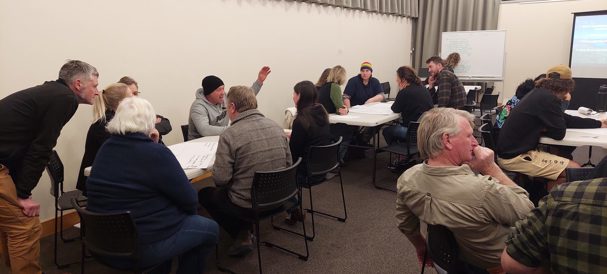 |
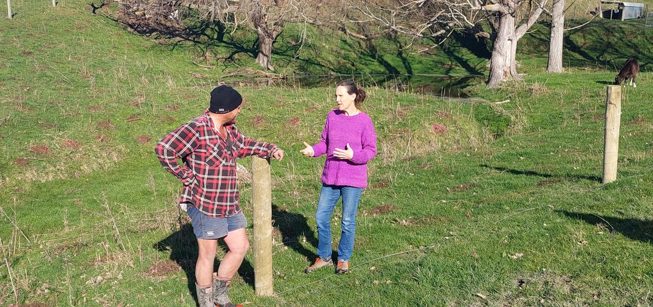
Attendees at the May community workshop discussing the opportunities and issues in Te Hakapupu catchment.
|
|
|
|
|
|
|
|
|
|
|
|
 |
|
Meet some of the team
|
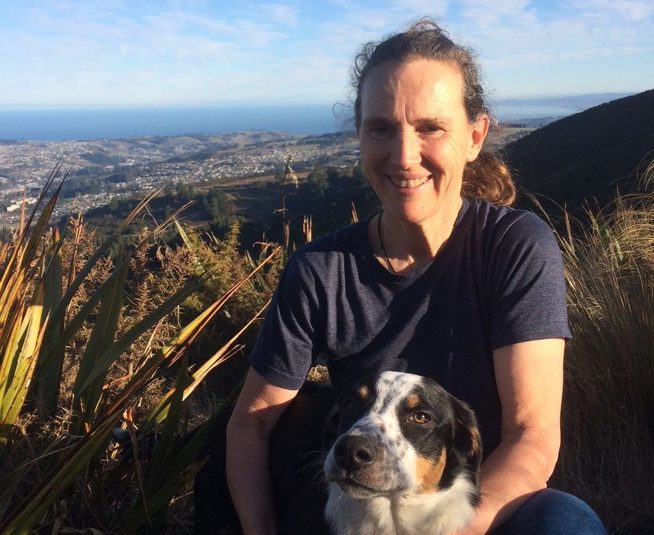 |
Melanie White
Otago Regional Council Project Delivery Specialist - Jobs for Nature
What’s your background?
Mel: Since she was very young, Mel has had a focus on every other living thing and its welfare. She grew up in Auckland but moved to the South Island following her school years. Mel has spent most of her life outdoors, engaging in sports, working, and observing the world around her. She has had diverse range of jobs but always with the theme of conservation using a pragmatic approach. She has built and renovated houses, managed a beach care project and developed her own property using ecological restoration principles. Mel has a family, both human and animal; dogs, hens and horses, all equally loved.
What are you most excited for with this project?
Mel: This project is exciting for Otago because it brings people together for the environment, specifically for the Awa. It is a way of helping us all come to a shared understanding of how we can live in a way that takes care of the mauri of the awa and the whenua, which ultimately is taking care of ourselves and each other. On a personal level, I just love planting trees, especially natives, and it is really exciting to meet others who are keen to do the same.
|
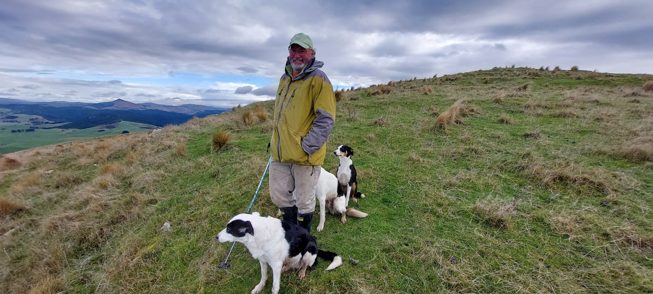 |
Hamish McFarlane
East Otago Catchment Group Chairperson
What’s your background?
Hamish: Well, it started growing up in Southland / Murihiku. Southland, Fiordland, Rakiura and the Sub Antarctics, and Southern Ocean is most definitely my Turangawaewae. I am certainly influenced by a family with a multi-generational interest in being active and observing and appreciating the great outdoors.
It is a family that was very involved with conservation issues and challenging the prevailing attitudes of the time towards the stewardship of our natural world.
I have had some pretty good adventures in the hills, rivers and sea involving kayaks, yachts, skis, climbing paraphernalia, rifles, fishing rods -a few cold wet nights shivering waiting for daylight. But lots of good times with some really cool folk. Fingers crossed there will be more...
Moving on from looking out the window at school, I took an interest in agriculture which seemed to be a way to be physically active, to learn new things and be outside. You even got a little bit of money – wasn't much then mind. But you got fed. This evolved into 12 years of looking out shearing shed windows/doors (which paid way more). Somewhere in there, deer farming entered my life and in a roundabout way, the journey to East Otago began...
What are you most excited for with this project?
Hamish: I’ve likely forgotten what excitement is.. but imagine it might be like winning Lotto - which is kinda like how this project is for the Te Hakapupu and all its residents, human and otherwise.
The project brings a possibility of changing what we are accustomed to as normal in the catchment and near coastal waters into something that is much better. Pre-human, it would have been amazing in this catchment. Teaming with life. Clean clear water. Our normal is an extremely ruined form of what it was. Also, it is now vulnerable to the excesses of climate change.
And although we are now missing a lot of what was here, with what we have left, effort on our part, and a consideration for things beyond ourselves and our daily toils and troubles - I know we can create a better habitat for all creatures, ourselves, and our descendants.
|
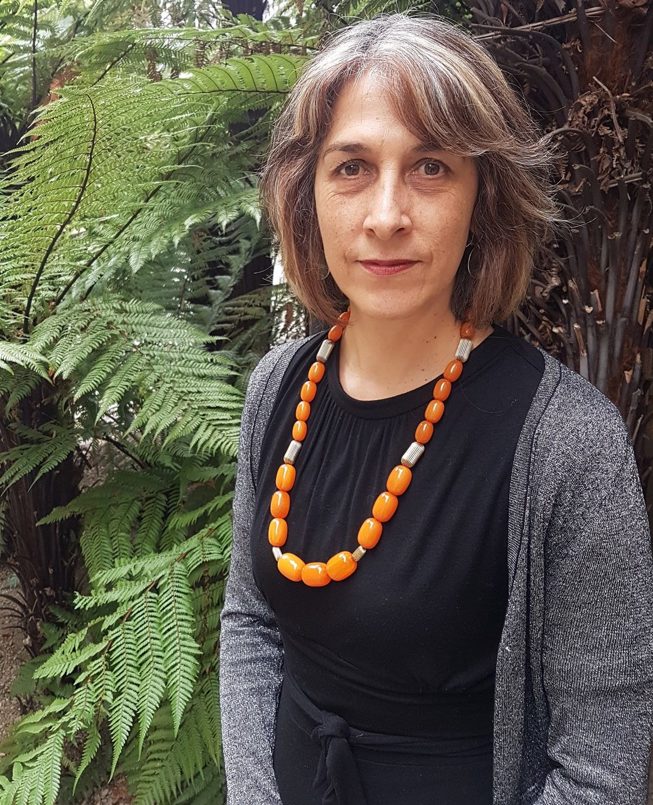 |
Katharina Ruckstuhl
Kāti Huirapa Rūnaka ki Puketeraki Representative
What’s your background?
Katharina: I whakapapa to Puketeraki through Kai Te Ruahikihiki. I’m on the Rūnaka Executive Committee and have been the Deputy Chair and also on the Tribal Governance Board of Ngāi Tahu. I represent the rūnaka on the ORC ‘mana to mana’ meetings. My day job is at the University of Otago Business School, where I’m the Associate Dean Māori. I’ve had a number of roles over the past few years – as a teacher, an iwi education consultant and manager, and as a researcher in the environment, business and technology areas. This background has emphasised to me that if we want to create change, we need to look for new and practical ways to sustain these changes through shifting minds, hearts, resources and practices.
What are you most excited for with this project?
Katharina: The Toitū Te Hakapupu project is one of the many projects that Puketeraki is involved in to rediscover and promote important cultural and environmental values that can help sustain our collective waterways. Although it is a project with a finite funding term, it provides the opportunity to share our knowledge and stories with each other and with others in the community, and to explore what ‘Te Mana o te Wai’ really means in practice.
It also presents an opportunity to reconnect our whānau to traditional ways of being with and inhabiting whenua and accessing our Mahika kai and seasonal resources. I'm excited to see the ecology of Te Hakapupu restored to states of health that encompasses all species, as well as evolving new ways of working with natural resources to add value to our community's cultural and economic health.
|
|
|
 |
|
Who we’re working with
|
The heart of this project is the partnership between Otago Regional Council and Kāti Huirapa Rūnaka ki Puketeraki, working together in collaboration with the East Otago Catchment Group and the local community. And we are very lucky to have such an engaged community, with more and more people showing interest every month and coming along to our events.
Some work throughout the project will require the services of ORC experts, and some, these hardworking members of the community and local landowners.
We will be working with landowners to develop Farm Sediment Plans to help reduce sediment and nutrient input into the water from individual properties.
We will also be engaging with the forestry industry in the hopes to develop a Forestry Action Plan for the catchment that will help put some practices in place to reduce sediment run off into the awa and its tributaries.
Some of the contracts we have in place to complete the project work:
- Plants are being grown and supplied by Kāti Huirapa Rūnaka ki Puketeraki’s community nursery and Ribbonwood Nurseries
- Aukaha have a team who will carry out the planting
- We have five fencing contractors on a panel who will complete fencing works for the project, in areas where landowners are not already erecting fences.
- Ahikā Consulting are leading the technical work to assess water quality and support the rūnaka and community in setting visions and goals for their catchment
|
|
|
|
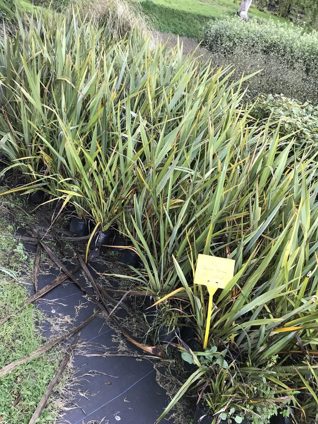
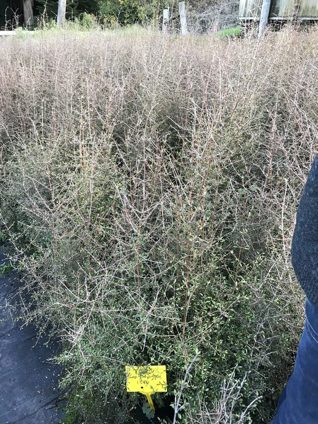
Left: Phormium tenax / harakeke (flax) Right: Coprosma propinqua / mingimingi
|
|
|
 |
|
Fencing and planting has begun!
|
Toitū Te Hakapupu has received its first signed landowner agreements, with fencing and planting now underway!
Steven Foote and family are completing fencing and planting actions around wetlands and waterways across their two farms in Te Hakapupu / Pleasant River Catchment.
They are the first of a group of landowners who have come forward to be part of Toitū Te Hakapupu, a Ministry for the Environment/ORC funded project in partnership with Kāti Huirapa Rūnaka ki Puketeraki to improve water quality in the Pleasant River catchment.
Steven and his family really appreciate the purpose of the project and have found people are connecting by thinking about the awa (river) and its protection.
|
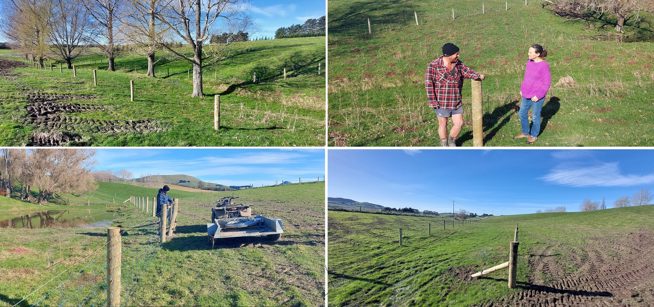 |
“Traditionally farmers used to connect sharing labour and resources, modern farming practices has taken much of this away. Now we have the chance to reconnect our community by collectively taking care of our waterways."
Steven will complete fencing on his property under his own steam, and will be helping Aukaha, the project planting team, to complete the planting. This will make up his 25% contribution to the total cost.
More landowners are about to being their planting and fencing projects in Te Hakapupu, so look out for new planting areas popping up!
|
|
|
|
|
Planting days
|
One of the ways we can help improve the health of the awa and the quality of its water is to plant native shrubs to stabilise the riverbanks and reduce sediment movement.
The project has a couple of planting days coming up in Te Hakapupu:
Community Planting Day
This is open to everyone in the local community and anyone else who would like to come along and help. Grab your gumboots, some gloves, and a shovel if you have one.
We’ll have a barbeque running so you can grab a bite to eat in between plantings.
Corner of Jefferis and Palmerston-Waikouaiti Road - look for the flags!
Sun Sep 3rd
1:00pm – 4:00pm
School Planting Day
We have also approached several local schools about a planting day in October which would give the students an opportunity to play a part in the restoration of their local catchment through planting and learning about the science behind water monitoring and ways to improve water quality.
If you know of a school or group that you think would like to be involved, please let us know at: tth@orc.govt.nz
|
|
|
|
|
Forestry working group
|
The Forestry Working Group has been created to guide the development of the Forestry Action Plan for the Toitū Te Hakapupu Restoration Project. It has representatives of the four main forestry companies in the catchment, Kāti Huirapa Rūnaka ki Puketeraki and the local community.
The objective of the Forestry Action Plan is to have agreed sustainable forestry management practices that reduce the impacts of forest management on water quality, riparian margins and identified catchment values and their attributes.
Forestry covers half of te Hakapupu catchment, so the plan is an important component of the overall restoration project.
The group’s second meeting on August 2nd focussed on relating the risks and benefits of forestry to catchment and community values.
A field day is being planned for later in the year to show the public the planning processes used in forestry and how those plans are applied on-site.
|
|
|
|
|
Some of the science
|
Scientific monitoring of water quality and biodiversity in the catchment’s waterways is an important part of the Toitū Te Hakapupu project.
At the beginning of the project, this work gives a vital baseline, so we can understand what we’re starting with and how water quality changes over time. We can compare our results with other waterways throughout the country to see how Te Hakapupu / Pleasant River stacks up relative to elsewhere.
As the project progresses, further monitoring will identify where specific water quality issues are in the catchment to help guide action and solutions.
Then, once the project has finished, ongoing monitoring in the future can show how our work has created long term improvement in Te Hakapupu to help meet the goals and values of mana whenua and the community.
Water quality monitoring
In May 2023, Riverwatch ‘waka’ were trialled in the catchment’s three main tributaries, Te Hakapupu / Pleasant River, Watkins Creek and Trotters Creek. These are kiwi-made tools with five sensors that can send monitoring data to a website every 15 minutes. They measure turbidity, temperature, oxygen levels, pH and conductivity.
Readings from these waka will give a good cross section of water quality. Turbidity is a measure of water clarity and is related to the amount of sediment in the water. Sediment levels affect habitat quality for aquatic animals and plants. They can change noticeably in relation to river flow levels and rainfall so real-time monitoring is really valuable for seeing this in detail.
Dissolved oxygen is critical for aquatic organisms such as fish and macro invertebrates. Measuring this is a good indicator of habitat health for them.
Temperature is being measured because it affects the amount of dissolved oxygen and the speed of chemical reactions, both of which impact habitat.
Similarly, the acidity (pH) and conductivity (concentration of dissolved salts and minerals) of the water relate to speed and nature of chemical and biological reactions, including metabolism, and these influence how habitable the test site is for aquatic animals and plants.
A new model of these Riverwatch waka are currently being tested and we will be one of the first catchments to use these new waka later this year.
|
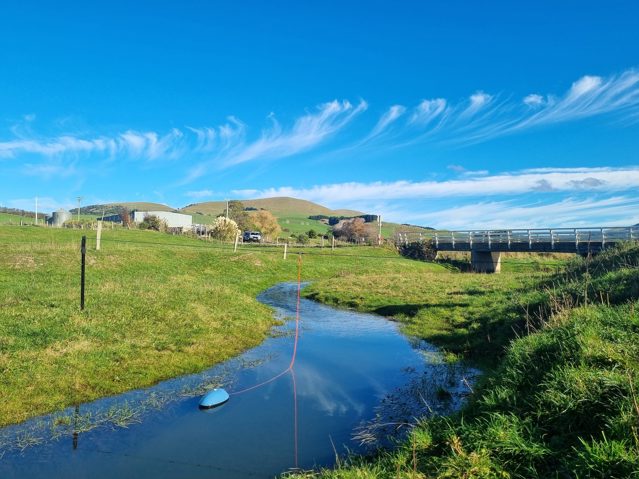 |
Riverwatch waka in place on Te Hakapupu / Pleasant River. Photo: Matt Dale, Waterscape Connections
|
eDNA monitoring
eDNA stands for environmental DNA, which is any tiny traces of genetic material from fish and other animals left behind in the water as they go about their business. Samples of water can be analysed in very fine detail to identify exactly what species are present at the testing site and further upstream.
The types of fish in the catchment have been monitored at six sites using eDNA analysis in December 2022. Ten species of freshwater fish were detected and seven estuarine/marine species. Three of the freshwater types are considered threatened. Four are considered mahika kai species, these are:
- banded kokopu
- īnaka
- longfin tuna
- shortfin tuna
There is no evidence yet of the non-migratory types of galaxiids which are becoming very rare throughout the country.
If they do appear in the next rounds of monitoring, options for their protection will be looked at as trout will eat them and compete with them for habitat.
|
|
|
|
|
|
|
|
|
|
|
|
|
|
Flyover and video series
|
Kāti Huirapa Rūnaka ki Puketeraki has offered to create video resources to contribute to the ongoing project of revitalising and restoring the health of Te Hakapupu - the Pleasant River Catchment.
We are envisaging a series of short videos focussed on different aspects of the river; its uniqueness, its history, its plant and animal life, how people historically and currently utilise it, as well as the work going on within this project, in terms of fencing, planting, and monitoring.
These stories will be both educational and inspirational, to support the ongoing engagement of the community who have links to and care about Te Hakapupu and its wider environment.
|
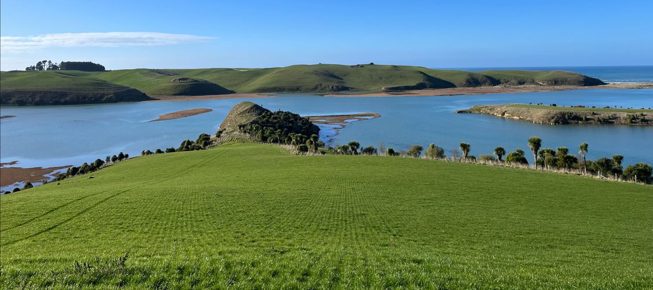 |
As a linking thread within these videos, and potentially as a standalone video, we are proposing to do a flyover of the river using a drone to create aerial based images of Te Hakapupu, showcasing its beauty and the diverse life and lifestyles it supports.
The aim for the flyover footage is to capture something that allows our communities and the wider public to see the river, as something that connects the inland to the coast, and to inspire more people to be involved in its ongoing care and restoration.
The footage we capture will be cared for by the Toitū Te Hakapupu Partnership Group and will only be utilised for the purposes of developing these video resources. We will be employing someone we know and trust to create some beautiful video images for our communities.
|
|
|
|
|
How can you get involved in the project?
|
If you’re a landowner with part of Te Hakakpupu / Pleasant River running through your property and keen to find out how you can be part of this project and help improve the health of the river you can register your interest here.
|
 |
We’re currently in the process of creating a community catchment management plan.
If you couldn’t make it to our community workshop on 24 May 2023 to share your ideas with the project team, or you have additional thoughts that you’d like to add that may help us develop this plan, please complete this survey.
There will also be a chance to be involved in environmental monitoring, for example, vegetation and bird surveys, eDNA sampling and water quality testing. We’ll also need volunteers for planting days.
Keep up to date on the project by subscribing to this newsletter if you aren’t already and watching for the latest news on Facebook at Otago Regional Council, Kāti Huirapa Rūnaka ki Puketeraki and East Otago Catchment Group.
|
|
|
|
|
Contacts
|
If you have any questions or would like to talk with us, please don’t hesitate to get in touch.
Otago Regional Council Project Delivery Specialist – Jobs for Nature
Melanie White
Email melanie.white@orc.govt.nz
Ph 027 357 2568
Otago Regional Council Project Administrator - Jobs for Nature
Soraya Engelken
Email soraya.engelken@orc.govt.nz
Ph 022 452 3818
Kāti Huirapa Rūnaka ki Puketeraki Representative
Katharina Ruckstuhl
Email katharina.ruckstuhl@otago.ac.nz
East Otago Catchment Group
Steph Scott
Email eocatchmentgroup@gmail.com
Ph 027 438 7875
|
|
|
 |
|
|
|
|
|
|
|