-
-
-
-
-
-
-
-
-
Toitū Te Hakapupu Newsletter #8 - September 2025
-
-
-
COMMUNITY UPDATE | SEPTEMBER 2025


Tēnā koutou katoa
Welcome to the September issue of the Toitū Te Hakapupu newsletter.
In this issue, we have some amazing achievements to share following the official close of the project on 30 June as well as some future work in the pipeline continuing the project’s efforts.
If you have any questions, please feel free to get in touch. You’ll find project partners and community contact details at the end of this newsletter.
For new subscribers and those who would like to know more about the project, you can learn more on ORC’s project webpage. You’ll also find past newsletters to catch you up on the journey.

Upcoming events in the catchment
Community Workshop: Let’s talk pest management
Pests are an ongoing challenge in Te Hakapupu / Pleasant River catchment — but now’s our chance to work together on solutions. Join East Otago Catchment Group for the first community workshop to scope pest plant and animal issues and help shape a local pest management strategy for the future.
Tuesday, 16 September
11am–2.30pm (lunch provided)
Waikouaiti Events Centre
Your input will guide the community’s vision for managing pests in our catchment.
To find out more or RSVP, contact Steph Scott on 0274 387 875 or email eocatchmentgroup@gmail.com

Celebration planting day
The community once again gathered in force on May 18 for a celebration planting day marking the close of the four-year Toitū Te Hakapupu: Pleasant River Catchment Restoration Project. With riverside planting, ice cream, coffee, and a BBQ, it was a day to enjoy, reflect, and look ahead.
Over the life of the project, local mahi has made a real difference: native plants have been established, waterways and wetlands have been fenced off, improvements have been made to fish passage, and sediment traps have been installed. These efforts are already improving water quality in Te Hakapupu, laying the groundwork for healthier waterways into the future.
The planting day wasn’t just about adding the final trees — it was a celebration of what’s been achieved and the lasting legacy of collaboration in the catchment.
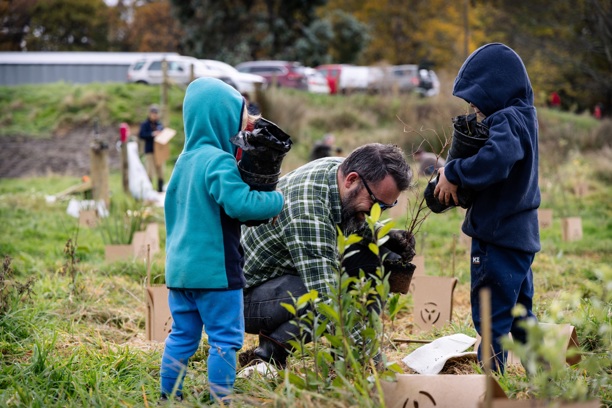
Members of the community lending a hand at the celebration planting day

Project achievements
Native planting
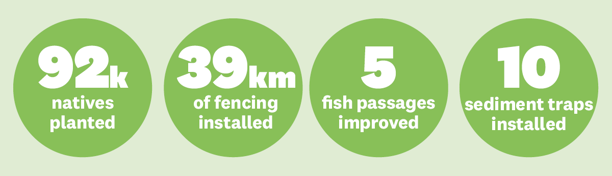
92,000 native plants established along waterways and wetlands.
Native plants such as carex, flax, rushes, toetoe and cabbage trees have been planted along waterways to act as filters. The plants trap water contaminants such as nutrients, sediment, and bacteria to help remove them from the waterway. The plants will also stabilise streambanks and create habitat to support improved biodiversity.
Fencing
39 km of fencing has been erected around waterways in the catchment.
This fencing will keep stock out of waterways and wetlands, helping to prevent contaminants from entering the river and reducing streambank erosion.
Fish passage barriers
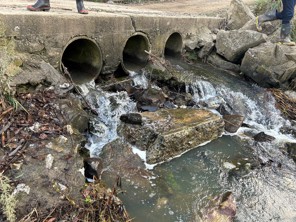
Five fish passages have been improved. There have also been significant gains in fish passage, opening up 95% of the catchment for migration.
Fish passage can be barred by instream structures. Our mission was to remove some of those barriers and give our fish freedom to roam! Three priority culverts in the lower catchment have been replaced, enabling fish passage to upper catchment feeding and breeding areas.
Whitebait monitoring carried out prior to modifications at Brookland’s Road ford found 12 whitebait upstream of the ford. The week following the concrete pour, monitoring found 600 whitebait!
 |
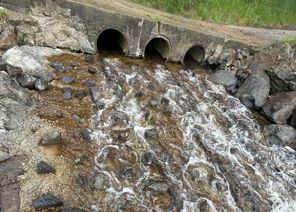 |
Before (left) and after (right) the installation of a rock ramp
to improve fish passage at the Brooklands Road ford
Sediment traps
10 sediment traps were installed in a priority site to help reduce the build-up of silt, sand and soil in the downstream river and estuary by trapping it close to the source.
Sediment traps will be monitored and emptied out if necessary. The amount of sediment collected will be estimated. These sediment traps have associated planting on the surrounding slopes to stabilise them over time. Native plants have also been established around and between the traps to capture more sediment and create native habitat.
In the first year, 1,082 cubic metres of sediment was caught and removed from the sediment traps — that’s 7,220 bathtubs full!
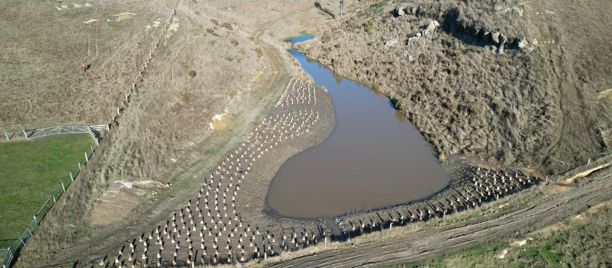
A sediment trap installed in the catchment to reduce the build-up of sediment downstream
Building a shared vision for the Pleasant River catchment
Alongside the hard work on the ground, partners Kāti Huirapa Rūnaka ki Puketeraki, the East Otago Catchment Group, landowners, and community members have also co-created a Catchment Action Plan. This is a living document setting direction for the next 40–50 years.
The plan, finalised in June 2025, sets out a pathway for protecting and enhancing the catchment, with actions grounded in community values and aspirations.
The process began in May 2023 with the first community workshop, where participants shared what makes the catchment special, their priorities for land and water management, and long-term hopes for the area. A second hui in August 2023 focused on identifying actions to address challenges and improve catchment health.
Feedback from these workshops, combined with scientific research and cultural knowledge, informed the draft plan developed by Whirika Consulting in late 2023. Over 2024, the draft was refined through collaboration with mana whenua, the East Otago Catchment Group, and the wider community, ensuring alignment with other ORC projects and monitoring work.
A community hui in October 2024 gave locals the opportunity to review the draft and provide input. This feedback was incorporated into the final version, released to the community in July 2025.
The Catchment Action Plan reflects a truly collective effort. It provides clarity of purpose, identifies shared goals, and sets out practical steps for looking after Te Hakapupu / Pleasant River. With the plan in place, the community now has a strong foundation to guide action, track progress, and secure support for future work.
Learn more about this shared vision and read the final Catchment Action Plan on the project website.
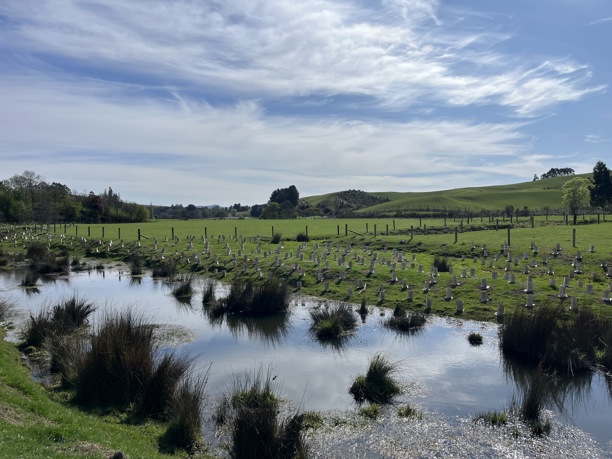
A great example of a fenced-off waterway with riparian plantings in Te Hakapupu
Succession workshops and the project’s future
Two community workshops in April brought people together to plan the future of the project and ensure its legacy continues past it’s official close.
Session One (8 April 2025, Waikouaiti) celebrated achievements, reflected on lessons learned, and encouraged open participation. Attendees brainstormed ideas and priorities for ongoing catchment care.
Session Two (28 April 2025, Palmerston) built on this work, refining ideas into a clear, community-driven succession plan with practical actions to carry the project forward.
Together, these workshops created a shared roadmap for the long-term protection and enhancement of the catchment.
This succession plan is currently in its final draft form and commencement of actions is being agreed upon by East Otago Catchment Group and Kāti Huirapa Rūnaka ki Puketeraki. More will be shared on the plan before the end of the year.

Bringing back oioi to Te Hakapupu
Restoring native ecosystems in Te Hakapupu / Pleasant River is crucial for creating a resilient catchment ki uta ki tai (from the mountains to the sea).
A key part of this is re-establishing oioi (jointed wire rush), a native wetland plant once common in the area. Oioi helps slow water, trap sediment, improve water quality, store carbon, and support native wildlife, while also enhancing cultural and recreational values.
An experiment in the South Arm of Te Hakapupu by the kaitiaki from Kāti Huirapa Rūnaka ki Puketeraki and residents of Tūmai Beach Farm Park tested how best to bring oioi back. Encouragingly, many plants are now thriving — growing tall, spreading, and flowering.
Key findings included:
Best locations
Oioi grows best on slightly raised ground with less tidal flooding and near freshwater inputs.
Challenges
Browsing by stock, rabbits, and hares limits growth, and invasive grasses can smother young plants.
Success factors
Plants need well-drained, less-salty soils. Spacing matters less than location, but closer spacing can help where weeds are a risk.
Patience is essential
Growth is slow, especially in salty soils. Some areas may take decades to form continuous oioi meadows.
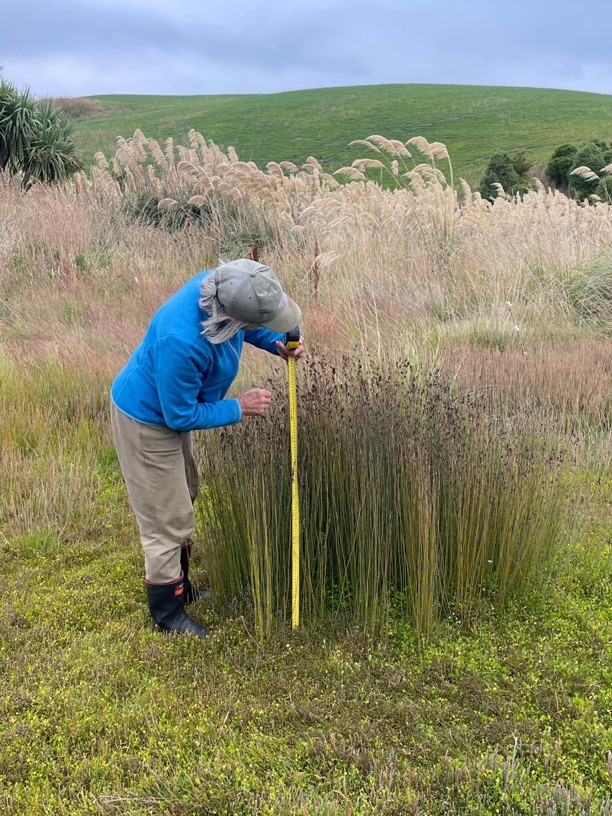
Measuring 1-metre-high flourishing oioi 27 months after planting
at Te Hakapupu. Photo: Angelina Young.
Recommendations include planting in upper saltmarsh margins, controlling grazers, managing grass competition carefully, avoiding frequently flooded areas, and continuing to trial methods.
A long-term, adaptive approach is needed to support successful establishment and maximise ecological and cultural gains.
Looking ahead, a formal prioritisation framework would help decide where oioi planting delivers the most benefit — whether for biodiversity, flood protection, water quality, mahika kai, or long-term success.
You can read the reports with full details on the trial on the project’s science and monitoring web page.
How can I stay updated on the project's progress?
Keep up to date on the project by subscribing to this newsletter if you aren’t already and watching for the latest news on Facebook at Otago Regional Council, Kāti Huirapa Rūnaka ki Puketeraki and East Otago Catchment Group.
You might also spot stories in the wild. These two below came about following a media release from Otago Regional Council and a council paper going before the Council noting all the achievements of Toitū Te Hakapupu over the past four years.
Jobs for Nature projects deliver lasting gains - Scoop
Many benefits flow from Otago river project - Farmers Weekly
Contacts
If you have any questions or would like to talk with us, please don’t hesitate to get in touch.
Otago Regional Council Project Delivery Specialist
Melanie White
Email melanie.white@orc.govt.nz
Ph 027 357 2568
Otago Regional Council Project Assistant
Soraya Engelken
Email soraya.engelken@orc.govt.nz
Ph 022 452 3818
Kāti Huirapa Rūnaka ki Puketeraki Representative
Katharina Ruckstuhl
Email katharina.ruckstuhl@otago.ac.nz
East Otago Catchment Group
Steph Scott
Email eocatchmentgroup@gmail.com
Ph 027 438 7875