 |
|
COMMUNITY UPDATE | APRIL 2024
|
 |
 |
Tēnā koutou katoa
Welcome to the April issue of the Toitū Te Hakapupu newsletter.
We have more updates to share with you on the work happening at Te Hakapupu/Pleasant River, including some key findings from scientific studies, how some of the work being done at Te Hakapupu will assist a local study and eventually the entire region, as well as the chance to meet more of the project team.
If you have any questions, please feel free to get in touch with us. You’ll find the project partners and their contact details at the end of this newsletter.
For our new subscribers and those who would like to know more about the project, you can learn more on our dedicated project webpage. You’ll also find past newsletters to catch you up on the journey so far.
|
|
|
 |
|
Meet some of the team
|
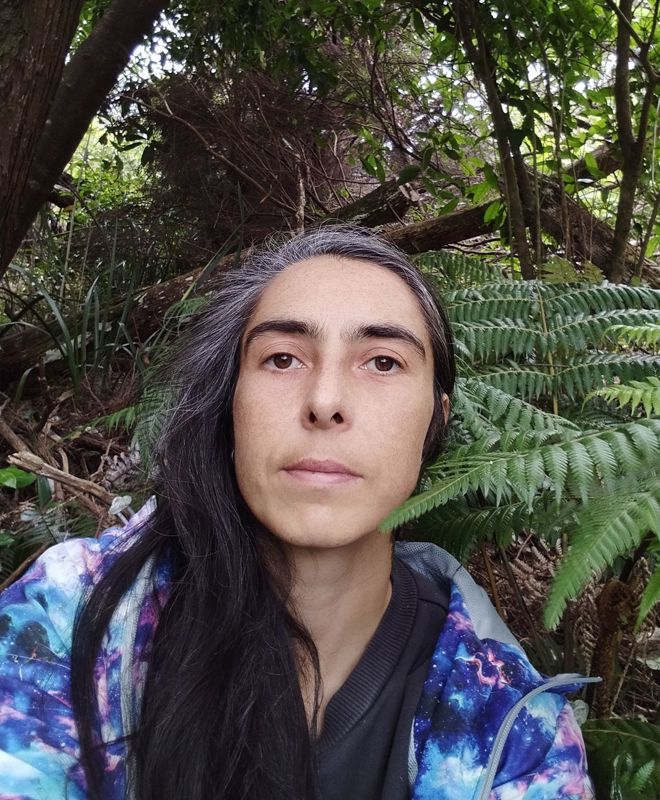 |
Rachel Ruckstuhl-Mann
Kāti Huirapa Rūnaka ki Puketeraki Representative and Communications
What’s your background?
Rachel: I am the daughter of Katharina Ruckstuhl, who is co-chair of the partnership group, and I also whakapapa through Kāi Te Ruahikihiki to Puketeraki. Throughout my childhood and youth, our whānau were developing and growing our understanding of what it meant to be Kāi Tahu, and in particular, Kāti Huirapa whānau, as there were (and still are) large gaps in both knowledge and practice around culture and ecology. We started to be really involved with anything that the Rūnaka was organising, and through that involvement across all manner of kaupapa, I was relating to the taiao — our ecology — as the source of our whakapapa, as well as a teacher, resourcer, healer and creative guide.
I have continued to be informed by these philosophies and practices of care and relatedness and bring them into the creative pursuits of design, performance making, teaching movement, video making, community and event organisation, as well as parenting.
What excites you most about this project?
Rachel: I see the potential of this project having a positive effect for the communities who care for Te Hakapupu, as well as the life it holds. Through this shift in state of health for both people and wai, there is greater energy for similar projects to grow within the surrounding catchments, especially as these are within the takiwā, area of responsibility for all parties within the partnership group of this particular project. We are facing multiple crises across all spheres of life, and the more that we are able to work with whole systems, the better we are able to feel and understand the reality of how these systems are and will be changing at both large and small scales.
The development and evolution of relationships between the different groups and Huirapa whānau has really become apparent as perhaps the greatest asset that the project has grown, and I can envisage that the groundwork created through this mahi will hold the energy for this restoration and regeneration work in years to come.
I'm also excited by the idea that whānau are and will have opportunities to reconnect to their ancestral practices in the context of the ecologies that informed and necessitated them.
|
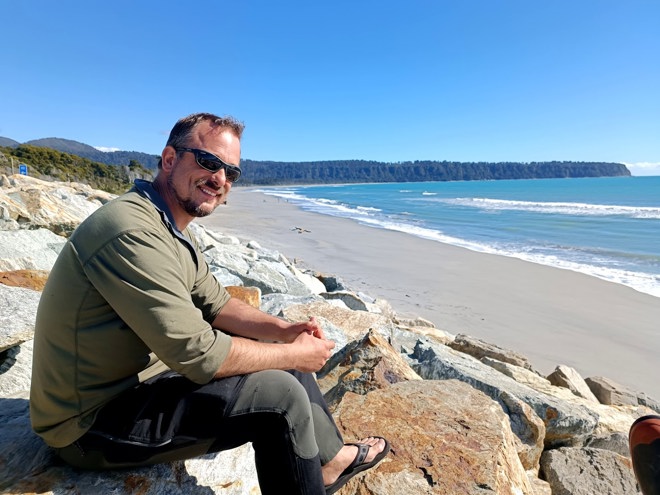 |
Matt Dale
Kaiwhakahaere Whakakaupapa Taiao / Environmental Project Manager – Kāti Huirapa Rūnaka ki Puketeraki
What’s your background?
Matt: Kia ora, I am the Kaiwhakahaere Whakakaupapa Taiao (Environmental Project Manager) for Kāti Huirapa Rūnaka ki Puketeraki. I have been in this role for around 18 months, mainly focusing on project management, but also providing technical support around freshwater and fisheries management. I have been supporting the Rūnaka for around 15 years and am lucky enough to call Puketeraki my home away from home. I have a strong interest in supporting mana whenua and the wider community to achieve positive environmental, cultural, and social outcomes, and particularly enjoy working in collaborative processes to achieve this. Way back in the day, I worked for the ORC as a water resources scientist, before spending eight years with Te Rūnanga o Ngāi Tahu. More recently, I started my own business (Waterscape Connections Ltd) to work directly with mana whenua and communities in the taiao (environmental) space.
I’m also a keen hunter and angler and am always looking for a chance to get out on the hills and rivers to stock up the freezer and recharge the batteries. I’m the proud dad of two girls, Gabby (11) and Harriet (8), who often join me on hunting and fishing trips, or spending a day on the awa wrangling tuna (eels).
What excites you most about this project?
Matt: The Toitū te Hakapupu project has been a great opportunity for connection in so many ways; it has helped create a waka to connect whānau with their ancestral whenua and awa but has also provided a fantastic opportunity to strengthen the bonds between the Rūnaka and the wider community. The creation of a shared understanding of the needs of the awa, mana whenua and the Hakapupu community has been a privilege to be a part of, and I’m very much looking forward to helping grow this further across the remainder of the project and beyond.
|
|
|
 |
|
Nature-based solutions … what are they?
|
Globally known as nature-based solutions, these are ways ‘green infrastructure’ may offer solutions to a number of environmental challenges - in this particular study, how they may reduce the effects of flooding.
Nature-based solutions are designed to protect, sustainably manage, and restore natural and modified terrestrial, freshwater, coastal and marine ecosystems.
These include:
- Restoring wetlands: absorbing floodwaters, filtering water, and supporting native wetland birds.
- Planting native trees: reducing erosion, sequestering carbon dioxide, and providing habitat for native birds and insects.
- Creating riparian buffers: stabilising riverbanks, reducing erosion, and improving water quality.
- Using green infrastructure: rain gardens, green roofs, and bioswales help manage stormwater and improve urban environments.
- Adopting regenerative agriculture: practices like reduced tillage and cover cropping improve soil health, reduce erosion, and enhance biodiversity.
As a regional council, ORC is always looking for new and better ways to protect people, livelihoods and infrastructure. Toitū Te Hakapupu has built relationships and developed a knowledge base, which makes it ideal for a pilot study modelling the use of nature-based solutions to flooding in the catchment.
This new study will look at work completed in the catchment and how nature-based solutions could lessen the effects of flooding. Its name:
Nature-Based Solutions Study
Wai i te reporepo, wai i te wao: what nature tells us about how to understand and prepare for flooding
The two-year nature-based solutions study is fully funded by the Ministry for the Environment’s (MfE) Essential Freshwater Fund and will explore the potential of nature-based solutions such as restoring wetlands and planting natives to help manage flooding, clean our water and support biodiversity in the region.
Engineering, water, planning and climate change experts will also be involved, combining local knowledge with international best practice to come up with ideas that could work.
Find out more about nature-based solutions and the study here.
|
|
|
 |
|
Life in Te Hakapupu part 2
|
The restoration of Te Hakapupu/Pleasant River catchment benefits more than just the community, landowners and those who value this beautiful East Otago river.
There are other species of fauna and flora here that will thrive from improvements in the catchment’s water quality. Here are some more below:
|
 |
Raupō / bulrush (Typha orientalis)
Photo: André Richard Chalmers
|
|
Raupō / bulrush is a wetland plant that grows on the edges of ponds, lakes, salt marshes, and slow-flowing rivers and streams.
The plant was very useful to Kāi Tahu and considered taoka (treasured). The rhizomes (underground stems) were cooked and eaten, while the pollen was baked into cakes. The leaves were prized for the wide variety of ways inwhich they could be made into everyday items, including; making mōkihi - small, temporary river craft; being used to make roofs, walls and occasionallycanoe sails; as a material for making kites, as well as many other thingsneeded for both living and travelling in Te Waipounamu.
|
|
|
|
|
|
|
|
|
|
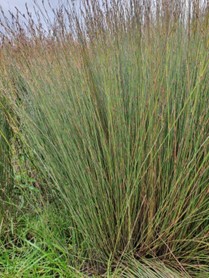 |
Oioi / jointed wire rush (Apodasmia similis)
Photo: Arnim Littek
|
|
Oioi / jointed wire rush is a plant that is endemic to New Zealand. It is a coastal plant but is also found around peat bogs and hot springs.
In an attempt to reintroduce these colourful, native wetland rushes to the area, and to learn the best ways to re-establish the plant around the estuary, more than 1600 oioi were planted around the south arm of Te Hakapupu estuary in December 2022. This was thanks to the hard work and collaborative efforts of the Kāti Huirapa Rūnaka ki Puketeraki marae nursery and Tūmai Beach Restoration Trust.
|
|
|
|
|
|
|
|
|
|
|
|
 |
|
Sedimentary, my dear Watson
|
The goal of Toitū Te Hakapupu is to improve water quality of the estuary through a reduction in sediment (e.g. mud and silt) and nutrients entering waterways in the upstream catchment. These actions are expected to reduce the risk of algal bloom formation and enhance dissolved oxygen conditions in the estuary, avoiding the development of oxygen-depleted zones.
Sediment is one of the main threats to New Zealand’s marine environment impacts freshwater ecosystems.
The erosion of soil from the land and its deposition in estuaries and the sea is a natural process, but the rate at which sediment is being deposited is higher than before human activities disturbed the natural land cover.
To understand the sources of sediments found in the estuary, the National Institute of Water and Atmospheric Research (NIWA) has undertaken sediment tracing using isotopic signatures. Think of these signatures like fingerprints; molecules released to the soil by plant roots.
Some of the key findings NIWA included in their report were:
- The main contributors to sedimentation in the river system are streambank and subsoil (the soil beneath the topsoil) erosion, together accounting for more than 80% of the sediment deposits.
- The majority (77%) of the sediment deposited in lower reaches of the Pleasant River is contributed by the Trotters Creek sub-catchment, although it only accounts for 30% of the total catchment area.
- While the main land use in the Trotters Creek catchment is sheep and beef farming, harvested pine contributed to the total sediment load at 69 times the rate of pasture and fodder crops.
- The majority of the recent sediment in the estuary is legacy marine sediment, which is ultimately composed of catchment soil eroded from upstream. The sediment is returned to the estuary on incoming tides, and most of it is accumulating in the sheltered side arms/creeks and salt marsh.
|
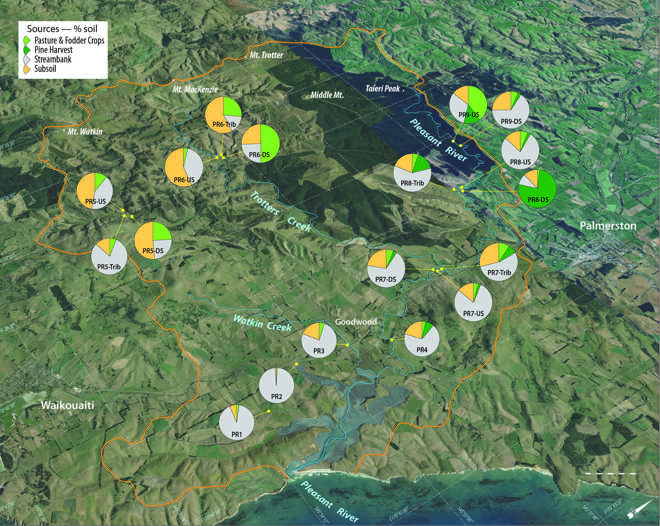 |
A map showing the main sources of sediment in the Pleasant River (Te Hakapupu) catchment
|
You can read more about the science and monitoring efforts being carried out in Te Hakapupu, including NIWA’s sediment reports, on the project’s new Science and monitoring web page.
|
|
|
|
|
Acknowledgement of landowners
|
On Thursday 15 February, the project team celebrated the progress made so far with a special event hosted by project partner Kāti Huirapa Rūnaka ki Puketeraki at the Huirapa Marae in Puketeraki.
A large part of the work completed over the last 12 months has been achieved thanks to landowners from properties in Te Hakapupu who, as early adopters, helped contribute to fencing and planting of native trees on their land. These efforts will go a long way to help stabilise the banks of waterways in Te Hakapupu and enhance the health and mauri/vital essence of the rivers and estuary in the Pleasant River Catchment.
A pōwhiri welcomed manuhiri (visitors) onto the marae. Food and conversation were shared, before Kāti Huirapa whānau shared their whakapapa in relation to Te Hakapupu and the things they are doing as part of the project. This included cultural health monitoring, fish passage work, and a short preview of a documentary they are producing that aims to tell the story of the awa and its diverse and layered ecologies.
The landowners who were able to attend the event shared some words about their experiences with the project and how easy and pleasant it had been. They were then presented with a plaque and thanked for their contribution.
Councillor Kevin Malcolm was also present and spoke briefly in support of the project and partnership.
Everyone in attendance was also treated to a visit to the nursery in Puketeraki, which connected landowners to the place in which their trees were grown and the people behind the scenes of this large undertaking.
Ka pai to everyone who has been a part of this wonderful project and journey so far!
|
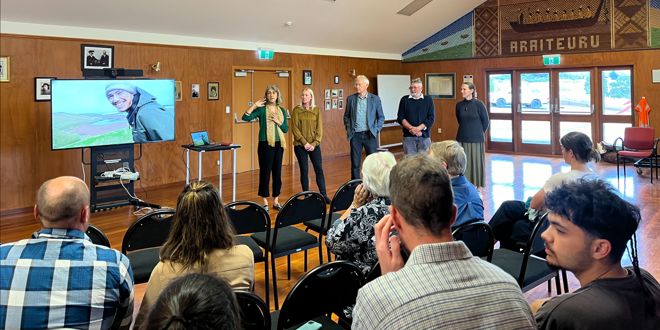 |
Members of the Partnership Group speaking at a recent event at Huirapa Marae in Puketeraki, acknowledging landowners for their contribution to the project.
|
|
|
|
|
How can you get involved in the project?
|
If you’re a landowner with part of Te Hakapupu / Pleasant River running through your property and are keen to find out how you can be part of this project and help improve the health of the river, you can register your interest here.
If you’re curious about what other landowners have achieved so far or are still on the fence and want to know more, feel free to drop an email to the team at tth@orc.govt.nz
|
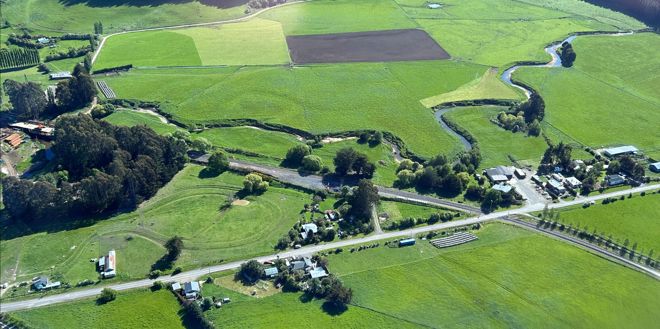 |
Te Hakapupu winding its way through Goodwood between Goodwood and Brooklands Roads.
|
We are in the final stages of developing a draft Catchment Action Plan. If you couldn’t make it to our community hui, or have additional thoughts you’d like to add that may help us develop this plan, please share your ideas with the project team by completing this survey.
There will also be a chance to be involved in environmental monitoring, for example, vegetation and bird surveys, eDNA sampling and water quality testing. We’ll also need volunteers for planting days.
Keep up to date on the project by subscribing to this newsletter, if you haven’t already, and watching for the latest news on Facebook at Otago Regional Council, Kāti Huirapa Rūnaka ki Puketeraki and East Otago Catchment Group.
You can catch up on the journey so far in our previous newsletters.
|
|
|
|
|
Contacts
|
If you have any questions or would like to talk with us, please don’t hesitate to get in touch.
Otago Regional Council Project Delivery Specialist
Melanie White
Email melanie.white@orc.govt.nz
Ph 027 357 2568
Otago Regional Council Project Engagement Officer
Soraya Engelken
Email soraya.engelken@orc.govt.nz
Ph 022 452 3818
Kāti Huirapa Rūnaka ki Puketeraki Representative
Katharina Ruckstuhl
Email katharina.ruckstuhl@otago.ac.nz
East Otago Catchment Group
Steph Scott
Email eocatchmentgroup@gmail.com
Ph 027 438 7875
|
|
|
 |
|
|
|
|
|
|
|


