-
-
-
-
-
-
-
-
-
-
-
-
-
-
-
-
-
-
-
Lower Clutha Rohe
-
-
-
-
-
-
-
-
-
-
-
-
-
-
-
-
Under national legislation, regional councils must manage waterways at an appropriate scale for setting freshwater objectives and limits.
We have set five Freshwater Management Units (FMUs) and divided the Clutha/Mata-Au FMU into five rohe (areas) as it is the largest river in the country, by catchment and volume.
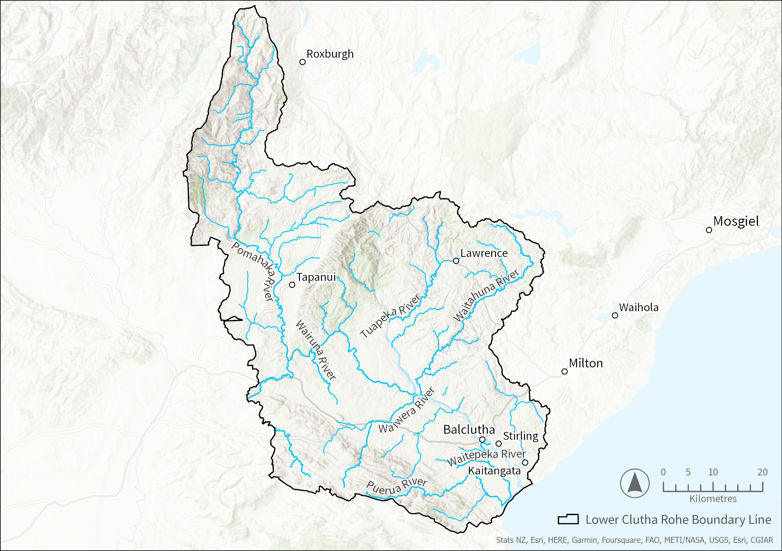
The Lower Clutha Rohe covers over 4,000 square kilometres. It has the Pomahaka catchment and several other river catchments that feed the Clutha/Mata-au including the Waiwera, Tuapeka and Waitahuna catchments, and smaller tributaries.
The rohe also includes Lake Tuakitoto, a small shallow lake with an adjoining wetland of a type now rare in Otago.
The Clutha/Mata-au River is important in Kāi Tahu traditions and history, and mana whenua have an ongoing relationship with wāhi tupuna (landscapes and places that embody the relationship of mana whenua and their culture and traditions) and mahika kai (the gathering of foods and other resources, the places where they are gathered, and the practices used to gather them) values. The river and its tributaries supported seasonal settlements and plentiful mahika kai. The Pomahaka River was important for people settled in the Catlins and Tautuku areas, and the coastal area at the mouth of the Mata-au/Clutha River offered a bounty of mahika kai, including eeling and harvest of other freshwater fish in lagoons and up the river.
Lower Clutha includes the townships of Lawrence, Tapanui, Clinton and Balclutha. The Otago goldrush began in Gabriel’s Gully near Lawrence, and the rohe still contains reminders of its mining past. The gold rush, the history of agriculture, and coal mining in Kaitangata provide the area with many heritage sites.
As of 2018, the Lower Clutha Rohe had approximately 12,000 residents (5% of the population in Otago and around three people/km2). This was an increase of around 200 people (or 1%) from 11,800 residents in 2006. The growth rate in the Lower Clutha Rohe is lower than that of the Otago region (+16%). Just under half of the residents live rurally, around a third live in Balclutha, and the rest of the population (approximately 20%) lives in four service centres of Tapanui, Kaitangata, Benhar-Stirling and Lawrence.
The local economy in the Lower Clutha Rohe relies heavily on water resources for primary production and primary goods processing. In 2020, the largest employment industries were primary and associated food manufacturing industries, which together provided more than half of all jobs in the rohe. Water is used to grow and dispose of food, and to dispose of the associated waste. Tourism-related industries are relatively small compared to other parts of Otago. They consist of retail trade (6% of all jobs), accommodation and food services (4%), and arts and recreation services (0.4%).
It is important to understand Māori history and the Māori economy when developing policy and assessing its impact. Pre-European Māori history shapes today’s Aotearoa, and the Māori economy is integral to the national economic system. A report prepared by Aukaha, with support from ORC, provides a Kāi Tahu assessment of the socio-economic impacts of freshwater management in Otago.

The most common land cover is high-producing grassland where a lot of the intensive agriculture occurs.
Dry stock farming consists mainly of pasture grazing beef cattle, sheep, and deer for meat, wool, and velvet production. While dry stock farming has decreased by 9%, it still remains the main land use in the Lower Clutha area and accounts for 56% of the rohe. 41% is sheep and beef; 7% mixed sheep, beef, and deer; and 8% sheep farming.
Dairy farming occurs on approximately 17% of land and has notably increased by 37% between 1990 and 2018.
Forestry has increased by 39% between 1990 and 2018 and now covers 9% of the rohe. Lower Clutha is about 7% conservation estate which has increased by 40% in the last 30 years.
Soil types include Brown, Melanic, Gley, Pallic, Recent, Organic, Anthropic and Podzols. Brown and Pallic soils are the main soil types and cover 45% and 42% of the rohe. Sheep and beef farming uses a large area of the Lower Clutha and is on high-producing exotic grasslands on Brown and Pallic soils.
Melanic soils cover 5% of the rohe and occur on ranges in parts of the Kaihiku stream, Pomahaka and Waiwera river catchments. Gley soils occur on 3% of the rohe, on alluvial deposits in lower areas.
Lower Clutha Rohe land use summary
The most significant water feature in the Lower Clutha Rohe is the Clutha/Mata-Au River, which flows to the coast and into the Pacific Ocean downstream of Balclutha. The Clutha/Mata-Au River is the largest by area and flow and is the second longest river in New Zealand. The Roxburgh power station highly modifies the flows between Roxburgh and Balclutha.
The headwater catchments of Lakes Wānaka, Whakatipu and Hāwea cover just 34% of the total Clutha/Mata-Au catchment area but generate 75% of the Clutha Mata-Au flow measured at Balclutha.
The Clutha Mata-Au has many tributaries in this rohe. The largest is the Pomahaka catchment which covers about 60% of the rohe area.
The Pomahaka can significantly affect the flows at Balclutha when it floods. About one-third of the water used in this rohe is in the Pomahaka catchment.
Water quality in the Lower Clutha rohe is generally degraded with high bacteria, high nutrient concentrations and poor water clarity. High-intensity agriculture is the main land use, and drainage via tile and mole drains has been a significant source of water contamination. ORC monitors water quality and ecology of rivers, streams, and lakes. The combined results can show the health of a water body, and analysis of long-term data shows trends in water quality over time.
Fourteen of 15 river sites we monitor for bacterial water quality failed to meet the required standard for E. coli, an indicator of faecal bacteria. About half of the river sites in this rohe did not meet the required standard for suspended fine sediment, which indicates water clarity.
Five sites had substantially elevated dissolved phosphorus concentrations. 25% of the sites monitored had degraded aquatic insect life. Lake Tuakitoto did not meet the national bottom line for chlorophyll-a (algae) and nutrients (concentrations of nitrogen and phosphorus).
The 20-year analysis showed degrading trends for rivers at most sites, particularly for nutrients (nitrogen and phosphorus). Our 10-year analysis indicated improving trends for most parameters across most sites in the rohe. Ten-year trends for Lake Tuakitoto show a degrading trend for phosphorus but improving trends for E. coli and suspended solids (water clarity).
LAWA Macroinvertebrate Community Index
Lower Clutha Rohe Water Quality State and Trends Technical Report
Introduction to water quality
Lower Clutha Rohe water quality summary
The Lower Clutha rohe contains the Pomahaka alluvial ribbon aquifer and the Inch Clutha gravel aquifer, which straddles the Lower Clutha rohe and the Catlins FMU.
The Inch Clutha gravel aquifer is found in the 130km2 Clutha Mata-Au delta, an alluvial deposit-filled valley formed by interactions between the Clutha/Mata-Au River and historical sea level fluctuations. The aquifer is a potentially significant resource for groundwater, given its size and thickness, but generally, groundwater use is low. ORC monitoring shows that the groundwater here has high ammonia and naturally occurring arsenic compared to the NZ Drinking Water Standards (DWSNZ, 2018; ORC, 2021).
The Quaternary alluvium consists of gravels, sands, silts, mud and peat. This complex geology means that permeability and connections with surface water vary across the Inch Clutha aquifer. We have recently installed groundwater monitoring bores to enable us to better understand the groundwater levels and monitor for saline intrusion into freshwater aquifers.
Our bore log data indicates the water table is shallow, less than three metres in places on the flood plain, and four to six metres on elevated terraces. The Inch Clutha area has a network of drains and pumps, which lower the water table on cultivatable land and lessen the flood hazard.
The Pomahaka alluvial ribbon aquifer is a series of narrow areas that follow the Pomahaka River from the upper Kelso basin to the lower Clydevale sub-basin. The gravels of the Pomahaka alluvial ribbon aquifer occur along gravel boundaries deposited by the Pomahaka River. The aquifer connects to the Pomahaka River, so groundwater bores within the ribbon aquifer are assigned to surface water.
Groundwater is often taken from fractured rock across the rohe, especially in the Pomahaka basins and into the Catlins FMU. This water resource is not mapped as an aquifer but is a locally important water source, particularly for stock water and servicing dairy sheds.
The Lower Clutha rohe is home to rare and threatened ecosystems and species. The vulnerable ecosystems include ephemeral wetlands, estuaries and wetlands. These ecosystems contribute enormously to national biodiversity, but are often threatened by processes such as land use change and invasive species. In many cases, we know little about the extent and/or condition of these ecosystems.
The Lower Clutha rohe has many species that depend on freshwater habitats and ecosystems, including fishes, invertebrates, plants and birds. We have identified 32 threatened freshwater-dependent species in the rohe. Threatened freshwater fishes are the Clutha flathead galaxias, gollum galaxias, Pomahaka galaxias, dusky galaxias and lamprey.
Freshwater invertebrates are koura and mussels, a threatened moth, caddisfly and stoneflies. Carex strictissima and Ranunculus ternatifolius are examples of threatened freshwater-dependent plants found here.
Many native birds depend on freshwater ecosystems, permanently or as mobile residents, including the threatened Australasian bittern, the threatened black-fronted tern and the at-risk black-billed gull. We lack information for many species, particularly for freshwater invertebrates, non-vascular plants, and algae.
Exotic fishes are goldfish, perch and four salmonids. Many native freshwater species are under threat, and their numbers continue to decline.
There are 28 sites in the rohe recognised as Regionally Significant Wetlands in the Regional Plan – Water for Otago (RPW). These are classified as swamp (12 sites), marsh (7), fen (6), and bog (2). These wetlands are found within five areas: Inch Clutha, Kaitangata, Clinton, Tapanui, and Lawrence.
On the seaward end of Inch Clutha, is the Molyneux Bay Swamp (150 hectares) which is a lagoon with swamp-edged fingers. Also in the Inch Clutha area is the Clutha/Mata-Au River Mouth Lagoon (29 hectares), an elongated water body with marsh margins; and the Clutha Matau Wetlands (21 hectares), a river-margin swamp.
Further upriver, the Culcairn Oxbow Marsh (8 hectares) is a curved pond of a former oxbow channel, marsh-fringed, in farmland. Finegand Lagoon Marsh (6 hectares), south of Balclutha, is a stream pond with willows and rush marshes.
Lake Tuakitoto Wetland (546 hectares) is located near Kaitangata. It is a shallow lowland lake bordered by sedge grass, rush swamp but with many crack willows. Smaller wetlands occupy fingers of stream valleys, as rush marshes, some with ponds and willows, or swamps with flax, shrubs, and red tussock. These smaller wetlands include the Frasers Stream Headwaters Marsh Complex (26 hectares); Stirling Marsh Complex (11 hectares); Camp Stream Swamp (8 hectares); Two Stone Hill Stream Swamp (5 hectares); and East Benhar Swamp (2 hectares).
Wetland sites in the Clinton district are remnants of former copper tussock country, which are the boggiest sites. These typically contain copper tussock, wire rush, sphagnum moss, sedge grasses, some heathland and coprosma shrubland. These wetlands are all on farms: Dunvegan Fen Complex (87 hectares); Three Stones Fen Complex (58 hectares); Hazeldale Fens (10 hectares); and Willowburn Bog (four hectares), where silver birch trees behave as weeds in the peatland. Macfarlane Road Oxbow Swamp (two hectares) and Marana Swamp (two hectares) are small, isolated hollows with ponds and willows.
To the east of the Blue Mountains, John O’Groats Hill Fen (22 hectares) and Blackcleugh Burn Swamp (three hectares) have red tussock wetlands on valley flats. The tops of the Blue Mountains, at around 900m altitude, have sphagnum moss and cushion bogs, but these are not currently listed in the RPW.
Farmland near Tapanui is home to three small marshes: the Clifton Hill Marshes (four hectares) with copper tussock, the Pomahaka River Oxbow Marshes, Dalvey (four hectares) and Koi Creek (two hectares), both with ponds and willows.
North of Lawrence, Bungtown Bog (28 hectares) is a bog with sphagnum moss, wire rush and bog pine – part of it is scientific reserve. Glendhu Swamp (22 hectares) has valley floor copper tussock, while Malones Dam Margins (two hectares) has a small swamp at one end.
In the north of the rohe, there are more upland wetlands (cushion bogs, snowbanks, sedge grass fens), which are not currently listed in the RPW. These are found in the headwaters of the Pomahaka by the Umbrella Range.
The Clutha/Mata-Au River has a tidal mouth where it joins the sea. The water at the river mouth is mostly freshwater as it is flushed regularly by the river. This regular flushing lowers the risk of contaminants building up and settling on the estuary bed where they can cause algal blooms.
Because most fine sediments and nutrients are flushed out to sea, no estuary nutrient modelling has been done and no limits/attributes can be measured or set for the river/coast interface.
November 2022
PDF | 656 KB
January 2003
PDF | 9 MB
July 2023
PDF | 523 KB
June 2023
PDF | 502 KB

September 2024
Aukaha (1997) Ltd
PDF | 4 MB
This report provides a Kāi Tahu assessment of the socio-economic impacts of freshwater management in Otago, which speaks to the development of a new Land and Water Regional Plan for Otago (LWRP).
November 2022
PDF | 1 MB
Contact your rohe Catchment Advisor for advice and assistance on sustainable land management practices that protect Otago’s waterways.
Sign up to our monthly newsletter On Stream for regular updates
Email customerservices@orc.govt.nz
Tel 0800 474 082


