-
-
-
-
-
-
-
-
-
-
-
-
-
-
-
-
-
-
-
North Otago FMU
-
-
-
-
-
-
-
-
-
-
-
-
-
-
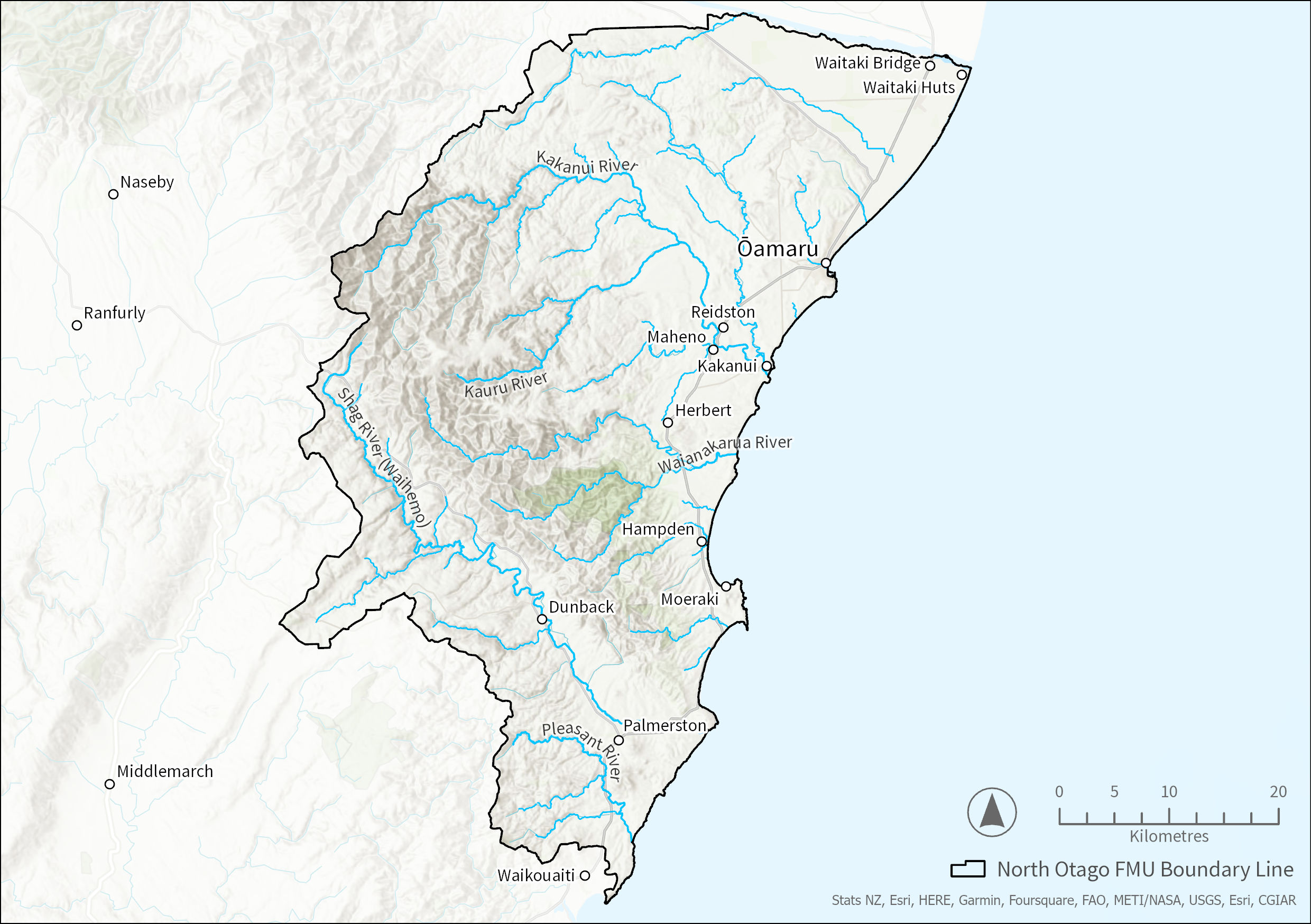
The North Otago Freshwater Management Unit covers about 296,000 hectares and extends from Waitaki Bridge down through Oamaru, Moeraki, and Palmerston townships to the bottom of the southern branch of the Waikouaiti River. It includes coastal margins to the north and east of Waitaki and Oamaru and the coastal strip from Glen Creek to the Waikouaiti River. Some major rivers within the FMU include the Kakanui, Shag, Waikouaiti and Pleasant.
High natural character values exist in the upper catchments of the Kakanui and Waianakarua rivers, Trotters Gorge, and the south branch of the Waikouaiti River.
Oamaru dominates the main urban areas. Semi-rural areas have a mixture of residential activities, including retirement homes, lifestyle blocks, and medium-sized farm holdings.
In Kāi Tahu tradition, the creation of the Kakaunui (Kakanui) River relates in time to Te Waka o Aoraki, the shaping of the island and the stocking of the waterways and forests. Historically, this river was an essential part of the coastal trails north and south. It was also part of the seasonal trail of mahika kai (resource gathering) and hapū and whānau bonding.
There are surviving rock art remnants and rock shelters associated with these activities, which are a particular taoka (treasure) of the area and provide a unique record of the lives and beliefs of tūpuna (ancestors).
This Economic summary covers an area smaller than the North Otago FMU. The reason for this is that the communities at the southern end (i.e., Buckland’s Crossing, Waikouaiti and Karitane) have closer socio-economic ties with Dunedin than Ōamaru. These areas are included in the Economic Snapshot for Dunedin and surrounds. Therefore, the analysis in the North Otago Snapshot focuses on communities located in Waitaki district who have economic ties with Ōamaru. For the purpose of this analysis, this area is referred to as Otago North.
In 2018, Otago North was home to around 20,000 residents (or around 9% of the population of Otago). In the 12 years between 2006 and 2018, there was a 10% (or 2,000 people) increase in population. Although this growth is lower than the average for Otago (+16%) or New Zealand (+17%), it is still sizable for a small population base. Most residents (nearly two in three) live in Ōamaru, while over one-quarter of the population lives in rural areas. The remaining 10% is settled in smaller rural service centres, i.e., Palmerston, Kakanui, Hampton, Maheno, Moeraki, and Herbert.
The local communities and economy in the North Otago area are especially reliant on water resources. The FMU contains the largest proportion of primary production land uses (89%) amongst all of Otago’s FMUs and both primary production and food processing require water as a necessary input. Local tourism is also dependent on water’s aesthetic value and ecosystem services (e.g., being part of the natural landscape and maintaining green spaces).
There are six main industry sectors in Otago North, providing more than two thirds of all jobs here. The Manufacturing industry and Tourism Related industries provide around 21% and 19% of all jobs respectively. Agriculture (10%), Health Care and Social Assistance (8%), Education and Training (7%), and Construction (7%) account for another one third of the employment in the area.
An understanding of Māori history and the Māori economy is essential for policy development and policy impact assessment. Not only does pre-European Māori history help shape modern day New Zealand, but the Māori economy is also integral to the New Zealand economic system. A report prepared by Aukaha, with support from ORC, provides a Kāi Tahu assessment of the socio-economic impacts of freshwater management in Otago.

The main land covers in the North Otago FMU are high and low-producing exotic grasslands, exotic forests, and tall tussock grasslands. High-producing exotic grasslands are the most common, covering approximately 44% of the FMU.
Dry stock farming is the main land use and accounts for 58% of the FMU. This is for the most part sheep and beef (45%); with some mixed sheep, beef, and deer (6%); beef (5%); and sheep farming (2%). Dairy farming occurs on approximately 12% of the FMU. Forestry and conservation estate occur in 7% and 6% of the area.
The notable trends in land use change over the past 30 years have been an increase in dairy farming by 57%, forestry by 67%, and conservation estate by 117%. The area of dry stock farming has decreased by 12%. However, it remains the main land use activity in the North Otago area.
Rich, volcanic soils produced food crops for early Māori and now for farmers, despite the dry climate. Land use has tended towards more water-demanding activities, including dairying, since the late 1990s, with water quantity pressures faced most acutely during dry and low-flow periods.
Brown soils are the most common soil type, covering 51% of the FMU. The land cover associated with this soil type is mainly high-producing exotic grasslands and forests. These occur in catchments such as Waianakarua and parts of Kakanui and Waikouaiti.
Pallic soils cover 40% of the FMU and appear in Waiareka Creek, Waikoura Creek, Awamoko Stream, and parts of Pleasant River catchments. Pallic soils have moderate to slow permeability and poor drainage.
North Otago FMU land use summary
North Otago is sheltered from wind and rain from the west but is exposed from the east. Westerly quarter winds and rainstorms affect the west and south of the South Island but bring very dry conditions to North Otago, which occasionally bring droughts, especially in summer and autumn.
The less frequent storms bringing easterly quarter winds and rain to this region provide the occasional heavy rainfalls, which can bring floods to the North Otago rivers and streams. A prolonged lack of these storms usually results in drought-like conditions in North Otago.
The main water use in this area is for irrigation, especially in very dry seasons, and low flows can be significantly affected by this. The construction and operation of the North Otago Irrigation Scheme has slightly eased the low flow situation in the Kakanui catchment, especially the Waiareka tributary.
This scheme, which draws water from the Waitaki River, has the capacity to extend further into, and south of, the Kakanui catchment and further ease pressure on low flows during dry periods. Extension of this scheme into the Shag catchment is not yet achievable.
Water quality in the North Otago FMU shows some degradation. There is pressure from land use and, at times, from low flows. Rivers in dry catchments have less dilution and flushing capacity, i.e., low levels and a higher concentration of contaminants. They are more susceptible to high nutrients and other water quality pressures associated with high-intensity land use.
ORC monitors the water quality and ecology of rivers, streams, and lakes. When the results are combined, they can show the health of a water body, and long-term data is analysed to show trends in water quality over time. We have been monitoring some sites in this FMU for less than five years, so some water quality states and trends are interim results.
Fourteen of sixteen sites monitored did not meet the required standard for at least one measurement. Water quality is most degraded in the Waiareka, Awamoko and Oamaru Creeks. These sites had elevated phosphorus and E. coli (faecal indicator bacteria).
Of the 14 sites only the three Shag River sites obtained an A band for E. coli. Of the eight sites monitored for aquatic insect life (measured by the MCI — Macroinvertebrate Community Index) only one site (Kauru) showed pristine conditions.
Oamaru Creek is the only urban creek monitored in this FMU. Stormwater discharges from urban environments affect water quality, increasing E. coli and nutrient concentrations.
Trend analysis for the North Otago FMU rivers showed some degradation at most sites, with many trends appearing in both the 20-year and 10-year analysis periods.
The Waianakarua River shows continuing degradation over the last 10 years for E. coli and nitrogen. Waiareka Creek over the same period shows degradation for phosphorus, but improvements for nitrogen and turbidity (visual clarity).
North Otago FMU Water Quality State and Trends Technical Report
Introduction to water quality
North Otago FMU water quality summary
The North Otago FMU contains several different aquifer types, including confined, unconfined, and alluvial ribbons. Unconfined, shallow aquifers within this FMU include the lower Waitaki Plains aquifer, the Kauru-Kakanui Alluvial Ribbon aquifer, and the Shag Alluvial aquifer.
The lower Waitaki Plains aquifer does not have much irrigation demand because the lower Waitaki Irrigation Scheme services the area. However, this aquifer has elevated nutrient loads, such as nitrate and dissolved reactive phosphorous (DRP), when compared to the New Zealand drinking water standards (DWSNZ, 2018; ORC, 2021).
South of Oamaru is the North Otago Volcanic aquifer. This aquifer is heavily used for irrigation, domestic use, and stock water, and is considered fully allocated. Our groundwater quality monitoring shows high nitrate concentrations and DRP (ORC, 2021).
The Kauru-Kakanui Alluvial Ribbon aquifer and the Shag Alluvial aquifer are ribbon aquifers highly connected to surface water. The high connectivity means contaminants in groundwater can affect surface water quality and vice versa. Groundwater use from these two alluvial ribbon aquifers is allocated against surface water.
Lastly, the deep, confined Papakaio aquifer underlies a large portion of the northern section of the North Otago FMU. This aquifer is divided into a series of groundwater basins, with depths from less than 10m to more than 400m deep. Some areas are under above-ground artesian pressures.
The aquifer is hosted within Cretaceous-aged gravels and contains water dated to nearly 25,000 years old. Due to the old age of the groundwater and the naturally elevated iron, manganese, and dissolved reactive phosphorous, the water has limited appeal for domestic use, stock water or irrigation. The Papakaio aquifers are not available for further allocation.
The North Otago FMU is home to rare and threatened ecosystems and species. The vulnerable ecosystems include braided rivers, ephemeral wetlands, tarns, lake margins, string mires, and wetlands. These ecosystems contribute enormously to national biodiversity; however, are often threatened by processes such as land use change and invasive species. Little is often known about the extent and/or condition of these ecosystems.
The North Otago FMU has many species that depend on freshwater habitats and ecosystems, including fishes, invertebrates, plants, and birds. There have been 44 threatened freshwater-dependent species identified within the FMU. The threatened freshwater fishes include Canterbury mudfish, lowland longjaw galaxias, Taieri flathead galaxias, and lamprey.
Threatened freshwater invertebrates include moths and a stonefly, with koura being at risk. Freshwater-dependent plants that are threatened include Carex strictissima, Ranunculus ternatifolius, and Myosurus minimus subsp. novae-zelandiae.
Many native birds depend on freshwater ecosystems as permanent or mobile residents, including the threatened black stilt, the threatened black-fronted tern, and the at-risk, black-billed gull. Information is often missing at a species level, particularly for freshwater invertebrates, non-vascular plants, and algae.
Exotic fishes include perch, tench, and three salmonids. Many native freshwater species are under threat and continue to decline in number.
Within the North Otago FMU, 17 sites are recognised as Regionally Significant Wetlands (RSWs) in the current Regional Plan: Water for Otago (RPW). These are classified as swamp (8 sites), marsh (3), salt marsh (3), and unclassified (3). Except for Red Bank Wetland Management Area (122 hectares) in the Macraes area uplands, all sites are coastal, mainly lagoons and estuaries associated with river and stream mouths.
Five sites are grouped close to Karitane and the Waikouaiti Estuary, the largest being Waikouaiti River Estuary Wetland Complex (71 hectares) and Hawkesbury Lagoon (43 hectares). A further eight such sites are scattered along the coast to the north, the largest being Pleasant River (84 hectares), Shag River (14 hectares) and All Day Bay (11 hectares).
The Pleasant River Estuary supports a large saltmarsh complex with marginal shrublands, a diverse range of bird species and an important, poorly described invertebrate fauna. Other estuaries and lagoons along the coast include additional distinctive lagoon and estuarine habitats, depending on the behaviour of the rivers as they near the coast. Many are protected and part of active restoration programmes, while others are subject to regular livestock grazing.
Inland, several rare wetland habitats are found. The only inland RSW, Red Bank Wetland Management Area, has wetlands among snow tussock, shorter grassland, and shrubland. The wetter soils have red tussock grassland, schoenus fens, sphagnum moss land, and examples of ephemeral wetlands. Ephemeral wetlands are common and associated with uplands around Nenthorn on the ancient schist peneplain. Several threatened plant species (e.g., Isolepis basilaris and Myosurus minimus subsp. novae zelandiae) are associated with these ephemeral wetlands.
No wetland sites have been identified yet in the RPW from the Kakanui Mountains. Potential areas for further recognition are in the Dansey Ecological District, e.g., near Mt Stalker and Mt Dasher. Wetlands in these uplands include copper tussock grasslands and cushion bogs.
There are four estuaries in the North Otago FMU: the Kakanui, Shag, Pleasant River and Waikouaiti. Modification and pressures vary from more intensive agricultural land use in the Kakanui to forestry and low-intensity agriculture in the other catchments. The estuaries cover a range of ecological conditions, and they are habitats for many species of wildlife, such as bar-tailed godwits, variable oystercatchers, flounder, and shellfish beds. ORC regularly monitors all estuaries in this FMU.
The Kakanui estuary is a shallow, short-residence time tidal river estuary (SSRTE) that can close to the sea when flows are low. It is vulnerable to nutrients and shows eutrophication via macroalgal blooms, especially when flows are low, or the mouth is closed.
The Shag River is under stress from sediment and showing signs of nutrient enrichment with nuisance algae growth below the tide but not between high and low tide areas. The areas with high mud content are primarily in sheltered arms in the upper estuary and along channel banks and sheltered areas in the main basin. There is a large expansive salt marsh, and the estuary supports a variety of substrates (natural elements on which organisms live or move over). Combined with the sediment issues, this places the estuary in a “fair” condition for ecological health.
The Pleasant River estuary is more degraded than the other estuaries and has large areas of high enrichment conditions. It has nuisance macroalgae, high mud content and poorly oxygenated sediment, especially in the side arms and deposition areas. These are signs of sediment and nutrient stress. The indicators of estuary health in the Pleasant River range from “fair” to “poor”, except for the salt marsh. The salt marsh is still extensive around the estuary and in a “very good” condition.
The Waikouaiti estuary supports various substrate types, small high-value seagrass beds and large salt marsh areas, with a healthy cockle bed in the lower estuary. However, there are signs of sediment stress in the upper estuary with higher mud content in sedimentary areas and side arms. Low levels of nuisance macroalgae are present in patches, indicating some nutrient stress is influencing the estuary.
North Otago FMU science summary
Management Flows for Aquatic Ecosystems in the Shag River Waihemo
Minimum Flow Assessment For Six Otago Streams And Rivers 2008
Shag Estuary Broad Scale Habitat Mapping 2016/ 2017
Shag Estuary Fine Scale Monitoring 2016 / 2017
Flow Naturalisation for the Shag River
Flow Naturalisation Island Stream in Kakanui catchment
Flow Naturalisation of Kakanui River
Flow Naturalisation of the Waikouaiti River
Shag River Nutrient Study
Synthesis of Groundwater Investigations in Lower Waihemo Shag Valley
Waiareka Creek Hydrology Report June 2023
November 2022
PDF | 1 MB

September 2024
Aukaha (1997) Ltd
PDF | 4 MB
This report provides a Kāi Tahu assessment of the socio-economic impacts of freshwater management in Otago, which speaks to the development of a new Land and Water Regional Plan for Otago (LWRP).
Contact your FMU's Catchment Advisor for advice and assistance on sustainable land management practices that protect Otago’s waterways.
Sign up to our monthly newsletter On Stream for regular updates
Email customerservices@orc.govt.nz
Tel 0800 474 082


