Regulatory update
Welcome to another edition of our newsletter from the Regulatory group. The Regulatory group includes the Consents, Compliance, Investigations, Harbourmaster and the Regulatory Systems and Data teams.
Keep reading to get the latest news from the Regulatory Team at ORC, meet new staff who are here to help and get updates on changes to process and interpretations.
In this issue we:
- Remind you of our public enquiries team
- Highlight dairy effluent consents are almost due
- Provide more intensive winter grazing information
- Make you aware of our consent fund
- Point you to our new Earthworks Guide
- Link to new resources, including application and booking forms
- Spotlight our new Environmental Data Portal
- Introduce you to another member of the ORC team
From the Consents Team
Online application forms
An exciting project for the consents support team is well underway where we are building online versions of the consents PDF application forms. The new online forms will enable customers to experience an easier and quicker way to complete a consent application.
Think online shopping, but for consents.
We have a number of forms live now on our website with more coming very soon.
Public enquiries
Do you have a question about any of the following?
- Consents
- Regional plans
- National legislation
We can help!
We have a dedicated Resource Consent Public Enquiries team that will offer you advice on rules and plans no matter where you are in the process, saving you time and worry. They have a very quick response time of up to three days where they will provide you with the relevant information to your query.
They have four points of contact:
- Email — public.enquiries@orc.govt.nz
- Phone — 0800 474 082
- In-person appointments — Booking form
- Walk ins — Level 2 — Philip Laing House, 144 Rattray Street, Dunedin
Reach out to us now so we can help get the ball rolling!
Pre-applications
Have you heard of our pre-application service?
This service is available to all who have in-depth questions relating to a consent application or process.
It is an opportunity for us to answer your specific questions relating to the consenting process, an application you are preparing, or to assist in determining the best next steps.
Processing an application is generally simpler, quicker and less costly if the applicant has already sought the council's advice on the relevant plan provisions and information requirements before making an application.
We provide you with information and guidance to ensure you have a good understanding of what needs to be done, before you submit your application.
To request a pre-application meeting, you can do either of the following:
- Email public.enquiries@orc.govt.nz
- Complete the pre-application form and send it to the above email address.
Dairy effluent consenting
Otago farmers are being reminded that consent applications must be in by early June for some farmers regarding future animal effluent storage and discharge of animal effluent to land. Last year’s effluent rule changes offer greater protections for keeping Otago’s waterways healthy.
Ultimately, these protections are to safeguard the future of waterways, which directly support various natural eco-systems.
The new provisions introduced last year include setting minimum standards for animal effluent storage and its application to land, and for the establishment of small in-stream sediment traps.
Farmers need to start thinking about the volume of effluent storage they have on their farm, and when they need to potentially install new storage facilities or have the resource consents in place to do so.
It is not only dairy farms that are covered by the rules; other farm types where liquid animal effluent is collected may also need consent — we recommend that people check in with the ORC’s Consents Team.
The first series of consent applications need to be in by 4 June 2023, which may seem like a few months away yet, but it would be best for farmers to get onto these applications now.
ORC staff are here to help farmers and have plenty of resources available:
- Advice can be sought from public.enquiries@orc.govt.nz
- ORC Catchment Advisors can be contacted on 0800 474 082
New application forms on the way
We are currently working on updating our forms and templates to cover activities associated with constructing wetlands/other environmental enhancement projects as we have found a need for a simpler pathway to getting resource consent for these activities.
The updates include:
- A new consent application form which will include all relevant consent triggers for ease of use
- A new template report for consent planners to use to reduce time and costs spent processing the application
We are also working to update our application forms around damming water consent requirements. Often there are multiple activity triggers to undertake this work, so having one form to fill out should make the process more streamlined.
Consent fund
Often community and catchment groups are involved in environmental enhancement projects such as wetland restorations, fencing of waterways, riparian planting or creating walkways for their communities. Parts of these projects may require resource consents from us.
Before your project can get off the ground you may need funding for consents.
We have a fund available to help with the consent fees associated with projects where there is an environmental benefit. This fund applies to consent processing fees alongside the compliance and administration costs associated with the granted consent. We have a total fund of $50,000 annually for this purpose.
Before you apply for processing fees support, you must have a pre-application meeting with a member of our consents team to discuss your application. Funding support for fees is not guaranteed.
To organise a time for this meeting, call us on 0800 474 082 or email public.enquiries@orc.govt.nz.
From the Compliance Team
ORC Compliance Plan
The ORC Compliance Plan 2023–2026 sets out the priorities for compliance monitoring and enforcement activities in Otago.
The Compliance Plan supports a responsive and risk-based approach to the allocation of resources for proactive compliance monitoring as well as reactive responses to environmental incidents in Otago.
The priorities are:
- Reduce non-compliant discharges for improved freshwater quality
- Take a proactive and integrated approach to monitoring large-scale activities
- Monitor water takes and use to protect water quantity
- Monitor structures and works in and adjacent to freshwater
- Reduce non-compliant air discharges to improve air quality
- Monitor coastal structures and oil spill preparedness
A more substantive review of the Compliance Plan will be undertaken in 2025 following the development of the Land and Water Plan, and the possible completion of the RM Reform programme.
Earthworks guide
Our Compliance team has put together a new guide to residential earthworks for developers, landowners, contractors and service providers.
The guide provides context to ORC’s residential earthworks provisions, consenting information and ongoing consent compliance requirements.
Along with the guide, we’ve created some easy-to-use forms that you can download and submit by email.
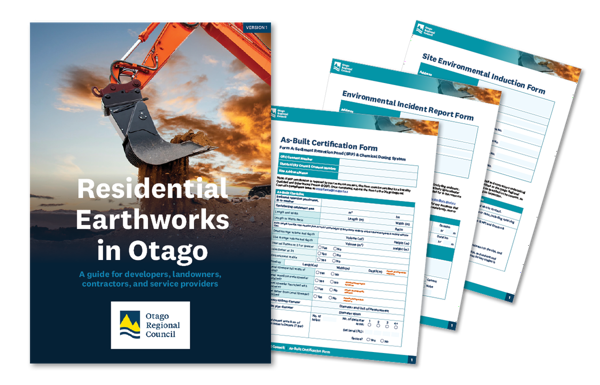
Check out the new Earthworks Guide.
NES for Freshwater online notifications
Under the National Environmental Standards for Freshwater, culverts, weirs, flap gates, fords and dams installed after 3 September 2020 must meet minimum reporting requirements such as height, width and location.
The installation, alteration, maintenance, and removal of some structures is a permitted activity if you can meet the specific requirements, and the information specified is collected and provided to the ORC within 20 working days after the activity is finished.
ORC has developed a series of online notification forms to support the submission of this information.
From the Data Team
Environmental Data Portal
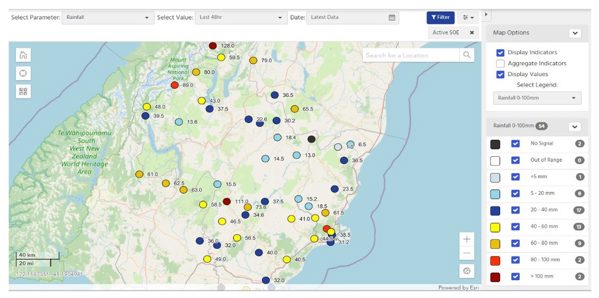
In February, ORC was thrilled to launch our new Environmental Data Portal. This portal is a copy of our internal environmental monitoring systems and provides public access to the raw data we collect. In some cases, this data goes back to the 1930s.
Currently we’re sharing water quantity information and some water quality parameters, with more types of data to be added over time. Quality assured data can be downloaded from the portal.
We encourage you to take a look at the new Environmental Data Portal.
You’ll find user guides and a training video on the welcome dashboard.
As an example of the web portal in action, the image below shows 48 hours worth of rainfall from midday on 20 March 2023.
Quick updates and new resources
Intensive Winter Grazing (IWG)
|
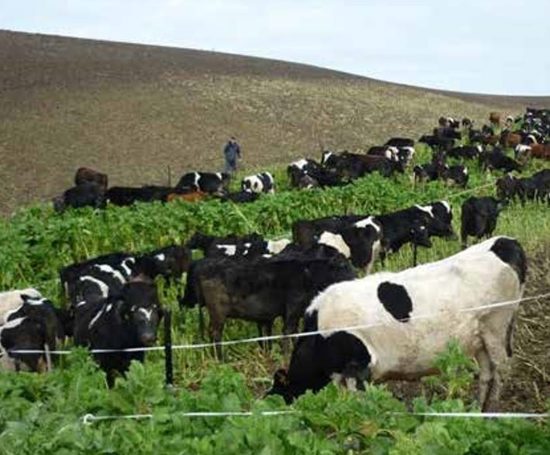
While the deadline for IWG applications was May 1, ORC continued to run “one-on-one” IWG workshops this month where Consent Planners walked farmers through their applications to completion. The focus in recent months has been on education around how farmers can either meet the permitted activity rules, or how to apply for IWG consents — which can cover up to 3-5 year periods. It was great to see so many people applying for consents or adapting their practices to meet permitted activities. We’ve received 250 applications, with over 220 consents issued so far, covering over 20,000 ha for this coming winter. We’re hoping to see a high level of good practice this winter, building on work from previous years. The focus now is how people manage their activity over winter to continue to meet permitted activity requirements and the conditions of their consents. A first round of flyovers, pre-May 1, were over areas historically used for IWG practices and looking at slope, compared with where there was an absence of consents. This data is still being processed. Planning is now underway for the next round of flyovers that will support Compliance by providing targeted information about rules and timeframes and to link farmers with further support. Any questions relating to IWG can be sent to Consents Public Enquiries at public.enquiries@orc.govt.nz. You can also contact ORC’s Catchment Advisors for further information on 0800 474 082. |
 |
| More details |
Farmer
’s Guide
Farmer’s Guide
Farmers are faced with many rules and regulations relating to farming activities.
The Farmer’s Guide on our website is a useful resource designed specifically to equip farmers with the information they may require.
This guide includes information on a range of activities such as:
The purpose of having information on various activities relating to farming is to bring attention to activities farmers may already be carrying out and help educate about the rules and regulations of these activities.
Staff are more than happy to attend site visits, meetings or sessions, or to answer questions about any activities and associate rules.
To request any of these services, please contact Consents Public Enquiries at: public.enquiries@orc.govt.nz
Staff profile

Ollie McPherson
Environmental Data Officer
How long have you worked at ORC?
I have been with ORC since January 2020. What a time to start a new job, right before COVID hit!
I was able to do some of my onboarding and inductions in person, but I finished my training remotely as we transitioned to working from home.
What is your job at ORC? As an Environmental Data Officer, I manage and assess compliance of regulatory data which consent holders are mandated to send in, such as water meter data, water quality data and air quality data.
What do you like about working at ORC? I enjoy knowing that I am making a small positive difference to the management of our local environment and that at the organisation level we are making a large positive difference together. Ehara taku toa i te toa takitahi, he toa takitini - Success is not the work of an individual, but the work of many.
I also enjoy having the opportunity to take a variety of training courses and expand my knowledge about a range of topics that are relevant to my job.
What has been your most challenging experience so far?
I think the most challenging experience so far has been moving from our old data management system called Hilltop to our new Environmental Data Portal.
For about six months, it felt like being in the wild west — every process that we did in the old system we had to replicate in the new system by building it up from scratch.
It has been so rewarding, though, as it has allowed us to filter data in more efficient ways that saves us time and allows us to be more proactive rather than only looking at one dataset at a time.
What’s something most people don’t know about your job or that you most enjoy?
Having most consent holders on telemetry systems where data is coming in daily rather than a yearly submission is so helpful. I enjoy when I notice a problem with the data and the consent holder is proactive in getting this rectified.
For example, I might notice data has stopped coming through, and it turns out the problem is a flat battery in the data logger, which can be replaced now rather than the next time the meter is due for a service.
Or I notice the rate of take has greatly spiked and let the consent holder know about this issue, and it turns out they have a leak in their pipe they did not know about, which they can then get fixed.
Next issue
The next issue of this newsletter will be in September 2023, but we will put out a special issue in advance of this if needed.
You are receiving this newsletter as you regularly interact with the Regulatory Group. This newsletter is just one of the ways that we are looking at providing more information to you as a customer of the Council.
If you have questions about anything in this newsletter, please get in touch with us by emailing public.enquiries@orc.govt.nz or call 0800 474 082.


