Environmental Delivery update
Tēnā koutou katoa,
Welcome to the December edition of ORC’s Regulatory Newsletter.
The Environmental Delivery group (formerly Regulatory group) at ORC includes the Consents, Compliance, Investigations, Harbourmaster, Regulatory Data and Systems, and Environmental Implementation teams.
In this issue, we:
- Update you on some changes to intensive winter grazing (IWG)
- Highlight some current environmental projects
- Point you to our Environmental Data Portal for tracking low flows
- Bring you up to speed on the new fast-track process
- Give brief updates on freshwater farm plans and the Land and Water Regional Plan
- Share some new resources!
From the Consents and Compliance teams
Freshwater farm plans
Regulations for freshwater farm plans are currently paused.
Councils are collectively engaging with Government and industry on what improvements to the system could look like, keeping communities and outcomes at the heart of our efforts. Once this engagement is complete, central government will provide information on the shape of the changes to the freshwater farm plan system and what council will then implement.
A meaningful freshwater farm plan system with consistency across the country and some regional influence will benefit freshwater outcomes and our reputation as world-class food producers.
With the roll-out of freshwater farm plans on hold, we understand this is a time of uncertainty for rural communities, and we are happy to answer any queries from farmers and growers as they come up.
You can reach out to our freshwater farm plans team at farmplans@orc.govt.nz or call us on 0800 474 082.
Fast-track process
The Government released its Fast-track Approvals Bill (Fast-track Bill) on 7 March 2024. The stated objective of the Fast-track Bill is to reduce consenting costs and time frames to enable the efficient implementation of large-scale projects. This Bill is currently in the parliamentary process.
If you, or your clients, are interested in using the fast-track process, then please engage with ORC early in your thinking on your project. To use this process, a pre-application form must be submitted, along with all relevant information for the proposal.
The first 30 minutes of advice is provided free of charge and then cost recovered after that.
A group of representatives across ORC meet regularly to have oversight of all current applications and their status. You can find the pre-application form here:
Intensive winter grazing (IWG)
Changes have been made to the National Environmental Standards for Freshwater (NES-F) that may impact intensive winter grazing (IWG) from next season.
The Resource Management (Freshwater and Other Matters) Amendment Act 2024 has made changes to the rules for IWG. Previously, IWG was allowed without a resource consent if certain conditions were met. If those conditions were not met, people needed to apply for consent.
With the recent changes, the criteria and rules that applied in previous seasons will no longer apply for next winter.
Farmers will need to meet the new regulations around:
- Minimum setbacks of 5 metres from the bed of any river, lake, wetland or drain (regardless of whether there is any water in it at the time)
- No grazing within critical source areas (CSA), maintaining ground cover over the critical source area, and no cultivation or harvesting of annual forage crops in critical source areas
If a consent is in place for IWG that allows grazing within a CSA, or within the specified distance of a waterway, then farmers can continue to operate under the consent, including preparing and having a grazing management plan.
All farmers are encouraged to have a grazing management plan in place for next winter.
During the winter of 2025, we will continue to monitor IWG activities under the updated regulations. We will still conduct our usual annual flyovers, focusing on land disturbance activities.
Over the past few seasons, Otago farmers and primary industry groups have made great progress with IWG management, and it’s important to maintain these gains. We thank you for your management of this activity and for your efforts.
We will be running good management workshops with industry on IWG in the first quarter of 2025 and ORC is already working with primary industry groups and stakeholders on the implementation of the new regulations.
October effluent workshops
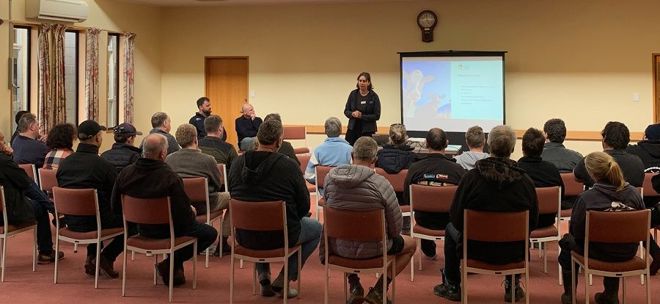
In October we ran dairy farm effluent workshops for consultants in North and South Otago. The aim of the workshops was to provide a space to discuss the current process, answer technical questions and gather feedback. We will run more of these sessions in the new year on a quarterly basis.
The rules for effluent storage and the discharge of effluent to land apply to several hundred farms around Otago. We have had great dairy farmer engagement with these workshops and letters to dairy farmers around the annual compliance programme over the past three years.
Farmers need to be considering:
- The volume of effluent storage they have on their farm
- When they potentially need to install new storage facilities or have the resource consents in place to do so
Land and Water Regional Plan
A draft of the proposed Land and Water Regional Plan (pLWRP) for Otago was scheduled to be considered by Council for a decision on notification on 23 October 2024. However, that decision was deferred after the Government introduced an amendment to the Resource Management Act 1991 (RMA) to prohibit regional councils from publicly notifying a freshwater instrument before 31 December 2025 or the date on which a replacement for the current National Policy Statement for Freshwater Management (NPSFM) is published, whichever date is sooner.
Work on the development of a pLWRP has now been paused until there is more clarity on the future national direction for freshwater management.
In the meantime, the Otago Regional Council has responded positively to the Government’s offer to work together collaboratively on freshwater matters and is pursuing future opportunities for ORC staff and councillors to engage with government officials on these matters. Staff are also investigating whether there are any unintended consequences of delayed notification of the pLWRP and the continued reliance on the Operative Water Plan that could have an impact on resource users or consent holders.
Draft consent conditions
There has been an increase in enquiries about the ability to vary conditions of consent shortly after the consent has been granted. In most instances, we provide copies of draft conditions for review prior to consents being granted. Comments on draft consent documents about why specific conditions have been added should be helpful to applicants when reviewing the drafts. Please ensure that both you and your clients review these draft conditions carefully and consider how they may impact the proposed activity before providing any comments back to the processing planner. If you need more time to review conditions when provided, then please let staff know. This may help you to avoid the time and costs associated with variations.
From the Data team
Environmental data
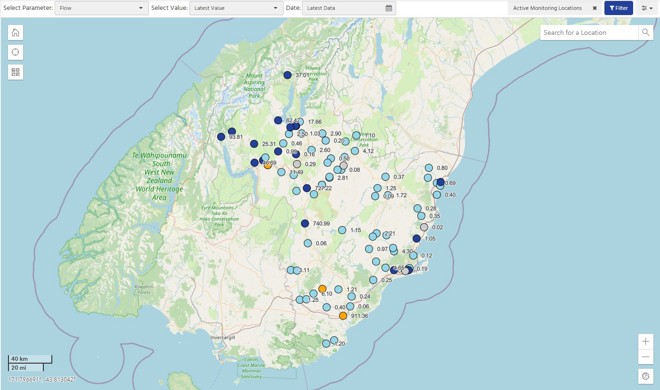
As we head into summer, council is preparing for low-flow monitoring. Last year saw many consent holders across Otago affected by low-flow restrictions, and we’ll be closely monitoring the situation this year.
The latest flow information, and data on a number of other environmental parameters, can be found on our Environmental Data Portal.
From the Environmental Implementation team
Hill Country Erosion
The Hill Country Erosion project is a partnership between the Ministry for Primary Industries / Te Uru Rākau, councils, and landowners. The project aims to identify and demonstrate existing effective erosion management practices and support landowners to adopt best-practice erosion control and prevention.
The key objectives of this project are to:
- Increase ORC’s knowledge of hill slope erosion
- Improve ORC’s engagement with mana whenua and landowners on ways to address hill country erosion
- Identify and reduce hill slope erosion in priority areas
We will provide further updates as this project progresses.
Toitū Te Hakapupu | Pleasant River Restoration Project
This $4 million Ministry for the Environment-funded project in the Pleasant River catchment is in its final year of delivery. The purpose of the Toitū Te Hakapupu project is to implement effective interventions to reduce sediment and nutrients and better safeguard the water resources — ki uta ki tai (mountains to the sea).
The ultimate receiving environment includes the proposed Te Umu Koau marine reserve, and supporting good-quality water entering this is important.
The project has three strands:
Rural Interventions Programme
This involves fencing waterways; planting and maintenance of 75,000 indigenous plants; supporting and implementing good management practices across water quality, biodiversity and biosecurity; restoration/remediation of degraded wetlands; and identification and rectification of fish passage barriers.
Forestry Interventions Programme
This involves engaging with, and supporting, landowners and forestry companies to develop a Forestry Action Plan. It also aims to implement practices to minimise impacts on stream health and biodiversity and to explore different approaches to prioritise land stewardship, and best practices for sustainable harvesting beyond regulation advice and action.
Community Engagement, Education and Action
This involves the development and implementation of a catchment action plan, and the provision of information and opportunity for the community to shape and influence project delivery.
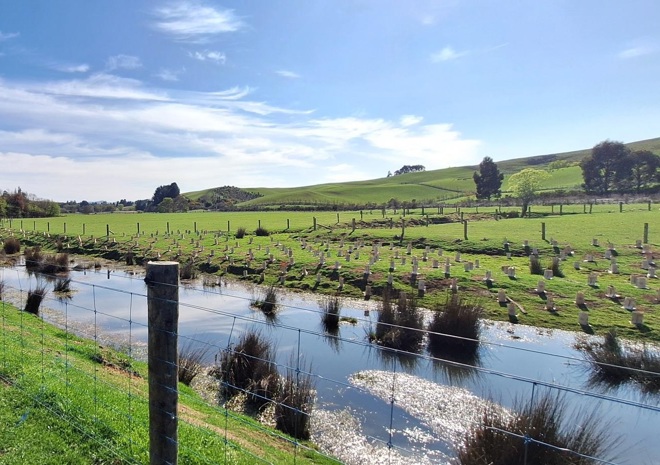
By June 2025, the project will have implemented on-the-ground mitigation activities in line with the funding deed with MfE.
By the end of the project, completed work is expected to include installation of over 20 km of fencing, planting over 75,000 native trees, restoration of fish passage to five barriers in the catchment, and a range of other potential remediation actions, such as sediment traps, erosion planting, willow removal, wetland restoration, and riparian buffers in forestry areas.
This is significant work by the community.
Catchment advisor priorities and work programme
The catchment advisors are out working with community groups, catchment groups and individuals year-round. These roles have a focus on supporting water quality and biodiversity enhancement across the region. The focus for the current financial year includes:
- Intensive winter grazing and supporting reductions in sediment and E. coli entering waterways
- Stream health checks and building knowledge and confidence in our communities about the value that waterways provide and what lives there
- Supporting behaviour change around land use that could impact water quality and how this connects to other environmental enhancements
- Urban waterways and supporting education around how urban drainage networks work, where they are and how we can reduce contaminants entering these and the receiving environments
- Biodiversity management to help people identify biodiversity values, eco-source seeds and propagate, understand planting plan principles, and manage weeds and pests around plantings
Any questions? You can contact the team directly through catchments@orc.govt.nz.
Integrated Catchment Management (ICM)
The development of the Integrated Catchment Management Programme (ICM) began in late 2021. ICM is based on a holistic, natural resource management philosophy that recognises that all the elements of an ecosystem, including the people, are connected.
ORC’s role is to facilitate the development, implementation, and review of integrated Catchment [Action] Plans in collaboration with iwi and community.
Managing natural resources on a catchment scale looks at the ecosystem from the mountains or headwaters of the catchment down to the sea. This aligns with the concept in Te Ao Māori of ki uta ki tai.
In 2022 the Catlins area was selected by Council as the pilot Catchment Action Plan (CAP) to be developed. On 20 November The Catlins CAP was endorsed by Council.
Some key points to note about the CAP:
- The CAP is a community owned and led plan developed with the support and input of ORC and mana whenua, as well as other organisations.
- The CAP is intended to be a living plan that will be continually updated and improved.
- The goals and strategies establish intended outcomes and a direction for how to get there.
- The CAP is a non-regulatory plan.
We will continue to work with the community and those who developed this plan to pursue actions being undertaken in the area.
Work has also commenced in the Upper Lakes area on development of a CAP, and this is due to be completed in June 2025.
Highly pathogenic avian influenza (HPAI) update
About the virus
HPAI – commonly known as bird flu – is currently spreading internationally among wild birds. While Aotearoa New Zealand has never had a case before, it is anticipated the virus will reach our shores within the next two to three years.
HPAI is a highly contagious virus that has caused high numbers of deaths in wild and domestic birds overseas, including shorebirds and seabirds. It can also spill over to mammals, including marine mammals and, in a few cases, humans.
Once HPAI reaches Aotearoa New Zealand, it will be considered endemic and there is unlikely to be a national biosecurity response.
What is Aotearoa New Zealand doing about it?
Biosecurity New Zealand and the Department of Conservation are monitoring the situation as HPAI spreads through other countries. This is providing the basis of an inter-agency preparedness programme.
The key actions developed will centre around:
- Minimising its impact on the domestic poultry industry
- Protecting highly threatened species
- Managing public health risks
ORC is contributing to the preparedness programme by providing advice and support from a regional sector perspective. We will provide information to the public as it becomes available, and support to other agencies if there are significant issues if/when HPAI arrives in Aotearoa New Zealand.
Where can I find out more?
Avian influenza: staying safe and alert when outdoors
Avian influenza: wildlife health
Further to this, a strain of HPAI, known as H7N6, has been detected on a free-range egg farm in rural Otago. While H7N6 is not the H5N1 strain circulating in wildlife around the world, Biosecurity New Zealand is taking the detection seriously. Biosecurity controls are in place restricting the movement of birds, poultry products, feed and equipment on and off the farms.
Quick updates and new resources
Gravel extraction
We now have an application form for requesting pre-application advice for gravel extraction consents. It is recommended that before applying you have a pre-application meeting with one of our Consent Planners for any gravel extraction consent application.
A guide for everything
Based on the success of the Farmers Guide webpage, we have now created a Developers Guide and a Forestry Guide as well. These pages bring together rules and guidelines to assist developers and those with forestry plantations, including when you might need a resource consent, permitted activities, useful links, and answers to frequently asked questions.
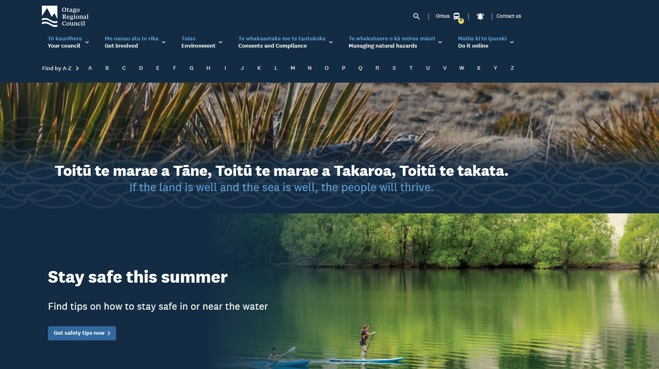
ORC’s new website — A-Z and everything in between
Seen our new website yet? Take it for a spin!
In July, we launched our new-look website and are pretty proud of it. There have been significant search function updates, including improved navigation and an A-to-Z search to help users find information faster! orc.govt.nz
Consents enquiries
You are receiving this newsletter as you regularly interact with the Regulatory Group. This newsletter is just one of the ways that we are looking at providing more information to you as a customer of the Council.
We have a dedicated team of planners that offer advice on rules, plans and legislation for up to 30 minutes, free of charge. This is our Consent Enquiries team.
You are encouraged to make use of this service, especially if you have a large-scale project or a project with a specific deadline.
We’ve recently changed our email address.
If you have any questions around consents or anything else in this newsletter, you can now reach us on consent.enquiries@orc.govt.nz (formerly, public.enquiries) and you can also call us on 0800 474 082.


